

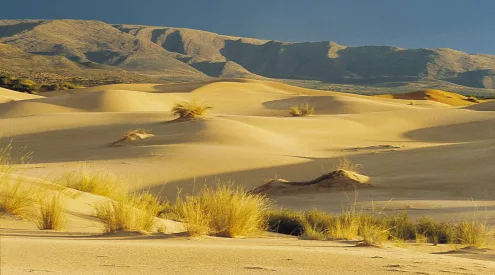
Some of Africa’s most extraordinary wildlife spectacles take place in landscapes that appear almost lifeless. Across the Great Rift Valley, shallow lakes shimmer with mineral deposits, their waters highly saline or alkaline and seemingly unsuitable for much aquatic life. Yet these unusual environments attract thousands of flamingos, sometimes gathering in vast pink flocks along their shores.
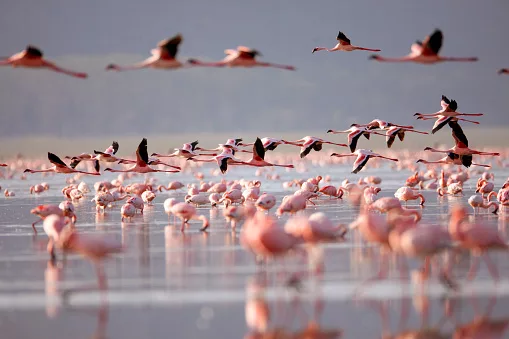
Flamingoes on Lake Nakuru/By: mantaphoto/Getty Images
From the mineral-rich waters of Tanzania’s Lake Natron to Kenya’s Rift Valley lakes, these birds have developed a remarkable relationship with some of the continent’s harshest aquatic environments. Understanding why they gather in these places also reveals how changes in rainfall, water levels and human activity can affect the future of these important wetlands.
The unusual lakes that attract flamingos
What makes a lake saline or alkaline?
Unlike ordinary freshwater lakes, saline and alkaline lakes contain unusually high concentrations of dissolved salts and minerals. Some, known as soda lakes, also have exceptionally high pH levels, making their waters strongly alkaline.
These conditions are often associated with geological activity, limited water outflow and high evaporation rates. As water evaporates, dissolved minerals become increasingly concentrated, creating an environment that supports a specialised range of organisms.
Many aquatic plants and animals struggle to survive in these conditions. Fish populations, for example, are often absent or limited in the most extreme soda lakes. However, certain bacteria, cyanobacteria and microscopic algae have adapted to thrive there.
For lesser flamingos, this is an important advantage. Their preferred food sources can flourish in waters where many other potential competitors cannot survive.
The result is an unusual ecosystem in which relatively few species dominate, but those that are adapted to the conditions can occur in extraordinary numbers.
A landscape built around microscopic life
The waters of East Africa’s soda lakes may look empty from a distance, but they contain complex communities of microscopic organisms.
Among the most important are cyanobacteria, sometimes called blue-green algae. One particularly significant food source for lesser flamingos is Arthrospira fusiformis, a spiral-shaped cyanobacterium historically associated with the name spirulina.
These organisms can multiply rapidly when temperature, nutrient availability and water chemistry are favourable. They form an important part of the food supply that attracts flamingos to these otherwise inhospitable environments.
This relationship illustrates an interesting ecological principle: an environment does not need to support a wide variety of life to sustain enormous concentrations of a particular species.
The feeding adaptations that give flamingos an advantage
Why their unusual bills are so important
Flamingos have evolved specialised bills that allow them to feed on tiny organisms suspended in shallow water.
When feeding, they lower their heads upside down into the water, using their tongues to draw water through their bills. Inside are rows of fine, comb-like structures called lamellae, which help filter food particles while allowing water to escape.
The lesser flamingo has particularly fine filtering structures, making it well suited to collecting microscopic cyanobacteria and algae.
This specialised feeding system allows the birds to exploit food sources that are difficult for many other waterbirds to access. Rather than competing directly with fish-eating or insect-feeding species, lesser flamingos occupy a distinctive ecological niche.
Not all flamingos eat the same thing
Although flamingos share similar feeding behaviours, their diets differ between species.
The lesser flamingo is particularly specialised, feeding primarily on microscopic cyanobacteria and algae. The greater flamingo, by comparison, has a more varied diet that includes small crustaceans, molluscs, aquatic insects and other aquatic organisms.
These differences help explain why the two species can sometimes share wetlands while exploiting different food resources.
Their feeding adaptations are also responsible for the pigmentation that makes flamingos so recognisable. The carotenoid pigments found in their food contribute to the pink and reddish colouring of their feathers. The intensity of this colour can vary according to diet and individual condition.
Why thousands of flamingos gather in one place
Flamingos are highly social birds, and large gatherings are a familiar feature of their feeding and breeding behaviour. However, their numbers at individual lakes can change dramatically.
A lake that attracts enormous flocks during one period may have relatively few flamingos during another. This is largely because the birds follow the availability of suitable food.
When microscopic algae and cyanobacteria flourish, a lake can become an important feeding destination. As conditions change and food becomes less abundant, flamingos may move to another wetland where the supply is better.
Lesser flamingos are particularly mobile, moving between feeding sites across East Africa. This makes the network of soda lakes in the Great Rift Valley essential to their survival. Rather than depending on one permanent feeding ground, they rely on several interconnected wetlands that offer suitable conditions at different times.
How rainfall and water levels influence their movements
Rainfall plays an important role in determining the conditions within saline and alkaline lakes.
When water levels rise, the concentration of dissolved salts and minerals can decrease. This dilution may alter the growth of the microscopic organisms that flamingos depend on, affecting the availability of food.
At the other extreme, prolonged evaporation can increase salinity and change the balance of organisms within the water.
These changes can influence where flamingos feed, how long they remain at a particular lake and whether conditions are suitable for breeding.
A 2024 study published in Current Biology, titled Productivity declines threaten East African soda lakes and the iconic Lesser Flamingo, examined 22 important soda lakes across East Africa between 1999 and 2022.
Researchers found significant declines in phytoplankton biomass, an indicator of food availability for Lesser Flamingos. Rising lake water levels were identified as a likely major contributor to the decline.
The findings highlight the vulnerability of these ecosystems to changing rainfall patterns and environmental pressures. They also demonstrate why protecting flamingos requires safeguarding an entire network of feeding habitats, rather than focusing on individual lakes alone.
Where to see flamingos in Africa

Greater Flamingos in Walvis Bay/By: sarawut/Getty Images
For travellers, these remarkable birds offer an opportunity to explore some of Africa’s most unusual landscapes. From volcanic lakes in Tanzania to seasonal wetlands in Namibia and South Africa, there are several destinations where flamingos can be observed in their natural habitats.
Sightings are never guaranteed, however. Numbers change according to rainfall, food availability and breeding conditions, so it is worth checking recent birding reports before planning a visit.
Lake Natron, Tanzania
Lake Natron, in northern Tanzania, is one of the most important habitats for lesser flamingos in East Africa.
Situated beneath the dramatic volcanic landscape of Ol Doinyo Lengai, the lake is known for its shallow, highly alkaline waters and striking mineral-rich shoreline. Its unusual chemistry supports cyanobacteria that provide an important food source for lesser flamingos.
Lake Natron is particularly significant as a breeding site. When conditions are suitable, large colonies gather on exposed mudflats and shallow areas, building distinctive mud nests where they lay their eggs.
The surrounding landscape is equally remarkable. Visitors can explore the Rift Valley scenery, photograph the volcanic formations and discover the communities living around this remote part of Tanzania.
For wildlife enthusiasts, the combination of flamingos, dramatic geology and relative isolation makes Lake Natron one of Africa’s most distinctive natural destinations.
Lake Bogoria, Kenya
Lake Bogoria, in Kenya’s Great Rift Valley, is another spectacular destination for flamingo enthusiasts.
The saline lake is surrounded by volcanic hills and is particularly well known for its geothermal activity. Hot springs and geysers emerge along parts of its shoreline, creating a landscape that feels almost otherworldly.
Its waters support microscopic organisms that attract lesser flamingos, and large flocks can gather along the shallows when food conditions are favourable.
Visitors can explore the surrounding reserve, photograph the geothermal features and enjoy birdwatching across the lake. It is an especially interesting destination because the flamingos are only one part of a much broader natural landscape.
Lake Nakuru, Kenya
Lake Nakuru National Park is among Kenya’s best-known birdwatching destinations. The lake was historically famous for its enormous flamingo gatherings, with thousands of birds sometimes creating a pink border along the shoreline.
However, changes in water levels and food availability have affected flamingo numbers over the years. The birds move between the Rift Valley lakes as conditions change, meaning that their presence at Nakuru can vary considerably.
The park remains an excellent destination for wildlife enthusiasts. Beyond its birdlife, visitors can encounter black and white rhinos, Rothschild’s giraffes, buffaloes and other wildlife across its grasslands and woodland habitats.
It is a worthwhile stop for travellers exploring Kenya’s Rift Valley, even when flamingo numbers are lower than expected.
Kamfers Dam, South Africa
Closer to home, Kamfers Dam outside Kimberley in the Northern Cape has an important place in South Africa’s flamingo conservation story.
The wetland became internationally recognised as a breeding site for lesser flamingos, with a purpose-built artificial island constructed in 2006 to provide a protected nesting area. At its peak, the dam supported tens of thousands of birds.
However, years of sewage pollution and deteriorating water conditions severely affected the wetland. The artificial breeding island was submerged, and the flamingos eventually abandoned the site as a breeding destination.
In October 2026, the Sol Plaatje Municipality announced that lesser flamingos had returned to Kamfers Dam, describing their presence, alongside reported sightings of chicks, as an encouraging development.
However, the announcement was subsequently challenged by environmental specialists who raised concerns about water quality, excessive water levels and whether suitable nesting conditions had actually returned. The reports underline an important distinction: seeing flamingos at a wetland does not necessarily mean that the ecosystem has recovered.
Visitors interested in the birds can enquire about viewing access at Flamingo View along the N12, but should check current conditions and access arrangements before travelling.
Kamfers Dam is a particularly important South African example of why wetland conservation matters. Protecting the birds means addressing the pollution and infrastructure problems affecting the habitat itself.
Walvis Bay, Namibia
Not all flamingo gatherings take place at alkaline soda lakes. Namibia’s Walvis Bay Lagoon offers a different but equally rewarding opportunity to observe these birds.
The coastal wetland is an important feeding and resting area for greater and lesser flamingos, alongside numerous other waterbirds. Its shallow waters and productive coastal environment provide suitable feeding conditions throughout the year.
Visitors can observe flamingos from designated viewing areas along the lagoon, with the surrounding salt works, tidal flats and Atlantic coastline creating a distinctive setting.
Walvis Bay is also an excellent destination for birdwatching, photography and exploring Namibia’s coastal landscapes. The lagoon demonstrates that flamingos can exploit a variety of wetland environments, not just the mineral-rich lakes of the Rift Valley.
The conservation challenges facing flamingos
Despite their ability to survive in extreme environments, flamingos are not immune to environmental change.
Their dependence on specialised feeding grounds makes them particularly vulnerable to changes in water quality, food availability and habitat conditions.
For lesser flamingos, the declining productivity of East Africa’s soda lakes is an increasing concern. Rising water levels, changing rainfall patterns and degradation of surrounding catchments can alter the chemistry of these lakes and affect the microscopic organisms that sustain the birds.
Human activities create additional pressures. Pollution, agricultural runoff, water extraction and poorly managed infrastructure can damage wetlands and disrupt the delicate ecological balance.
Kamfers Dam illustrates how serious these impacts can become. The sewage crisis has affected one of South Africa’s important lesser flamingo breeding sites, demonstrating that even wetlands supporting internationally significant bird populations can be compromised by inadequate environmental management.
Conservation therefore needs to extend beyond protecting the birds themselves. It requires maintaining healthy water systems, monitoring pollution, managing catchments and protecting suitable feeding and breeding habitats.
Because flamingos move between wetlands, conservation efforts also need to consider the wider network of lakes and feeding grounds on which their populations depend.
How to observe flamingos responsibly
Watching thousands of flamingos gather along a lake is an unforgettable wildlife experience. However, responsible observation is essential, particularly when birds are feeding, resting or breeding.
Travellers can help protect these spectacular gatherings by following a few simple guidelines:
-
Keep your distance: Use binoculars or a camera with a zoom lens rather than approaching the birds.
-
Respect breeding areas: Never enter restricted nesting grounds or approach breeding colonies.
-
Keep noise levels down: Loud noises and sudden movements can disturb feeding and resting birds.
-
Never feed flamingos: Human food is unsuitable and can interfere with their natural feeding behaviour.
-
Use established viewing areas: Stick to designated paths and observation points.
-
Choose responsible guides: Local birding guides can help visitors understand the environment while minimising disturbance.
It is also worth remembering that flamingo sightings are influenced by environmental conditions. A destination celebrated for enormous flocks may have relatively few birds during certain periods. Checking recent sightings and consulting local guides can help travellers make informed decisions.
A remarkable relationship between birds and their environment
The sight of thousands of flamingos gathering on an otherwise seemingly lifeless lake is a reminder of how extraordinary nature can be.
These birds have evolved to exploit food sources that many other species cannot access, turning some of Africa’s most extreme aquatic environments into important feeding and breeding grounds.
But their survival depends on more than their remarkable adaptations. It relies on the health of the wetlands, the availability of microscopic food sources and the environmental conditions that allow these ecosystems to function.
For travellers, visiting these destinations offers more than an opportunity to photograph one of Africa’s most recognisable birds. It is a chance to discover the hidden ecological processes that sustain some of the continent’s most extraordinary wildlife gatherings.
Follow us on social media for more travel news, inspiration, and guides. You can also tag us to be featured.
Instagram | Facebook | Twitter | Spotify
ALSO READ:
Gabon’s forest elephants: Exploring a rainforest conservation frontier