







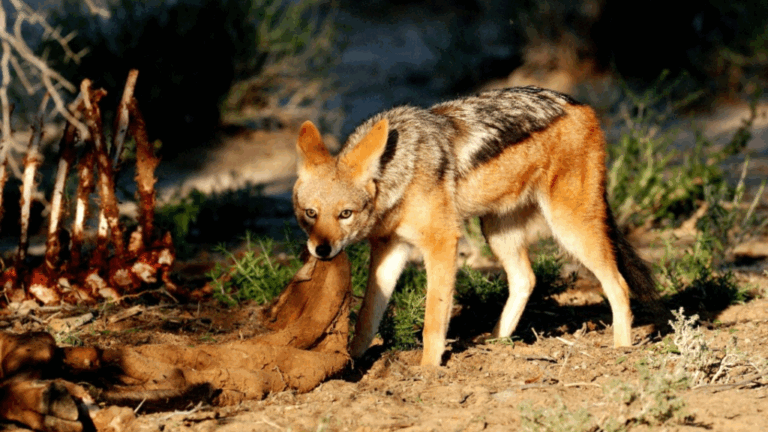
Black-backed jackals are increasingly proving to be a nightmare for small-scale subsistence and emerging farmers across South Africa, as these opportunistic predators wreak havoc on sheep herds, Cape {town} Etc reports.
Picture: Supplied
The losses are not merely financial; they carry significant emotional and psychological burdens for those who rely on livestock for their livelihoods.
Traditional methods of managing this rising threat have failed to achieve the desired outcomes.
‘Predation by black-backed jackals is a difficult problem for farmers, with few clear solutions,’ explains Megan le Roux, a doctoral student at Stellenbosch University (SU) in the Digital Signal Processing Laboratory.

Picture: Supplied
Even standard tactics such as ‘calling and shooting at night,’ which employs recorded jackal and prey distress sounds to lure the animals, have yielded disappointing results.
Compounding the issue, ecologists have raised concerns over lethal control, suggesting that it disrupts the jackals’ complex social structures and could inadvertently lead to increased predation.
With fewer natural enemies and a significant loss of habitat, the populations of black-backed jackals have surged in areas where livestock farming is prevalent.
In response to this escalating problem, Le Roux devised a groundbreaking biotelemetry system as part of her recent master’s degree in electronic engineering at SU. This innovative system aims to provide farmers, ecologists, and wildlife biologists with critical insights into jackal behaviour by monitoring their activities remotely.
The system integrates video recording capabilities with environmental sensors to gather extensive data about the elusive creatures and their hunting patterns.
Comprising a network of wireless sensor nodes strategically deployed across both a rural and equestrian farm, the system captures video footage while simultaneously monitoring environmental conditions.
‘Each node is equipped with cameras capable of functioning in low-light conditions, essential since jackals are predominantly nocturnal. This allows for comprehensive recording when movement is detected,’ explains Le Roux.
ALSO READ:
Petrol price could soar by nearly R2.80/l in October, CEF data shows
During testing, which lasted five days from 5 to 10 November 2025, the system proved remarkably effective, transmitting an impressive 709 video clips, resulting in over 1.3 gigabytes of data collected autonomously without the need for human intervention.
‘Movement is detected by a passive infrared sensor. Once triggered, the system records 30-second video snippets, processes them, and transmits them seamlessly to an online platform,’ she outlines.
Additionally, each node features solar harvesting equipment, ensuring that the system operates independently of the power grid, significantly reducing the need for human maintenance.
Not only does this enhance the system’s usability in remote areas, but it also provides a wealth of data that could transform our understanding of jackal behaviour.
The implications of Le Roux’s innovative work could be revolutionary, paving the way for more ethically acceptable and ecologically sustainable practices in managing these problematic mesopredators.
By gathering large quantities of video data on hunting and breeding patterns, the system can ultimately support farming practices that coexist harmoniously with wildlife, safeguarding both farmers’ livelihoods and the ecological balance of agricultural areas.
Article previously shared by Cape Etc.
Follow us on social media for more travel news, inspiration, and guides. You can also tag us to be featured.
Instagram | Facebook | Twitter | Spotify
ALSO READ:
Avalanche in Nepal kills two mountain guides as others remain missing