


High in Oman’s Hajar Mountains, where rugged limestone peaks rise above deep valleys and the surrounding landscape appears almost entirely barren, an unexpected sight transforms the mountainsides each spring.
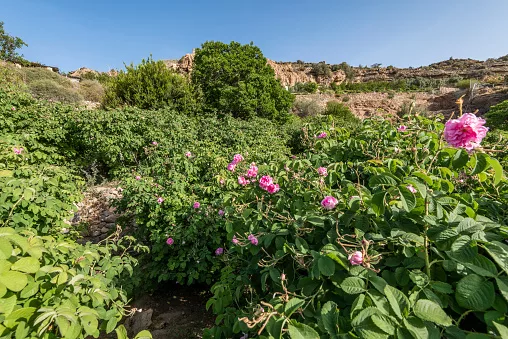
Jebel Akhdar is famous for its labyrinth of wadis and terraced orchards, where pomegranates, apricots and roses grow in abundance due to its mild Mediterranean climate/By: Baiju Jose/
iStock
Terraced farms burst into shades of pink as thousands of Damask roses bloom, filling the air with a fragrance that seems almost out of place in the arid Arabian landscape.
This is Jebel Akhdar, meaning ‘Green Mountain’ in Arabic, a high-altitude region where traditional farming communities have cultivated fruit orchards, rose gardens and vegetable terraces for generations. Sitting on the Saiq Plateau, at elevations of around 2,000 metres above sea level, the mountain offers a striking contrast to the desert landscapes and coastal scenery for which Oman is often known.
Its most celebrated natural spectacle arrives between March and April, when the Damask rose harvest begins. Across villages such as Al Aqr, Al Ayn and Ash Sharayjah, families gather the delicate flowers by hand before transforming their petals into fragrant rosewater using traditional distillation methods.
Yet there is more to Jebel Akhdar than its seasonal blooms. Its ancient irrigation systems, dramatic mountain scenery, historic settlements and enduring agricultural traditions offer a glimpse into a different side of Oman, one shaped by the relationship between people, water and the land.
Where roses bloom high in the Hajar Mountains
Jebel Akhdar forms part of the Western Hajar mountain range in northern Oman, within the country’s Ad Dakhiliyah Governorate. Its elevated plateau creates a noticeably cooler environment than the lowland desert and coastal regions, allowing crops that might seem unlikely in the Arabian Peninsula to flourish.
The mountain’s name, Green Mountain, reflects the agricultural terraces and vegetation that distinguish parts of the region. While the surrounding mountains are characterised by rocky slopes and rugged limestone formations, cultivated pockets of land reveal orchards, gardens and small farming plots carefully arranged along the mountainsides.
The region is particularly associated with its Damask roses, known locally as Al Muhammadi roses. These fragrant pink flowers are cultivated on narrow terraces, often alongside fruit trees and other crops. Their flowering season is relatively short, making spring an especially popular time for visitors hoping to experience the mountain at its most colourful.
The roses are more than an attractive seasonal feature. They form part of a longstanding agricultural tradition that supports local families and contributes to the region’s cultural identity.
The mountain villages behind Oman’s rose harvest
Some of the most memorable experiences on Jebel Akhdar can be found in its traditional mountain villages. Settlements such as Al Aqr, Al Ayn and Ash Sharayjah are closely associated with rose cultivation, with their terraced farms offering a window into agricultural practices that have been maintained across generations.
Al Aqr and its fragrant terraces
Al Aqr is one of the villages most closely associated with Jebel Akhdar’s rose-growing tradition. During the flowering season, its agricultural terraces become a patchwork of pink blooms, with farmers moving between the bushes to collect the flowers.
The harvest is generally carried out during the cooler hours of the morning, when the delicate petals can be gathered before the heat of the day. The work requires patience, with flowers carefully picked and collected for processing.
Visitors arriving during the season may have opportunities to learn about the cultivation process, meet local growers and see how freshly harvested petals are transformed into rosewater.
Al Ayn and the agricultural landscape
Al Ayn is another important village in the region’s rose-growing landscape. Its elevated terraces overlook the surrounding valleys, creating a dramatic setting for the cultivated gardens.
The village is particularly beautiful during spring, when the pink flowers contrast with the stone-coloured mountains and traditional buildings. Beyond the roses, its agricultural plots support fruit trees and other crops that benefit from the mountain’s cooler conditions and carefully managed water supply.
Walking through the village offers a closer look at how farming communities have adapted to the steep terrain, making productive use of relatively small areas of cultivable land.
Ash Sharayjah and the traditions of rosewater
Ash Sharayjah, also known as Al Shuraijah, is another settlement associated with the annual rose harvest. Here, the cultivation and processing of Damask roses remain closely connected to family traditions.
Rosewater production is an important part of the village’s agricultural heritage, with knowledge of the distillation process passed between generations.
The harvest period also provides opportunities for visitors to experience aspects of rural Omani life, from seeing the flowers gathered to learning how they are processed into one of the country’s best-known traditional products.
From delicate petals to traditional Omani rosewater
The most fascinating part of Jebel Akhdar’s rose season arguably begins after the flowers have been picked.
For generations, local farmers have transformed Damask rose petals into rosewater through a traditional distillation process. The craft requires considerable quantities of flowers and careful preparation, with the petals processed shortly after harvesting to preserve their fragrance.
Traditional distilleries, often associated with family homes and farms, use specially designed ovens and vessels to extract the aromatic liquid.
One traditional method involves placing the petals in large containers known as al-duhjan, which are heated in mud ovens. As the contents warm, steam carries the fragrance of the flowers through the distillation apparatus. The resulting liquid is collected and allowed to cool, producing fragrant rosewater.
The process is a labour-intensive one, requiring experience and an understanding of the right temperatures and proportions. It is also a practice that connects modern visitors with a much older part of Oman’s cultural heritage.
Rosewater has a variety of uses in Omani households. It is added to traditional sweets and beverages, including coffee, and is valued for its fragrance in perfumes and other household products.
For farming families, the annual harvest offers more than a seasonal agricultural activity. It provides an opportunity to sell locally produced rosewater and welcome visitors interested in learning about the craft.
ALSO READ:
Chefchaouen: Discover Morocco’s beautiful blue mountain town
The ancient irrigation systems keeping the mountain green
The roses of Jebel Akhdar would not flourish without the water systems that sustain the region’s agricultural terraces.
Across Oman, traditional irrigation channels known as falaj have played an important role in supporting settlements and farming communities in otherwise dry environments. These carefully constructed channels transport water from natural springs and other sources to agricultural land, distributing it across fields and orchards.
On Jebel Akhdar, the falaj systems help irrigate the mountain’s terraced gardens, supporting roses as well as a variety of fruit trees and other crops.
The system reflects generations of knowledge about water management, particularly in a country where rainfall is limited and water resources are valuable. Its continued use demonstrates how traditional engineering has enabled communities to cultivate productive landscapes in challenging environments.
The mountain’s agricultural diversity is especially evident outside the rose season. Pomegranates, apricots, peaches, figs, grapes, apples, walnuts and almonds are among the crops grown across the region.
The changing harvests give Jebel Akhdar a different character throughout the year, with spring associated with roses and late summer bringing the much-anticipated pomegranate season.
More than roses: Walking Jebel Akhdar’s mountain trails
Although the spring rose harvest is a major attraction, Jebel Akhdar offers plenty to explore throughout the year.
The region’s walking routes pass through traditional villages, agricultural terraces and dramatic mountain scenery. One of the best-known experiences is the Three Village Walk, which connects Al Aqr, Al Ayn and Ash Sharayjah.
The route provides an opportunity to explore the cultivated landscape on foot, passing stone pathways, old settlements and terraced gardens while taking in views across the surrounding valleys.
Spring is particularly rewarding, when the roses are in bloom, and the mountain air carries their fragrance. Outside the flowering season, the walk still offers insight into the region’s agricultural heritage, with orchards and traditional irrigation channels providing plenty of interest.
Discovering Wadi Bani Habib
Another worthwhile stop is Wadi Bani Habib, a historic settlement known for its abandoned stone houses and dramatic mountain setting.
The remains of the old village sit among the rocky slopes and vegetation, offering a glimpse into earlier mountain life. Walking through the settlement reveals traditional architecture and the relationship between the village and the surrounding agricultural landscape.
The area is also known for its walnut trees and terraced farming plots, making it an interesting addition to a wider exploration of Jebel Akhdar.
For visitors interested in photography, the combination of old stone buildings, rugged mountains and green agricultural pockets creates a particularly striking setting.
A mountain landscape worth protecting

This is a photo of the terraced fields in Jebel Akhdar, Oman. In the fields various plants are cultivated, like roses, pomegranate, olives etc/By: George Pachantouris/Getty Images
Jebel Akhdar’s significance extends beyond its agricultural and cultural heritage. The wider mountain environment supports a variety of habitats and wildlife, including species adapted to the region’s rugged terrain.
Its ecological importance was recognised in 2025 when Al Jabal Al Akhdar was designated a UNESCO Biosphere Reserve. The designation highlights the value of its mountain ecosystems, biodiversity and traditional ways of life, while recognising the importance of balancing conservation with the needs of local communities.
The reserve includes mountain forests, fertile valleys, terraced agricultural areas and habitats for wildlife such as the Arabian tahr, an endemic mountain ungulate found in the Hajar region.
The designation also places greater emphasis on protecting the landscapes and traditional practices that make the area distinctive.
For visitors, it is a reminder that Jebel Akhdar is not simply a scenic mountain destination. It is a living landscape where agriculture, biodiversity and cultural heritage remain closely connected.
Planning a visit to Jebel Akhdar
The best time to experience Jebel Akhdar’s famous rose gardens is during the spring flowering season, generally between March and April. The exact timing varies with weather conditions and altitude, so visitors hoping to see the harvest should check local updates before travelling.
Arriving early in the day is worthwhile, particularly for those interested in watching the harvesting process. Some local farms and traditional distillation facilities also offer opportunities to learn about rosewater production, although arrangements and access may vary.
The mountain is accessible by road from the direction of Nizwa and Birkat Al Mouz. Visitors should note that a four-wheel-drive vehicle is required to travel up the mountain road, with a vehicle checkpoint in place before the ascent.
Even outside rose season, Jebel Akhdar remains an appealing destination for walking, exploring traditional villages and enjoying the cooler mountain climate. The changing agricultural seasons offer different experiences throughout the year, from spring flowers to late-summer pomegranates.
For those looking to explore a side of Oman beyond its deserts, forts and coastline, Jebel Akhdar offers something quite different. Here, ancient irrigation channels sustain productive terraces, families continue to preserve traditional crafts and delicate pink roses flourish high above the surrounding arid landscape.
Follow us on social media for more travel news, inspiration, and guides. You can also tag us to be featured.
Instagram | Facebook | Twitter | Spotify
ALSO READ:
Following the Vjosa: Exploring Albania through its wild river national park