
Botswana has faced criticism from animal welfare advocates after authorising the hunting of 23 elephants to provide meat for the country’s 60th independence celebrations.
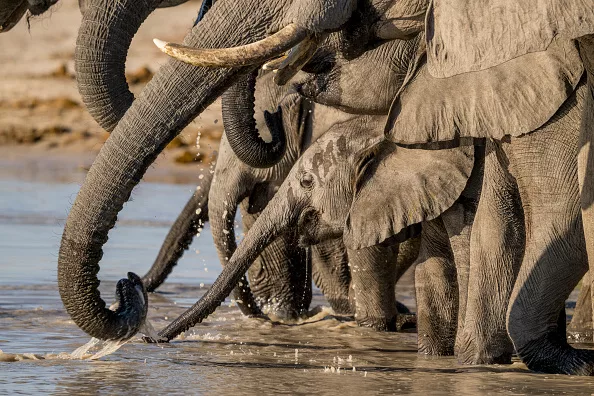
Image used for illustrative purposes/By: Wolfgang Kaehler/Getty Images
The southern African nation marked six decades of independence from Britain on Wednesday, 30 September, with celebrations taking place across the country.
A licence issued by Botswana’s Ministry of Environment and Tourism authorised the hunting of 23 elephants and other wild animals for complimentary purposes, with the meat distributed as part of traditional celebrations.
The decision has sparked renewed debate over Botswana’s approach to elephant conservation and its policy of regulated hunting.
According to the BBC, Oaitse Nawa, chairman of the Botswana-based Elephant Protection Society, warned that the decision could undermine conservation efforts by creating the perception that killing elephants is acceptable when sanctioned by the government.
Nawa also argued that elephants need greater protection, saying repeated hunting and human-wildlife conflict can disrupt their social structures.
Concerns over elephant meat
The 23 elephants were allocated across eight districts in Botswana, with game meat expected to form part of the traditional feasting associated with the independence celebrations.
Local reports and images showed residents gathering around elephant carcasses to collect and share the meat.
The distribution process also raised concerns in some communities.
In Chobe, a wildlife-rich district in northern Botswana near the borders with Namibia, Zambia and Zimbabwe, local MP Simasiku Mapulanga raised concerns after residents reportedly collected portions of elephant meat directly from a carcass at a school.
He called for future distributions to be better organised, suggesting that the meat could instead be processed into packages to improve hygiene and make distribution more accessible to elderly people, pregnant women and people with disabilities.
Concerns have also been raised about eating game meat during an ongoing foot-and-mouth disease outbreak, which has prompted authorities to introduce measures aimed at containing the disease.
Botswana’s complicated relationship with elephants
Botswana is home to more than 130,000 elephants, giving it one of the largest elephant populations in the world.
The animals are an important part of the country’s tourism industry, but communities living alongside them have long raised concerns about crop destruction, damage to property and, in some cases, threats to human safety.
The government has defended regulated hunting as one way of managing the elephant population and reducing human-wildlife conflict, while also generating revenue for conservation and rural communities.
Botswana previously banned trophy hunting in 2014 under former president Ian Khama. The ban was lifted in 2019 under his successor, Mokgweetsi Masisi.
Hunting has continued under current president Duma Boko, who came to power after the 2024 election.
The government maintains that revenue from regulated hunting can support conservation and communities living in areas affected by wildlife.
Environment and Tourism Minister Wynter Mmolotsi told parliament last year that special elephant hunting quotas generated 15.6 million pula (about US$1.1 million) in 2025 for projects in areas where elephants are found.
Conservation organisations, however, have questioned whether current hunting levels are sustainable.
A long-running conservation debate
The controversy surrounding the independence celebrations highlights the difficult balance Botswana faces between protecting its internationally significant wildlife populations and addressing the costs of living alongside large numbers of elephants.
Supporters of Botswana’s hunting policy argue that international criticism can overlook the challenges faced by rural communities, where elephants can destroy crops, damage infrastructure and pose risks to people.
Critics, meanwhile, argue that hunting elephants for celebratory meat sends the wrong conservation message and could weaken efforts to protect the species.
The debate is likely to continue as Botswana seeks to balance wildlife conservation, tourism and the needs of communities living alongside its elephant population.
Source: BBC
Follow us on social media for more travel news, inspiration, and guides. You can also tag us to be featured.
Instagram | Facebook | Twitter | Spotify
ALSO READ:
Reintroduced Grauer’s gorilla gives birth in DRC’s Virunga National Park