





Broken bones found in Siberian caves have revealed a long-lost relative of the modern yak, giving scientists a glimpse into an Ice Age animal that survived for hundreds of thousands of years before disappearing.
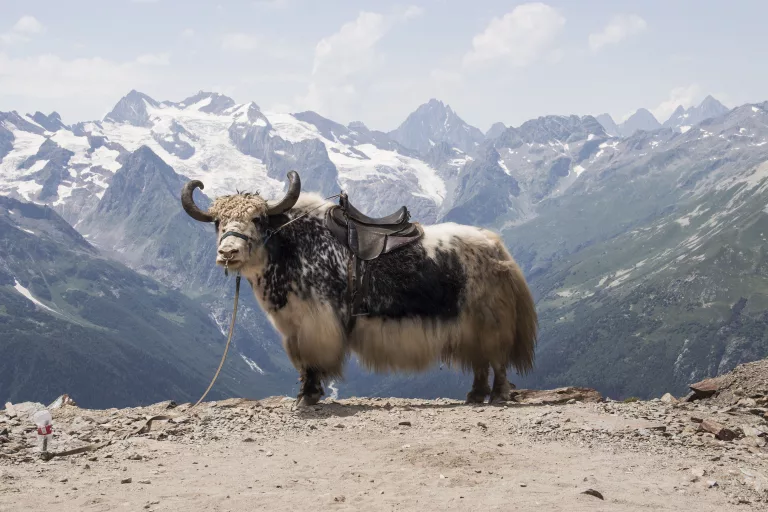
A yak stands proudly with a saddle on a snowy mountain backdrop / Yaroslav Chaadaev / Pexels / Illustrative purposes only
Researchers analysed ancient DNA from 20 fragmented bones found at sites including Denisova Cave in southern Siberia. The genetic evidence revealed a previously unknown bovine lineage, nicknamed “yak X”, that lived in the region between roughly 247,000 and 27,000 years ago.
The discovery is significant because many of the bones are too fragmented to identify by appearance alone. Their DNA, however, preserved a much clearer story.
A hidden branch of the yak family
Genetic analysis suggests yak X began diverging from the ancestors of modern yaks around 400,000 years ago. By about 250,000 years ago, it had become largely separated from them.
The animal appears to have lived through major climatic shifts in Siberia, including a period of significant warming. Researchers believe changing conditions may have helped isolate populations and push them along different evolutionary paths.
Yak X was not alone in the region. Its remains were found alongside evidence of other Ice Age animals, including steppe bison and aurochs, the extinct wild ancestor of modern cattle. Despite living alongside other bovines, the genetic evidence shows little sign that yak X regularly interbred with them.
Another mystery from Denisova Cave
The discovery adds another layer to the story of Denisova Cave, already famous for revealing the Denisovans, an ancient human group identified through remains found at the site.
Now, the cave is helping reconstruct another lost chapter of the region’s past, one bone fragment at a time. Scientists still do not know exactly when or why yak X disappeared. The youngest remains date to around 27,000 years ago, but researchers say more evidence is needed to establish its final fate. There is also a possibility that yak X could be linked to a previously described fossil animal known as the Baikal yak. For now, though, that connection remains unconfirmed.
What makes the discovery remarkable is how easily this animal could have remained unknown. Its bones were broken and difficult to identify, yet they carried enough ancient DNA to reveal an entire branch of the bovine family tree. Sometimes, the smallest fragments of the past have the biggest stories to tell.
Source (Earth.com / Popular Science)
Follow us on social media for more travel news, inspiration, and guides. You can also tag us to be featured.
Instagram | Facebook | Twitter | Spotify
ALSO READ:
Juvenile humpback dies after swimming 11km upstream in Australian river