



At the northern tip of KwaZulu-Natal, where South Africa meets Mozambique, an extraordinary fishing tradition continues to shape life along the waterways of Kosi Bay.
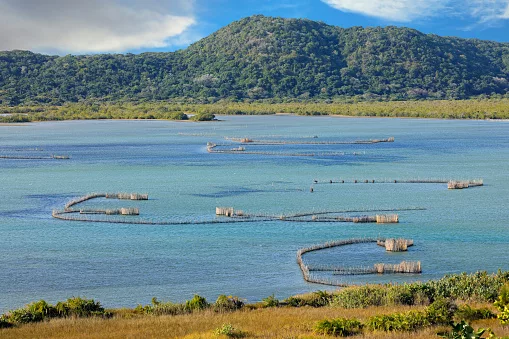
Traditional Tsonga fish traps built in the Kosi Bay estuary, Tongaland/By: EcoPic/
iStock
Here, among interconnected lakes, tidal channels and lush coastal vegetation, traditional fish traps built by the local Thonga communities stand as a reminder of a relationship with the water that stretches back centuries.
Known locally as utshwayelo, these carefully constructed fishing systems use the natural movement of the tides to guide fish into enclosed areas, where they can be harvested by local fishermen. Made using materials sourced from the surrounding environment, the structures are both practical and deeply connected to the area’s cultural heritage.
While Kosi Bay is celebrated for its remarkable aquatic biodiversity and beautiful coastal scenery, its traditional fish traps offer visitors another reason to explore this part of the iSimangaliso Wetland Park: an opportunity to discover the living heritage of the communities who have called this landscape home for generations.
A fishing tradition passed down through generations
The Kosi Bay lake system is part of the traditional homeland of the Tembe-Thonga people, whose relationship with its waterways extends back hundreds of years.
Fishing has long been an important source of food and livelihoods for communities living around the lakes. Over generations, local knowledge of fish movements, tides, seasons and the surrounding environment informed the development of the traditional fish traps that remain a distinctive feature of the landscape.
The system is believed to have been practised in the region for more than 600 years, with some accounts placing its history even further back. The traps are not simply fishing equipment; they represent an accumulation of knowledge passed between generations.
According to research into the region’s customary fishing practices, the traps developed from earlier methods involving woven grass funnels. These eventually evolved into the more elaborate structures found throughout the Kosi Bay waterways today.
The practice is closely connected to customary fishing rights and the cultural identity of the local communities, making its preservation about more than maintaining an unusual fishing technique.
How Kosi Bay’s traditional fish traps work
One of the most fascinating aspects of the Kosi Bay fishery is how it uses the natural movement of water rather than relying on engines or modern fishing technology.
The traps are constructed along the tidal channels that connect the lakes and the estuary. They consist of carefully positioned guide fences, traditionally made using reeds, branches and other natural materials collected from the surrounding environment.
These fences are arranged in curved or hook-shaped formations, directing fish towards enclosed catching areas known as kraals.
As fish move through the channels, the structures guide them towards baskets or specialised openings designed to prevent their escape. The fishermen can then collect their catch, traditionally using spears to retrieve fish from the traps.
The design takes advantage of the natural movement of fish through the waterways, with the changing tides playing an important role in how the system operates.
Unlike many modern fishing methods, the traditional traps are stationary structures that work with the landscape rather than against the movement of the water.
Their construction also requires an intimate understanding of the channels, water levels and the behaviour of different fish species. Maintaining the structures is a skill developed through experience and passed down within fishing families.
ALSO READ:
Matjiesrivier: Where ancient stories are written into the Cederberg landscape
A remarkable ecosystem beneath the surface
The fish traps are part of a much larger natural system that makes Kosi Bay one of the most distinctive aquatic environments in South Africa.
Situated within the iSimangaliso Wetland Park, the area comprises four interconnected lakes, namely Makhawulani, Mpungwini, Nhlange and Amanzimnyama. These waterways connect to the Indian Ocean through an estuarine channel, creating a network of habitats that support a variety of freshwater, estuarine and marine species.
The combination of lakes, mangroves, coastal forests and tidal channels makes the area particularly important for aquatic biodiversity.
Its clear waters are home to numerous fish species, while the surrounding vegetation provides habitats for birds and other wildlife. The coastal environment also forms part of an important habitat for marine turtles, including loggerhead and leatherback turtles that nest along the area’s beaches.
For visitors, the landscape offers a different perspective on KwaZulu-Natal’s natural attractions. Beyond its beaches and coastal scenery, Kosi Bay is a place where the relationship between people, wildlife and water is visible in everyday life.
When traditional fishing meets conservation
Although the fish traps are a longstanding part of Kosi Bay’s cultural heritage, their continued use exists within a changing ecological and social landscape.
The fishery has attracted scientific attention for decades, particularly as researchers have investigated the impact of fishing pressure on the area’s fish populations.
A study published in the African Journal of Marine Science in 2013 examined 30 years of monitoring data, covering the period from 1981 to 2010. Researchers estimated that more than 1.2 million fish, representing 43 species across 23 families, had been caught during the monitoring period.
The study also found that the number of traditional fish traps remained relatively stable until 1994, before increasing more than threefold by 2001. Although numbers subsequently declined, they remained considerably higher than earlier levels.
Researchers raised concerns about the cumulative impact of traditional trapping, recreational angling and gillnetting on fish stocks, suggesting that the overall catch rate could be unsustainable without appropriate management.
These findings highlight an important distinction between preserving traditional knowledge and managing fishing pressure. A practice that has existed for generations can still face challenges when the number of fishers, fishing methods and demands on the ecosystem change.
The use of modern materials and modifications to traditional trap designs has also raised concerns. Smaller gaps in the structures can prevent juvenile fish from escaping, potentially affecting the ability of fish populations to replenish themselves.
Conservation efforts therefore need to consider both the ecological health of the waterways and the communities whose livelihoods depend on them.
Protecting cultural heritage and community livelihoods
The relationship between conservation and traditional fishing in Kosi Bay is not always straightforward.
The area falls within a protected landscape, with overlapping conservation designations and management responsibilities. While these protections are important for safeguarding biodiversity, restrictions on fishing access have also created challenges for local communities.
Small-scale fishing is more than an economic activity for many households. It is connected to food security, customary rights, cultural identity and knowledge of the natural environment.
The Masifundise Development Trust’s profile of Kosi Bay’s fishing communities highlights concerns about access to traditional fishing grounds and the difficulties local fishers face under conservation regulations.
This raises important questions about how protected areas can balance biodiversity protection with the rights and needs of the people who have lived in these landscapes for generations.
Meaningful community participation is an important part of that conversation. Local fishers hold knowledge about the waterways, fish behaviour and seasonal changes that can contribute to conservation planning and fisheries management.
Protecting Kosi Bay’s natural environment should therefore also involve recognising the cultural heritage and livelihoods connected to it.
Exploring Kosi Bay responsibly
For travellers looking beyond the usual coastal holiday, Kosi Bay offers an opportunity to experience one of KwaZulu-Natal’s most distinctive natural and cultural landscapes.
Visitors can explore the interconnected waterways, discover the area’s coastal vegetation and enjoy activities such as guided boat excursions, canoeing and snorkelling, subject to local conditions and permitted access.
The traditional fish traps are among the most interesting features of the landscape, particularly when viewed within the wider context of the local communities’ relationship with the water.
Travellers interested in learning more about the fishing tradition should consider engaging local guides and community-based tourism operators who can provide insight into the history and significance of the structures.
Responsible visits should respect fishing activities, local customs and protected habitats. Visitors should avoid interfering with the traps, entering restricted fishing areas or removing natural materials from the environment.
Supporting locally owned tourism experiences can also help ensure that communities have a meaningful role in the benefits generated by visitors to the region.
A living tradition worth protecting
Kosi Bay’s traditional fish traps are more than an unusual sight along the waterways of northern KwaZulu-Natal. They represent centuries of accumulated knowledge, a connection to the natural environment and a fishing tradition that continues to form part of local life.
Their future, however, depends on finding a balance between cultural preservation, community livelihoods and the ecological health of the lake system.
As conservationists and local communities navigate these challenges, the fish traps remain an important reminder that protecting a landscape also means understanding the people and traditions that are part of it.
For travellers, discovering Kosi Bay is an opportunity to experience a side of South Africa’s heritage that cannot be separated from its natural environment.
Follow us on social media for more travel news, inspiration, and guides. You can also tag us to be featured.
Instagram | Facebook | Twitter | Spotify
ALSO READ:
Pack the car! Five KwaZulu-Natal destinations to explore this December






