



There are places on Earth that seem almost too strange to be real. Blood Falls, spilling from Taylor Glacier in Antarctica’s McMurdo Dry Valleys, is one of them.
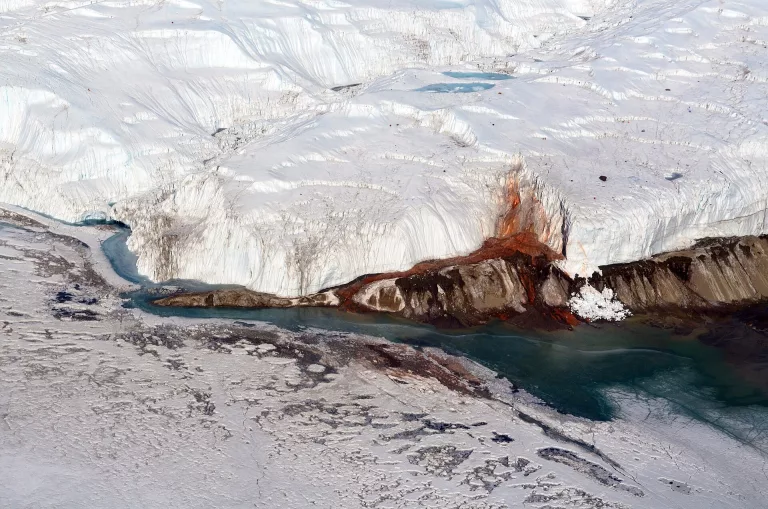
Blood Falls seeps from the end of the Taylor Glacier into Lake Bonney / National Science Foundation/Peter Rejcek / Wikimedia Commons
Against a landscape of white ice and bare rock, a deep crimson stream emerges from the glacier, staining the ice as it flows towards Lake Bonney. It looks almost as though the glacier itself has been wounded.
The reality is just as fascinating. The red colour comes from iron-rich, hypersaline water trapped beneath Taylor Glacier. When the brine reaches the surface and meets oxygen, the iron oxidises, creating the distinctive rusty-red colour that gives Blood Falls its name.
But the colour is only the beginning of the story.
A hidden river beneath the ice
Blood Falls was first documented during the 1911 Terra Nova Expedition, when Australian geologist Thomas Griffith Taylor explored the glacier that would later bear his name.
For decades, scientists knew the colour was linked to iron, but the source of the water remained a mystery. Research has since revealed an extensive system of hypersaline brine beneath the glacier.
Unlike ordinary water, this brine can remain liquid at temperatures well below freezing because of its exceptionally high salt concentration. Radar studies have detected the brine extending beneath the glacier, showing that Blood Falls is not simply a surface trickle, but the outlet of a much larger hidden hydrological system.
And then there’s the iron. When the oxygen-poor brine emerges from the glacier, its dissolved iron begins to oxidise. Scientists have also identified tiny iron-rich nanoparticles in the water, helping explain the intense colour visible at the glacier’s edge. So, what looks like blood is, essentially, an extraordinary natural chemistry experiment unfolding in the Antarctic landscape.
Life in the darkness
Perhaps even stranger is what exists beneath the glacier. Scientists have discovered microbial communities living within the brine, despite the absence of sunlight. Rather than relying on photosynthesis, some microorganisms can obtain energy through chemical reactions involving compounds such as iron and sulfur.
The brine also appears to have a much older story. It’s chemistry and microbial communities suggest a connection to seawater that entered the Taylor Valley during a warmer period in Antarctica’s past. As the climate cooled and the glacier advanced, some of that salty water became isolated beneath the ice, where freezing further concentrated its salts.
That means the strange red flow visible today may be connected to a marine environment that existed long before the landscape became the frozen desert we know.
A glimpse into an ancient world
New research published in 2026 has added another layer to the mystery. Scientists studying samples from the McMurdo Dry Valleys found marine-associated microscopic organisms around the Taylor Glacier terminus, including groups such as diatoms and dinoflagellates. Some showed signs of biological activity, supporting the idea that marine influences have persisted within this isolated environment.
It’s one of the reasons Blood Falls intrigues scientists far beyond Antarctica.
The environment beneath the glacier offers a rare natural laboratory for studying how life can survive extreme cold, high salinity and darkness. It may also help researchers understand what life could potentially look like in similarly harsh environments elsewhere in the Solar System, where liquid water may exist beneath layers of ice.
More than a red waterfall
Blood Falls is easy to dismiss as a strange photographic curiosity. The image alone is enough to stop you scrolling: a glacier in one of the most inhospitable places on Earth apparently bleeding into the snow.
But look closer and the story becomes far more remarkable. Beneath the ice is a hidden system of ancient, salty water. Within it are microorganisms surviving without sunlight. At the surface, iron reacts with oxygen and transforms an otherwise ordinary-looking outflow into one of Antarctica’s most surreal natural spectacles.
It’s a glorious reminder that nothing is ever quite as it appears, and that life can flourish in even the harshest environments. Another quiet lesson in just how extraordinary Mother Nature really is.
Follow us on social media for more travel news, inspiration, and guides. You can also tag us to be featured.
Instagram | Facebook | Twitter | Spotify
ALSO READ: