

There are places on Earth that seem so otherworldly, they make you question just how powerful Mother Nature can be. El Ojo is undeniably one of them.
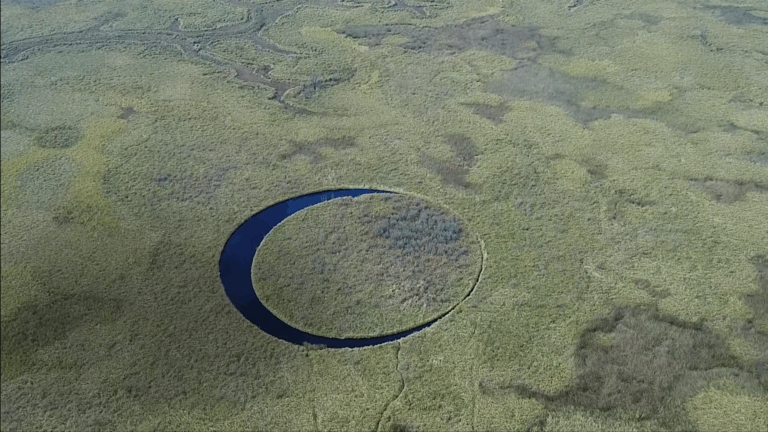
Aerial photo of El Ojo rotating floating island in Paraná Delta, Buenos Aires Province, Argentina/ Argentina Government / Wikimedia Commons
Deep in Argentina’s Paraná Delta, north of Buenos Aires, a near-perfect green circle floats inside an equally neat ring of dark water. It looks less like a wetland and more like something carefully drawn onto the landscape.
The island is known as El Ojo, meaning “the Eye”. Look at it from above and the name makes immediate sense. Then comes the even stranger part: it moves.
The island that drifts
El Ojo is an uninhabited island roughly 118 metres across, sitting within a circular body of water in the vast Paraná Delta, a constantly changing landscape of waterways, wetlands and islands.
Unlike a conventional island fixed to the riverbed, El Ojo appears to float. Satellite imagery shows that its position has shifted over time, with the island also appearing to rotate within the surrounding water.
It came to wider attention in 2016, when Argentine filmmaker Sergio Neuspiller discovered it on Google Earth while researching a film about unusual phenomena in the delta. Historical satellite images showed that the island had not remained in exactly the same position. Naturally, he wanted to see it for himself.
Getting there was not easy. The delta is a maze of waterways and dense vegetation, and an early expedition failed to reach the island. A later attempt succeeded, allowing Neuspiller and his team to investigate it from the ground. What they found only added to the fascination.
Nature’s strange geometry
El Ojo has attracted plenty of dramatic theories, from supernatural activity to extraterrestrial explanations. There is, however, no scientific evidence supporting those claims. The more plausible explanation involves something considerably earthlier: water, erosion and a floating mass of vegetation, roots and organic material.
If the island can move within its surrounding water, currents may gradually erode and reshape its edges. Over time, that movement could help create the remarkably circular form visible today. The Paraná Delta is a landscape built around change. Water, sediment and vegetation constantly reshape its islands and channels. El Ojo may simply be an unusually striking example of those natural processes.
It’s exact history, however, remains unclear. Satellite imagery shows the formation existed by at least 2003, but it can’t tell us precisely when it formed or explain every detail of its movement. And that little gap in our knowledge is part of the appeal.
The Eye in the delta
There is something wonderfully human about the way El Ojo was found. Someone was looking at a landscape on a computer screen and noticed something that did not quite make sense: a tiny green island sitting almost perfectly inside a circular pool.
Instead of scrolling past, they went looking for it. That impulse is familiar. We see something strange on a map and immediately want to know what it is. With El Ojo, the answer leads to an even better question: how does an island like this move?
From the ground, it’s easy to imagine El Ojo disappearing into the surrounding wetlands. It’s extraordinary geometry only becomes obvious from above, where the island’s green centre and dark circular channel form the unmistakable shape of an eye.
Look at older satellite images, though, and the picture changes again. The Eye has moved.
A mystery worth leaving alone
There is a temptation to explain strange places until there is nothing mysterious left about them. El Ojo resists that neat ending.
Water currents and erosion offer a plausible explanation for its shape and movement, but it’s precise formation and history remain uncertain. Perhaps that’s what makes it so intriguing.
In a world where almost everything seems mapped, photographed and explained, El Ojo is a reminder that nature can still produce something that makes us stop scrolling and look twice.
Somewhere in Argentina’s sprawling wetlands, a small island continues to turn quietly inside its circular pool. And from above, it looks as though the landscape is looking back at us.
Follow us on social media for more travel news, inspiration, and guides. You can also tag us to be featured.
Instagram | Facebook | Twitter | Spotify
ALSO READ: