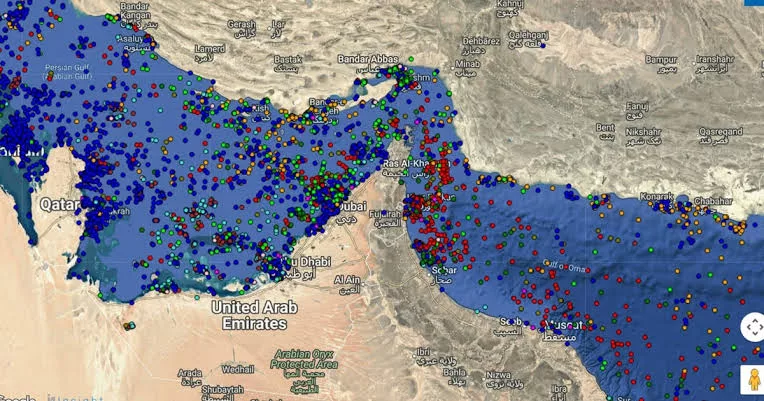


For nearly two months, six cruise ships sat in limbo in Gulf waters, their itineraries frozen, their passengers long flown home, and their futures tied to a geopolitical situation far beyond tourism.

Sourced: X{@DekhoToSahii}
According to the traveler, now, in a rare break in tension, all six vessels have finally made it through the Strait of Hormuz, ending one of the most unusual disruptions the cruise industry has faced in recent years.
It’s the kind of maritime story that feels almost surreal: luxury liners stuck not by storms or technical failure, but by a regional military standoff that turned one of the world’s busiest shipping lanes into a temporary dead zone.
The crisis began in late February 2026, when escalating military strikes on Iran triggered sweeping restrictions in and around the Strait of Hormuz. For cruise operators, the impact was immediate and severe.
Six ships, including MSC Euribia, Celestyal Discovery, Celestyal Journey, Mein Schiff 4, Mein Schiff 5 and the Saudi-backed Aroya Manara — found themselves effectively stranded in ports such as Dubai, Doha and Dammam.
Passengers were quickly repatriated by air. But the ships themselves stayed put, caught between security warnings, naval activity, and shifting restrictions that made any attempt to sail risky.
For weeks, the Gulf’s once-busy cruise routes went silent.
The first breakthrough came in mid-April when Celestyal Discovery made a cautious exit from Dubai and successfully passed through Hormuz on 17 April.
That single movement set off a chain reaction.
Over the following days, other cruise ships followed in staggered departures, effectively forming an unofficial convoy as conditions briefly allowed safe passage.
By 20 April, the final vessel, Aroya Manara, had cleared the strait and was recorded sailing off the coast of Oman, marking the end of the Gulf’s cruise bottleneck.
While headlines focused on ships moving again, the human story had already unfolded weeks earlier.
Thousands of passengers had their holidays abruptly cut short as cruise lines moved quickly to disembark travellers in Gulf ports. Many were rerouted home through emergency flight arrangements.
Crew members, however, remained on board for the duration of the crisis, maintaining vessels while waiting for safe clearance to move. For many, it meant weeks of uncertainty in port rather than at sea, a quieter but equally disruptive experience.
Even as the ships exit the region, the broader security situation remains unstable.
Recent developments in the Gulf include renewed military activity, shifting restrictions on transit, and continued scrutiny of commercial vessels moving through the waterway. Shipping advisories still describe conditions as unpredictable, with brief windows of safe passage rather than stable reopening.
That volatility is what made the coordinated departure of all six cruise ships so notable, operators had to act quickly once risk assessments aligned with a short-lived opportunity.
Now that the strait is behind them, each ship is racing to recover lost time.
Each vessel now faces a logistical challenge: rebuilding schedules, replacing cancelled sailings, and rebalancing a season already heavily disrupted.
The incident has sparked quiet debate in the travel industry about how exposed cruise itineraries can be to geopolitical flashpoints.
Before the crisis, the Gulf region had been promoted as one of the fastest-growing winter cruise markets, with modern ports and expanding tourism investment. But the sudden closure of Hormuz exposed a vulnerability: a single chokepoint can disrupt an entire cruise ecosystem.
On social media and travel forums, reactions have ranged from relief that the ships finally moved, to concern about how quickly vacation routes can become dependent on global politics.
While the immediate crisis has passed, the ripple effects are only beginning.
Operators now face higher insurance costs, rerouted deployments, and cautious planning for future Gulf seasons. Some may scale back exposure to the region entirely, while others may shift focus toward shorter regional sailings that don’t rely on Hormuz passage.
Still, the safe exit of all six ships is a rare positive outcome in an otherwise tense maritime chapter.
It’s a reminder that in global cruising, even the most carefully planned itineraries are only ever as stable as the waters they pass through and sometimes, those waters can change overnight.
Source: the traveler
Follow us on social media for more travel news, inspiration, and guides. You can also tag us to be featured.
TikTok | Instagram | Facebook
ALSO READ:
Necessary cookies are absolutely essential for the website to function properly. These cookies ensure basic functionalities and security features of the website, anonymously.
| Cookie | Duration | Description |
|---|---|---|
| cookielawinfo-checkbox-analytics | 11 months | This cookie is set by GDPR Cookie Consent plugin. The cookie is used to store the user consent for the cookies in the category "Analytics". |
| cookielawinfo-checkbox-functional | 11 months | The cookie is set by GDPR cookie consent to record the user consent for the cookies in the category "Functional". |
| cookielawinfo-checkbox-necessary | 11 months | This cookie is set by GDPR Cookie Consent plugin. The cookies is used to store the user consent for the cookies in the category "Necessary". |
| cookielawinfo-checkbox-others | 11 months | This cookie is set by GDPR Cookie Consent plugin. The cookie is used to store the user consent for the cookies in the category "Other. |
| cookielawinfo-checkbox-performance | 11 months | This cookie is set by GDPR Cookie Consent plugin. The cookie is used to store the user consent for the cookies in the category "Performance". |
| viewed_cookie_policy | 11 months | The cookie is set by the GDPR Cookie Consent plugin and is used to store whether or not user has consented to the use of cookies. It does not store any personal data. |
Functional cookies help to perform certain functionalities like sharing the content of the website on social media platforms, collect feedbacks, and other third-party features.
Performance cookies are used to understand and analyze the key performance indexes of the website which helps in delivering a better user experience for the visitors.
Analytical cookies are used to understand how visitors interact with the website. These cookies help provide information on metrics the number of visitors, bounce rate, traffic source, etc.
Advertisement cookies are used to provide visitors with relevant ads and marketing campaigns. These cookies track visitors across websites and collect information to provide customized ads.
Other uncategorized cookies are those that are being analyzed and have not been classified into a category as yet.