






It looks a little like a lemur, has the gliding membrane of a flying squirrel and spends its nights moving through the forest canopy. But the colugo is neither a lemur nor a flying squirrel, and it doesn’t actually fly.
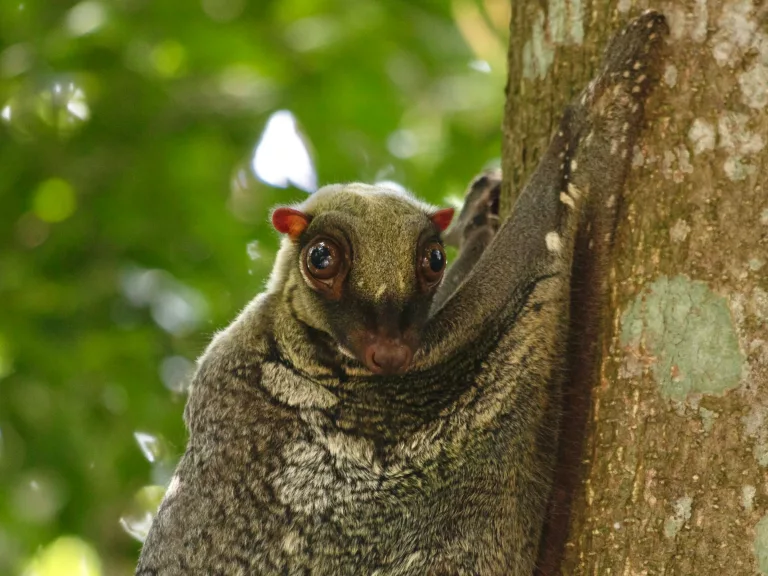
Photo: Unsplash
Also known as the “flying lemur”, this strange Southeast Asian mammal belongs to an order all of its own. There are only two recognised living species, making the colugo one of the most unusual and least familiar mammals in the region.
What is a colugo?
Colugos are small, nocturnal mammals belonging to the order Dermoptera. The two recognised species are the Sunda colugo (Galeopterus variegatus) and the Philippine colugo (Cynocephalus volans). They occur in forests across Southeast Asia, including parts of Indonesia, Malaysia, the Philippines and Singapore.
They spend almost their entire lives in trees, where their mottled brown or grey fur helps them blend into tree trunks and branches. During the day, they can remain almost completely still, tucked against a tree. Once night falls, they become active, feeding and moving through the canopy.
And then there’s the really strange part.
It has a built-in gliding suit
A colugo’s most distinctive feature is its patagium, a large membrane of skin that stretches between its limbs.
While several mammals can glide, the colugo’s membrane is unusually extensive. It runs from the neck along the sides of the body and between the legs, reaching towards the tail and even extending around the fingers and toes. When the animal leaps from a tree, it spreads this membrane to glide through the forest.
Colugos have been recorded gliding for around 150m, allowing them to travel between trees without descending to the forest floor. It’s an energy-efficient way of getting around and keeps them in the canopy, away from some of the dangers below.
Despite the nickname, though, a colugo cannot fly. Unlike birds or bats, it cannot generate powered flight. It’s a glider, using gravity and its membrane to control its movement through the air.
Its teeth are rather weird
The colugo’s unusual anatomy doesn’t stop with its gliding membrane.
It has specialised teeth known as toothcombs. Some of the lower teeth are divided into fine, comb-like projections, which help the animal groom itself.
That is particularly useful for an animal whose enormous membrane is constantly exposed to the tropical forest environment. Dirt, insects and other debris can collect on it, so keeping the membrane clean is important.
What does a colugo eat?
Colugos are mainly herbivorous. Their diet includes leaves, flowers and fruit, with leaves forming an important part of their diet.
Their nocturnal lifestyle means they can quietly forage through the canopy while most of the forest is asleep.
They also have large eyes suited to their life in low light, while their long limbs and sharp claws help them grip tree trunks and branches.
Where can you see one?
The Sunda colugo occurs across parts of mainland and island Southeast Asia, while the Philippine colugo is found in the southern Philippines.
Singapore is one of the more accessible places to encounter the Sunda colugo. The animals have been recorded in several forested areas, including Bukit Timah and the Central Catchment Nature Reserve.
But spotting one isn’t guaranteed. Colugos are elusive, nocturnal animals, and their camouflage can make them surprisingly difficult to pick out against tree bark.
Look up into the canopy after dark, though, and you might catch one launching itself from a trunk and sailing silently towards another tree.
A mammal with a very unusual family tree
There may be only two recognised living colugo species, but researchers have found considerable genetic differences between geographically isolated populations. A 2016 genomic study suggested that what is currently classified as two species may contain substantially more evolutionary diversity than previously recognised.
For now, the colugo remains the only living member of its own order alongside its single close relative species. It is an odd combination of gliding mammal, nocturnal tree-dweller and primate relative.
And perhaps that’s what makes it so fascinating: the colugo looks like several familiar animals stitched together, but evolution has given it a completely separate story.
ALSO SEE: 5 South African animals that have made surprising comebacks