

Transylvania may be famous for its vampire legends, but Romania’s best travel stories are found beyond the castle associated with Dracula. Over 72 hours, discover fortified Saxon villages, rolling countryside, the Carpathian Mountains, rescued bears and hearty regional food.
Day 1: Discover Transylvania’s Saxon villages
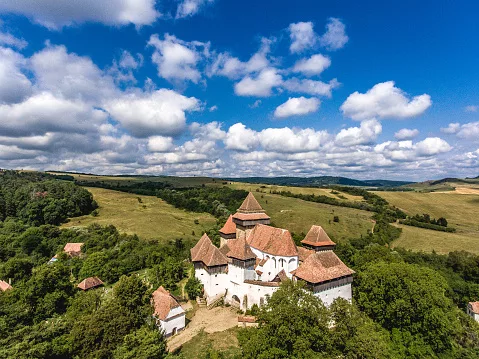
Viscri church aerial view from a drone. Transylvania, Romania/By: CalinStan/iStock
Start in Viscri
Begin your journey in Viscri, a small village surrounded by rolling Transylvanian countryside. Its quiet lanes, traditional houses and fortified church offer a glimpse into a very different side of the region.
Viscri is one of seven villages included in the UNESCO World Heritage site Villages with Fortified Churches in Transylvania. These settlements were established by Transylvanian Saxons, and their fortified churches reflect the communities and agricultural landscapes that developed here from the late Middle Ages onwards.
The fortified church sits above the village, with defensive walls and towers that once protected the community. Rather than rushing through, allow time to walk the village lanes and take in the traditional houses, gardens and surrounding pastureland.
The church is open to visitors, although opening arrangements can vary, so check ahead before arriving.
Continue to Biertan
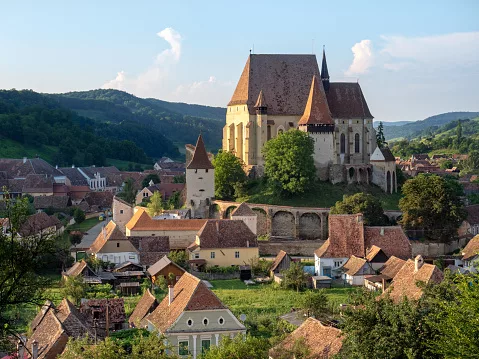
Biertan, Transylvania, /By: Andrea Ricordi, Italy/Getty Images
From Viscri, continue through the countryside to Biertan, another of Transylvania’s UNESCO-listed fortified villages.
The village is centred around its imposing fortified church, which stands on a hill above the settlement. Biertan was an important religious centre for the Transylvanian Saxons for centuries, and its church is surrounded by multiple defensive walls, towers and gateways.
The wider UNESCO landscape is significant because it preserves not only individual churches, but also the historic relationship between the villages, farmsteads and surrounding agricultural land.
Spend the afternoon exploring Biertan on foot before settling in at a village guesthouse or returning towards Sighișoara for the night.
End the day in Sighișoara
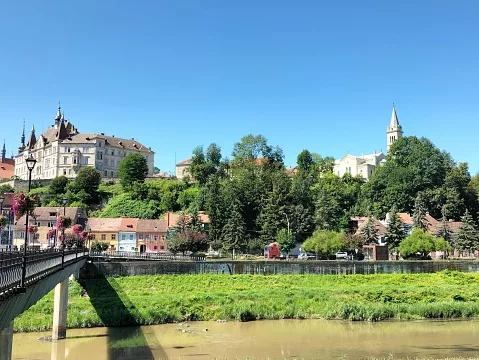
Views of Sighișoara in Romania, on a sunny day/By: Javier Jimenez Lopez/
iStock
If you have time, make Sighișoara your evening stop.
Its historic centre is another UNESCO World Heritage site and is one of the finest surviving examples of a small fortified medieval town founded by Transylvanian Saxons.
Walk through the old streets as the day-trippers leave, looking out for the colourful houses, defensive towers and steep lanes leading through the historic centre.
And while Sighișoara is sometimes pulled into Dracula-related itineraries because of its association with Vlad Țepeș, there is far more to the town than that connection. Its real draw is its architecture, history and surviving medieval character.
ALSO READ:
The Devil’s Kettle: The Minnesota waterfall that appears to swallow half its river
Day 2: Trade castles for the Carpathians
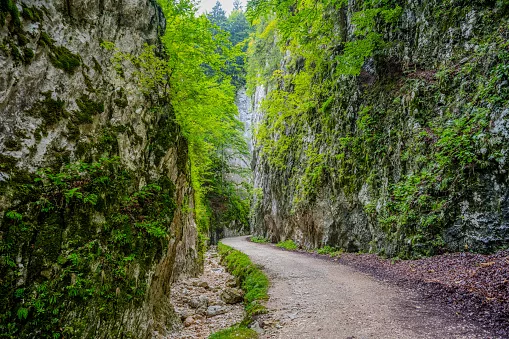
A stunning view of the Zrneti Gorge in Piatra Craiului National Park, Romania/By: Emad aljumah/Geetty Images
Head towards Zărnești
On your second morning, leave the villages behind and head towards Zărnești, at the foot of the Carpathian Mountains.
This is where the scenery changes dramatically. The gentle farmland gives way to forested slopes, rocky peaks and mountain valleys.
Zărnești is one of the main gateways to Piatra Craiului National Park, an area known for its mountain scenery and hiking routes. The local tourist information centre highlights the park, the Zărnești Gorge and the trails towards Curmătura Chalet and Plaiul Foii among the area’s main attractions.
Walk through the mountain landscape
You do not need to attempt a demanding summit to experience the Carpathians.
Choose a shorter marked trail suited to your fitness and the weather, or explore the area around the Prăpăstiile Zărneștilor, a dramatic limestone gorge surrounded by forest and mountain scenery.
The landscape is a reminder that Transylvania is not simply a collection of medieval villages. Much of its character comes from the mountains and forests that surround them.
Allow plenty of time for the walk, especially if visiting outside the height of summer when daylight hours are shorter.
Visit a bear sanctuary
View this post on Instagram
In the afternoon, learn about one of Romania’s most recognisable wild animals at Libearty Bear Sanctuary near Zărnești.
The sanctuary was established in 2005 to rescue bears that had been kept in cruel captive conditions. Today, the animals live in a large forested environment where visitors can learn about their individual histories and the importance of responsible wildlife tourism.
This is a very different way to encounter Romania’s bears than searching for wild animals yourself. The sanctuary’s focus is on rescue, welfare and education, making it an opportunity to understand the consequences of keeping wild animals in captivity.
Visits are guided and operate at set times, so check the current schedule before travelling. Children under five are not permitted inside the sanctuary.
Stay close to the mountains
Spend your second night around Zărnești or nearby Brașov.
A countryside guesthouse makes sense here, particularly if you want to continue the rural feel of the trip. Alternatively, Brașov offers a livelier base with restaurants and easy access to the surrounding mountains.
Day 3: Eat your way through Transylvania

Crispy Fried Fish with “Mămăligă” Romanian Cornmeal Dish/By: Elena Sevciuc/iStock
Start with a traditional breakfast
Set aside your final morning for food.
Transylvanian cuisine reflects the region’s Romanian, Hungarian and Saxon influences, resulting in hearty dishes built around meat, cheese, vegetables, grains and locally produced ingredients.
Look for fresh bread, local cheeses, eggs, jams and other homemade produce at a guesthouse or local market.
Try the regional classics

Hungarian traditional sweet food Kurtoskalacs, also called chimney cake/By: SiyueSteuber/
iStock
For lunch, look beyond international restaurants and try some of the dishes associated with the region.
Mămăligă, a polenta-like cornmeal dish, is often served with cheese and sour cream. Other traditional favourites include cabbage rolls, bean soup with smoked meat, goulash and papanași, a rich cheese-based dessert.
You may also come across kürtőskalács, the spiral-shaped sweet bread cooked around a spit. It is particularly associated with the Székely communities of Transylvania.
Local cheeses are another highlight. Sheep’s cheeses such as urda and burduf are traditionally produced in the region, while village producers also make preserves, honey, elderflower syrup and fruit jams.
Take the slow route back
Use the final afternoon to revisit the countryside rather than squeezing in another major attraction.
Stop at a village café, browse a local craft shop or simply take a walk through the surrounding fields. In places such as Saschiz, traditional crafts and locally produced foods offer another way to experience the region beyond its medieval architecture. The village is known for its fortified church, traditional pottery and small-scale food producers.
If your route allows, finish in Sighișoara or Brașov for one final Romanian meal before continuing your journey.
Romania beyond the legend
Dracula may have put Transylvania on the map, but the region’s real appeal is considerably broader.
There are centuries-old villages and fortified churches, forests filled with wildlife, dramatic Carpathian landscapes and a food culture shaped by several communities living alongside one another.
In just three days, you can move from medieval villages to mountain trails and from rescued bears to village kitchens.
Follow us on social media for more travel news, inspiration, and guides. You can also tag us to be featured.
Instagram | Facebook | Twitter | Spotify
ALSO READ:
The world’s most extraordinary castles: 7 places that look almost unreal