

Elephants are changing the landscape in parts of Kruger National Park, but new research suggests their impact on trees varies considerably across the reserve.
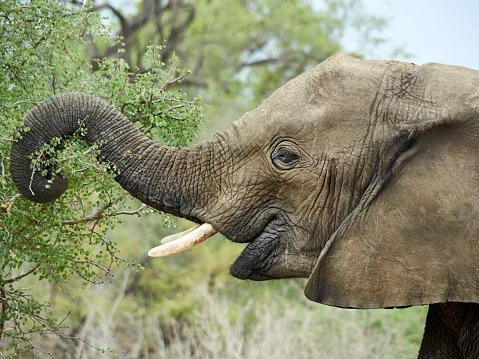
Profile of an elephant eating from a tree in Kruger National Park/By: Westend61/Getty Images
Scientists from South African National Parks (SANParks) used satellite data to track changes in woody vegetation between 2007 and 2022, helping identify areas where elephant activity may be contributing to tree loss.
According to SANParks vegetation dynamics scientist Dr Corli Wigley-Coetsee, elephants damage trees by stripping bark, breaking branches, snapping stems and pushing trees over. Severe damage can leave trees more vulnerable to fire and drought.
Monitoring these changes across Kruger’s nearly two million hectares is challenging, particularly because much of the park’s vegetation consists of smaller shrubs that are difficult to track individually.
Tree species also respond differently to elephant activity. Some, such as sjambok pod and tree wisteria, are generally avoided by elephants. Others, including silver-cluster leaf and red bushwillow, can recover from damage by producing new growth.
More vulnerable species include marula and knob thorn. These trees tend to grow slowly and often struggle to replace damaged branches or stems.
ALSO READ:
Study identifies areas experiencing tree loss
SANParks scientists collaborated with researchers from national and international universities and institutions to investigate vegetation changes in Kruger.
Rangers and conservation practitioners identified 31 areas where woody vegetation had declined, and elephants were considered a possible contributing factor.
Researchers then used GEDI-fusion remote-sensing data to assess changes in vegetation cover and height over 15 years. GEDI is a NASA laser-based system that measures vegetation structure from space.
The findings revealed declines in woody cover in 19 of the 31 areas identified as experiencing current elephant impacts. Most of these areas also recorded decreases in trees taller than five metres.
However, the research did not indicate a park-wide decline in woody vegetation. About a third of Kruger experienced increases of at least 2.5% in woody vegetation cover, highlighting the differences between individual areas.
River systems face particular pressure
Elephant impacts were especially pronounced along seasonal rivers, in areas affected by intense fires and beside perennial rivers where flooding can remove established trees.
In flood-prone areas, elephants can also make it difficult for younger trees to reach maturity by heavily browsing seedlings and saplings.
The resulting changes can reshape habitats. While some areas lose large trees, others become increasingly dominated by shrubs.
Large trees play an important ecological role, providing shade, habitat and nesting sites for wildlife. Their loss can therefore have consequences beyond the vegetation itself.
Are there too many elephants in Kruger?
The research points to a more complex picture than a simple yes-or-no answer.
Elephant pressure appears to be too high in certain vulnerable areas, while woody vegetation is increasing in others. This suggests that the effects of elephants depend on local conditions, including vegetation type, fire and flooding.
According to Wigley-Coetsee, targeted and flexible elephant management could help protect vulnerable large trees while maintaining a resilient and biodiverse landscape.
The findings highlight the importance of understanding how elephant activity interacts with other environmental pressures before concluding elephant numbers across the entire park.
Source: Lowvelder, reporting on research by SANParks vegetation dynamics scientist Dr Corli Wigley-Coetsee.
Follow us on social media for more travel news, inspiration, and guides. You can also tag us to be featured.
Instagram | Facebook | Twitter | Spotify
ALSO READ:
Kruger Shalati retains two MICHELIN Keys for its unique Kruger National Park stay