



At first glance, Peru’s Rainbow Mountain looks almost too vivid to be real.
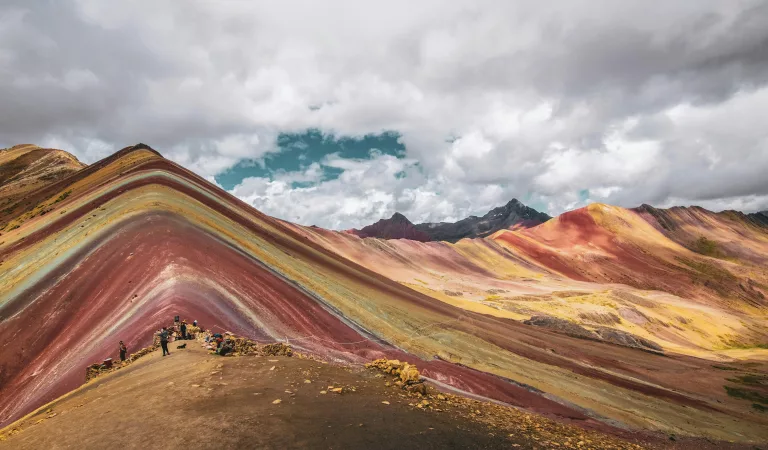
Rainbow Mountain, Cusco, Peru / McKayla Crump / Unsplash
Bands of dusty pink, rusty red, mustard yellow and green stretch across the Andes, resembling a mountainside painted by an artist. But these colours are no illusion. They are the result of millions of years of geological change.
Known locally as Vinicunca, the Mountain of Seven Colours lies in Peru’s Cusco region, within the Vilcanota mountain range. It’s striking appearance has made it one of the country’s most recognisable natural attractions. Beneath it’s colourful slopes, however, lies a story of ancient sediments, mineral-rich rocks and the tectonic forces that raised the Andes.
How Rainbow Mountain got it’s colours
Millions of years ago, sediments accumulated in changing environments, including ancient marine, lake and river settings. Layers of clay, sand and other mineral-rich material gradually built up, preserving traces of the conditions in which they formed.
As the Nazca Plate moved beneath the South American Plate, tectonic forces lifted and deformed these rock formations, helping build the Andes. Erosion eventually exposed the layers, revealing the colourful bands across Vinicunca’s slopes.
What looks like a rainbow painted across the mountainside is actually a glimpse into the Earth’s geological past.
The science behind the colours
Vinicunca’s distinctive palette comes from differences in rock composition and mineral content. The familiar seven colours are not separate stripes of paint, but variations across layers of sedimentary and altered rock.
- Red and pink: Iron oxides, including hematite, contribute to the reddish tones.
- Yellow and ochre: Iron-bearing minerals, including goethite and other hydrated iron oxides, produce yellowish and brownish shades.
- Green: Greenish layers are associated with mineral-rich rocks containing iron and magnesium.
- Purple and lavender: Clay-rich sediments and combinations of minerals contribute to the muted purple tones.
- White and cream: Quartz-rich sandstone and carbonate-rich rocks, including limestone, account for paler bands.
- Brown: Iron-bearing minerals, weathering and differences in sediment composition create earthy shades.
The exact mineral composition varies between layers, so colour alone cannot identify a rock with certainty. Together, however, these mineral differences create the mountain’s extraordinary appearance.
Why iron matters
Iron plays an important role in Rainbow Mountain’s colour palette. When iron-bearing minerals react with oxygen and water, chemical changes can produce iron oxides and hydroxides in shades of red, yellow and brown.
Hematite, for example, is associated with red tones, while goethite often produces yellowish or brown hues. These changes can occur through weathering, as rocks are exposed to air and water, as well as during earlier stages of geological formation.
Over millions of years, these processes helped create the contrasting bands now visible on the mountainside.
Why the mountain looks different in photographs
Sunlight, cloud cover, moisture and snow all influence how vivid Rainbow Mountain appears. Strong sunlight can emphasise the contrast between layers, while wet rock may look darker and snow can conceal parts of the landscape.
The mountain’s international popularity grew rapidly around 2016, when travellers began sharing photographs of it’s striking slopes online. The retreat of snow and ice helped expose the colourful terrain to wider attention.
Climate change did not create the colours, but changing conditions helped reveal a landscape that had existed for millions of years.
Visiting Rainbow Mountain
Located southeast of Cusco, Vinicunca rises to approximately 5,200m above sea level. The altitude makes the hike physically demanding, even for reasonably fit travellers.
Allow time to acclimatise before attempting the ascent. Move slowly, stay hydrated and take symptoms such as headaches, nausea and dizziness seriously. Do not push on if you suspect altitude sickness.
May to October is generally the drier season, although weather in the Andes can change quickly. Rain and snow are more common from November to April and can make trail conditions challenging.
Beyond the photographs, take time to notice the changing textures and shades across the slopes. Each band represents a different combination of materials and processes, preserved in rock and exposed by the forces that shaped the Andes.
A rainbow written in stone
Rainbow Mountain’s beauty lies in more than it’s impossible-looking colours. It’s slopes preserve a geological history shaped by ancient sediments, mineral transformations and the movement of tectonic plates.
What appears to be a painted landscape is, in fact, the Earth revealing it’s past. Vinicunca may draw travellers with it’s extraordinary palette, but understanding how those colours formed makes the mountain even more remarkable.
Follow us on social media for more travel news, inspiration, and guides. You can also tag us to be featured.
Instagram | Facebook | Twitter | Spotify
ALSO READ: