



Three documented sightings of the Amazon river dolphin in Bolivia have expanded scientific knowledge of the species’ distribution, highlighting the importance of citizen science and local communities in wildlife conservation.
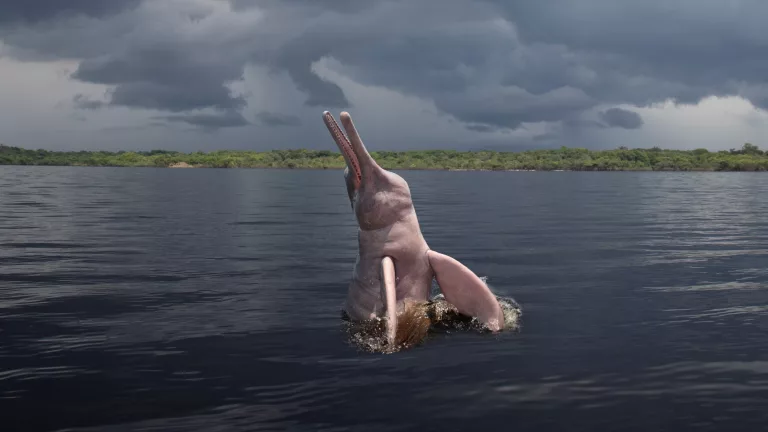
The Amazon River Dolphin, known for its pink color, thrives in the river’s murky waters and is an
iconic species of the rainforest. Image credit: ©️Kenneth Højgård/Shutterstock
The sightings, recorded between 2025 and 2026, provide the first documented evidence of the Amazon river dolphin (Inia geoffrensis) in Bolivia’s Acre River basin in the department of Pando. The findings were published in the journal Neotropical Hydrobiology and Aquatic Conservation.
The discovery offers new insight into the biodiversity of the region and the connections between river systems in Bolivia and neighbouring Brazil.
Three sightings confirm the dolphin’s presence
Research into river dolphins in Bolivia has largely focused on the Bolivian river dolphin (Inia boliviensis), a species found in the Mamoré and Iténez river basins. The newly documented sightings, however, concern the Amazon river dolphin, which is associated with the wider Amazon River system.
The Acre River forms part of the Purús River basin, which connects to the Amazon drainage system. Its waterways provide suitable habitat for the species and highlight the ecological connections between rivers across national borders.
The first sighting was recorded on 27 April 2025, when two dolphins were observed in the Acre River near the Junín neighbourhood of Cobija. The observation took place during the city’s first participation in the City Nature Challenge, a global initiative that encourages people to document local biodiversity.
Two further records were subsequently contributed by local fishers. One was reported near Puerto Alto in November 2025, while the other came from the Frontera neighbourhood in May 2026.
Together, the three records establish the species’ documented presence in this part of Bolivia, although researchers say more work is needed to understand the dolphins’ movements and population.
Local knowledge helps researchers confirm the discovery
Ximena Morales of the Shimanú Amazon Conservation Program said the initial sighting prompted the team to photograph and film the dolphins as part of the City Nature Challenge. Researchers then interviewed local residents, particularly fishers, who were already familiar with the animals and had additional video footage.
Between May and June 2026, the team interviewed 34 fishers from San Pedro, Junín and Brisas del Acre. Some had more than 30 years of fishing experience.
Their observations helped researchers establish that the dolphins had been seen in the area and provided further information about how frequently they appeared in the river.
The study was conducted by researchers from the Shimanú Amazon Conservation Program, the Institute of Ecology at the Universidad Mayor de San Andrés, Juventud Proactiva de la Amazonia and the Wildlife Conservation Society’s Bolivia programme, with contributions from local fishers.
Dr Robert Wallace, senior conservation scientist at the Wildlife Conservation Society, described the finding as an important addition to knowledge of Bolivia’s biodiversity. He also highlighted the role of citizen science in bringing new wildlife records to the attention of researchers.
Further research needed to protect the dolphins
Despite the significance of the discovery, several questions remain unanswered. Researchers say additional studies are needed to estimate the number of dolphins in the Acre River, track their movements and determine whether they remain in the area throughout the year.
Understanding these patterns will be important for assessing the species’ conservation needs in a part of Bolivia where it has received little scientific attention.
Protecting the Acre River ecosystem is also essential. The study highlights the need to conserve riverside forests, maintain water quality and preserve the natural connections between waterways that allow aquatic species to move through the region.
Because the basin extends across Bolivia, Brazil and Peru, researchers also stress the importance of cross-border cooperation. Sharing scientific information and coordinating habitat protection could help improve monitoring and conservation efforts throughout the wider river system.
For now, the three records provide a valuable starting point for future research. They also show how observations made by local communities, combined with scientific investigation, can help reveal previously undocumented aspects of South America’s remarkable wildlife.
Follow us on social media for more travel news, inspiration, and guides. You can also tag us to be featured.
Instagram | Facebook | Twitter | Spotify
ALSO READ:
Tange Lake: Denmark’s man-made lake offers fishing, hiking and scenic escapes