
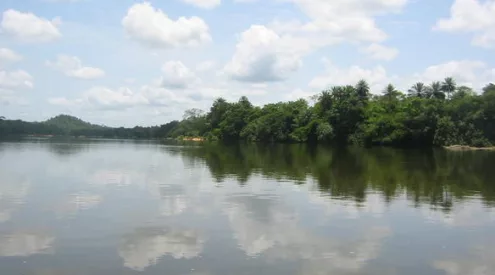
Some of the Lowveld’s most interesting wildlife is found away from the usual game-viewing routes. Along the shaded banks of the Sabie River, beneath overhanging trees and thick vegetation, lives the African finfoot (Podica senegalensis).
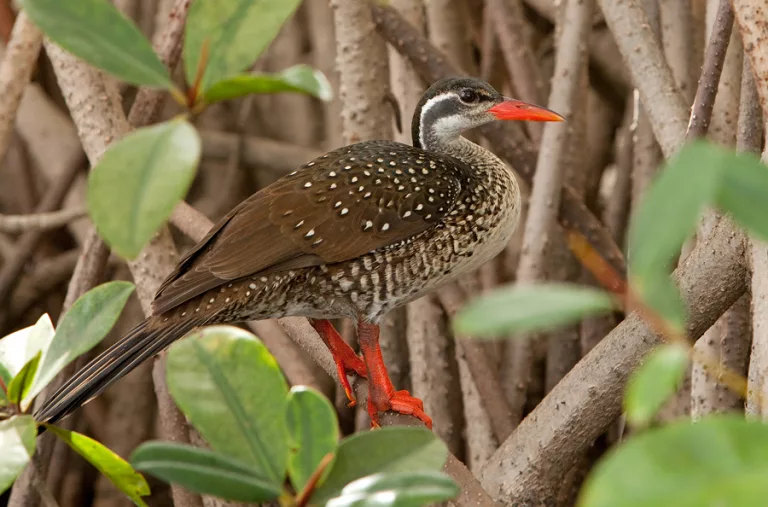
African Finfoot, Male breeding plumage / Paul Cools / Wikimedia Commons
Shy and naturally scarce, this unusual waterbird spends much of it’s time close to cover, making it a rewarding find for birdwatchers. The river around Skukuza and Lower Sabie in the Kruger National Park is a good place to start looking.
Getting to know the African finfoot
About the size of a Reed Cormorant, the African finfoot has a distinctive coral-red bill, salmon-orange legs and unusually large, lobed feet. Males are darker, while females have browner plumage and more noticeable facial markings.
It’s usually found alone or in pairs along clear, permanent rivers with thick vegetation. Rather than swimming out into open water, it keeps close to the banks, where it searches for aquatic insects, crustaceans, small fish and amphibians. It’s preference for secluded stretches of water makes it easy to overlook. Even in suitable habitat, the bird can remain hidden among the vegetation.
Where to look along the Sabie River
The H4-1 between Skukuza and Lower Sabie is a good starting point. The road follows the Sabie River, with several places to stop and look across the water.
One particularly worthwhile spot is the high-level bridge just east of the Sabie and Sand river confluence. Kruger birding guides identify this as one of the better places in the park to look for African finfoot.
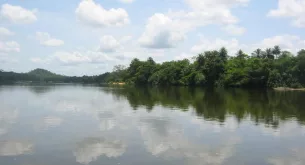
Nkuhlu Picnic Site is another stop worth including. Set beside the Sabie River, it offers views over the water and surrounding riverine vegetation. For a quieter drive, take the Salitjie Road (S30), which follows the northern banks of the river. It’s secluded pools are specifically noted as places where the shy African finfoot can sometimes be seen.
The key is to look along the shaded edges of the water, particularly where branches hang low over the river. Watch for movement close to the bank rather than expecting the bird to appear in the open.
Why protecting these rivers matters
The African finfoot relies on healthy waterways and natural vegetation along riverbanks. Clearing this vegetation, excessive water extraction, siltation and pollution all threaten the habitat it depends on.
It’s conservation status also makes the search more meaningful. BirdLife South Africa’s 2025 Red Data Book classifies the species as Vulnerable in South Africa, Lesotho and Eswatini, with fewer than 1,000 mature individuals estimated across the region. It’s global status, however, remains Least Concern.
The regional assessment also identifies declining reporting rates and waterbird counts, highlighting the importance of protecting the remaining suitable river habitats. For a bird so closely tied to it’s surroundings, conserving the river is just as important as protecting the species itself.
Planning your search
Skukuza and Lower Sabie make convenient bases for exploring the Sabie River. Include the H4-1 and S30 in your drive, and allow time to stop at the river viewpoints.
A pair of binoculars will make scanning the banks easier, while a camera with a zoom lens is useful for photographing birds without disturbing them. Recent birding reports and advice from local guides can also help identify areas with recent sightings.
The finfoot is not a guaranteed sighting, even in it’s preferred habitat. Keep to designated viewpoints and avoid approaching or disturbing the riverbank for a better photograph.
Worth looking for
You could drive along the Sabie River several times without seeing an African finfoot. But searching for one offers a different perspective of the Kruger National Park, taking your attention away from the larger animals and towards the quieter life along it’s waterways.
Between the shaded pools, riverine trees and birds moving along the banks, there is plenty to notice. And if an African finfoot happens to emerge from the vegetation, it makes the search all the more worthwhile.
Follow us on social media for more travel news, inspiration, and guides. You can also tag us to be featured.
Instagram | Facebook | Twitter | Spotify
ALSO READ:
Bazaruto beyond the beach: The marine wilderness protecting Mozambique’s coast