






About 50km southeast of Johannesburg, Heidelberg is a town with a history that often goes overlooked. From it’s brief role as a republican capital to it’s place in the South African War, it witnessed events that shaped the former Transvaal.
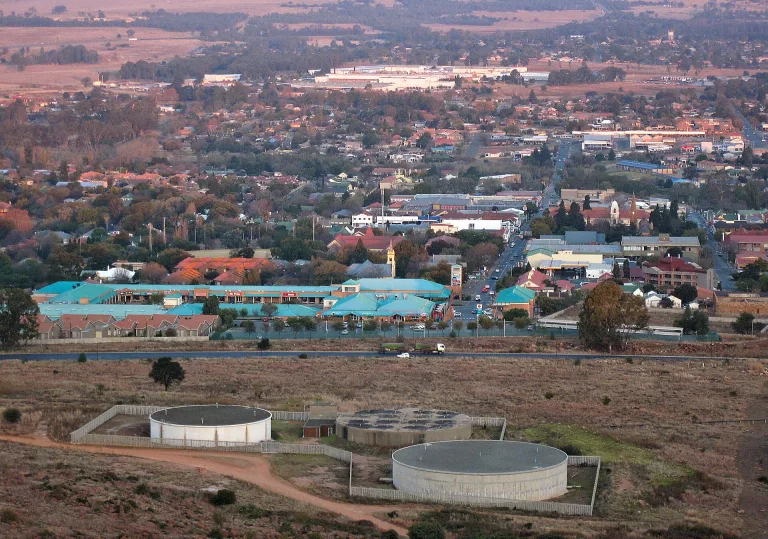
View over the town of Heidelberg, Gauteng, South Africa / Ossewa / Wikimedia Commons
Proclaimed in 1866, Heidelberg developed into an important regional centre. It’s surviving landmarks and historic sites offer a closer look at the people and events behind it’s past.
A town with a political past
Heidelberg’s early development is closely linked to German-born trader Heinrich Julius Friedrich Christian Ueckermann, who established a trading store on the farm Langlaagte. A settlement grew around it before the town was formally proclaimed in 1866.
During the First Anglo-Boer War (1880–1881), Heidelberg briefly became the seat of government of the Zuid-Afrikaansche Republiek (ZAR). With no British troops stationed in the town, it offered the Boer government a base from which to re-establish the republic. On 16 December 1880, the republican flag was raised in Heidelberg, marking the start of the war.
The history of the Klipkerk
The Klipkerk remains one of Heidelberg’s most recognisable landmarks. It’s history dates to an earlier church, the Kruiskerk, built on the same square in 1865.
The cornerstone of the present building was laid by Commandant General PJ Joubert on 12 April 1890. Designed by architects Brislin and Seal in the Norman style, the church was inaugurated in March 1891. It’s tower collapsed in 1909 following structural problems and heavy rain, but was later rebuilt to resemble the original.
Remembering Heidelberg’s Black concentration camp
Some of Heidelberg’s most important history is less visible. During the South African War (1899–1902), British forces established concentration camps for displaced Black and white South Africans. The experiences of Black people in these camps have received far less historical attention.
Research by historians Willem Pretorius and Fransjohan Pretorius documents four Black concentration camps in the wider Heidelberg district: Heidelberg, Nigel, Balfour and Greylingstad.
Approximately 2,300 Black people were held at the Heidelberg camp. Conditions were difficult, with inadequate food and medical care. Residents were also expected to provide labour to the British military. Academic research records improvements in health services after June 1901, but the camp had already suffered significant loss of life.
Historical records indicate that 150 people died there, including 121 children. On 28 August 2026, the Heidelberg Heritage Association unveiled Heritage Blue Plaque No. 85 at the former camp cemetery, behind Heidelberg Mall. The burial site was rediscovered in June 1999 during research into an old map, with approximately 30 graves identified.
The plaque brings greater recognition to a painful chapter in Heidelberg’s history and the families affected by the war.
A railway station facing an uncertain future
Heidelberg Railway Station opened in October 1896 and was declared a national monument in 1975. In 1995, it became the Heidelberg Heritage Museum, housing historical photographs, artefacts and railway memorabilia.
The station also reflects the country’s history of racial segregation, with separate facilities once provided for Black and Indian passengers.
It’s more recent history has been troubling. A September 2026 report described the deteriorating building, which had been closed to the public for more than a year amid disputes over it’s management and maintenance. It remains an important heritage site, but visitors should confirm access before making a stop.
Heidelberg’s literary connection
Heidelberg was also home to Dr Andries Gerhardus Visser, one of Afrikaans literature’s best-known poets. Born in 1878, Visser first trained as a teacher before studying medicine in Edinburgh. He settled in Heidelberg in 1916, where he established his medical practice and continued writing poetry.
His former residence and consulting rooms, built in 1890, still stand at the corner of Van der Westhuizen and HF Verwoerd streets. A heritage plaque marks the property, which once operated as a museum displaying his personal belongings and cultural artefacts.
Discovering Heidelberg
Heidelberg’s history extends well beyond it’s best-known landmarks. It’s brief role as a republican capital, the stories of those held in it’s concentration camp, and it’s railway and literary connections reveal different sides of South Africa’s past.
For travellers interested in heritage, the town offers a worthwhile detour from Gauteng’s better-known attractions. It’s history is not always comfortable, but understanding it makes a visit all the more meaningful.
Travel note: The Heidelberg Heritage Museum was reported closed to the public in September 2026. Confirm access to heritage properties before visiting.
Follow us on social media for more travel news, inspiration, and guides. You can also tag us to be featured.
Instagram | Facebook | Twitter | Spotify
ALSO READ:
Cahokia: The enormous ancient city hiding beneath the American Midwest