




Imagine standing on top of an enormous earthen mound, looking across a landscape that was once home to one of North America’s largest cities. Almost a thousand years ago, this stretch of land near the Mississippi River was filled with homes, ceremonial spaces, busy public plazas and thousands of people going about their daily lives.
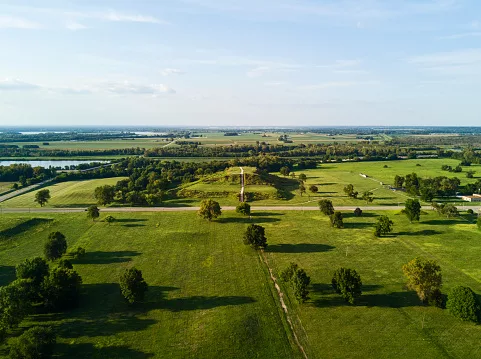
Aerial of the ancient Cahokia mounds and Monk’s Mound pyramid in Illinois, USA/By: Matt Champlin/Getty Images
Today, much of that city has disappeared beneath the surrounding landscape. But its enormous grass-covered mounds, ancient gathering spaces and archaeological remains can still be explored at Cahokia Mounds State Historic Site in Illinois.
Located near Collinsville, just outside St Louis, Missouri, Cahokia was once a thriving Indigenous urban centre. At its height, around AD 1050 to 1150, it is estimated to have supported between 10,000 and 20,000 people. Its extraordinary earthen structures and carefully organised settlement made it one of the most significant pre-Columbian cities in North America.
Designated a UNESCO World Heritage Site in 1982, Cahokia is now a fascinating destination for travellers interested in history, archaeology and the ancient landscapes of the American Midwest. And while much of its former cityscape is no longer visible, there is plenty to discover on foot.
Start with the enormous Monks Mound
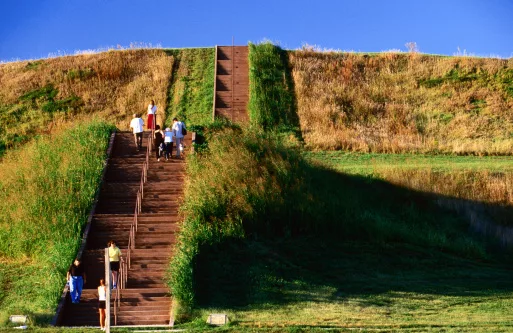
Tourists climbing steps up Monks Mound/By: Eddie Brady/Getty Images
No visit to Cahokia is complete without seeing Monks Mound, the largest prehistoric earthen structure in the Americas.
Rising approximately 30 metres above the surrounding landscape, this enormous flat-topped mound covers around six hectares. It was constructed by generations of Cahokians who transported and deposited countless baskets of soil to create its impressive terraces.
Today, visitors can climb the staircase to the top, where the elevated position offers a different perspective of the archaeological site and its surrounding landscape.
From here, it is easier to appreciate the scale of Cahokia and imagine how its central precinct might have looked when the city was at its busiest. The contrast between the ancient earthworks and the modern St Louis metropolitan area makes for a particularly striking view.
Allow time to explore the base of the mound and the surrounding pathways, rather than treating the climb as a quick photo stop.
Walk through the ancient Grand Plaza
Another highlight is the Grand Plaza, a vast open space that once formed the heart of Cahokia’s public life.
The plaza was deliberately levelled and surrounded by important structures, including several earthen mounds. It would have provided space for gatherings, ceremonies and other communal activities.
Today, the open landscape offers an opportunity to explore the layout of the ancient city at a slower pace. Walking through the area, visitors can see how the mounds and public spaces were positioned in relation to one another.
It is also one of the best places to appreciate the sheer scale of the settlement. What might initially look like a collection of grassy hills begins to reveal itself as a carefully organised urban landscape.
ALSO READ:
Discover Woodhenge, Cahokia’s ancient solar calendar
One of the site’s most intriguing features is Woodhenge, a reconstructed circle of large wooden posts associated with the observation of the sun.
Archaeologists believe the original structures were used to mark important solar events, including the solstices and equinoxes. These observations would have helped the people of Cahokia track seasonal changes and organise aspects of their agricultural and ceremonial calendars.
The reconstructed wooden circle gives visitors a tangible sense of how the structure may have appeared centuries ago.
If your visit coincides with a seasonal solar event, it is worth checking whether any special interpretation or activities are planned. Otherwise, Woodhenge is still a worthwhile stop for anyone interested in ancient astronomy and the relationship between early societies and the natural world.
Follow the walking trails and explore the landscape
Beyond the main monuments, Cahokia is a destination worth exploring on foot.
The grounds contain several walking routes that take visitors through different sections of the archaeological landscape. Along the way, you can encounter additional mounds, open grasslands and traces of the enormous timber palisade that once surrounded the city’s central precinct.
The original palisade extended for approximately two miles and was rebuilt several times during Cahokia’s history. Although much of the structure no longer survives, its archaeological footprint helps researchers understand how the city was organised and protected.
For those who enjoy combining history with time outdoors, the trails offer a quieter way to experience the site. They also provide opportunities to appreciate the surrounding natural landscape, particularly the prairie vegetation.
Comfortable walking shoes, sunscreen, a hat and drinking water are recommended, especially during the warmer months.
Spend time at the Interpretive Centre
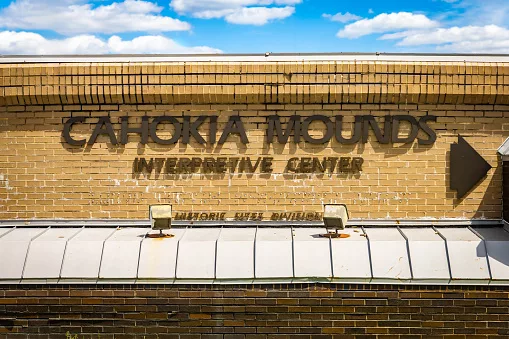
Cahokia Mounds State Historic Site Entrance Sign/By: GummyBone/Getty Images
For a better understanding of what you are seeing outdoors, make time for the Cahokia Mounds Interpretive Centre.
The centre provides information about the people who built the city, their daily lives, agricultural practices and the archaeological discoveries that have helped reconstruct Cahokia’s history.
However, visitors should be aware that the cultural exhibition galleries are currently closed while the site reviews its collections and continues consultation with descendant Indigenous communities.
The lobby, including the site model, canoe exhibit, temporary exhibition, gift shop and visitor facilities, is open Wednesday to Sunday from 9am to 3pm, according to the site’s current visitor information.
It is worth checking the official website before travelling, as access to exhibitions and facilities may change.
Join a guided tour
If you would prefer to explore with someone who knows the history of the site, consider joining a guided walk.
Cahokia currently advertises free guided tours covering Monks Mound and the Grand Plaza. The published schedule lists a Monks Mound tour at 10am and a Grand Plaza tour at 1pm, Tuesday to Sunday. Tours take approximately an hour.
Reservations are required, so contact the site before your visit to confirm availability and arrangements.
A guided experience can add valuable context to the landscape, particularly when it comes to understanding the purpose of individual mounds and the significance of the city’s different spaces.
Planning a visit to Cahokia Mounds
Cahokia Mounds State Historic Site is located at 30 Ramey Street in Collinsville, Illinois, approximately 13km from downtown St. Louis, Missouri.
Its proximity to St Louis makes it an accessible day trip for travellers exploring the city and the wider region.
A few things to know before you go:
- Opening times: The outdoor grounds are open daily from dawn until dusk.
- Admission: There is currently no admission or parking fee, although donations are welcomed.
- Visitor facilities: The Interpretive Centre lobby is open Wednesday to Sunday, 9am to 3pm. The cultural galleries remain closed.
- Guided tours: Free tours are advertised Tuesday to Sunday, subject to reservations and availability.
- What to bring: Comfortable walking shoes, drinking water, sunscreen, a hat and insect repellent.
- Getting around: A car is a convenient option, particularly if you are travelling from St. Louis or exploring other attractions in Illinois.
For the latest opening arrangements, guided-tour bookings and visitor updates, consult the official Cahokia Mounds website.
Cahokia may no longer be the bustling city it once was, but its surviving monuments offer an extraordinary opportunity to explore a lesser-known chapter of American history. From climbing Monks Mound to walking through the Grand Plaza and standing among the reconstructed posts of Woodhenge, a visit brings the scale and ingenuity of this ancient civilisation into perspective.
For travellers passing through the American Midwest, it is a fascinating detour that offers something quite different from the region’s more familiar city attractions.
Follow us on social media for more travel news, inspiration, and guides. You can also tag us to be featured.
Instagram | Facebook | Twitter | Spotify
ALSO READ:
The N9 road trip: Four mountain passes, rooftop dragons and a fossil treasure trove