



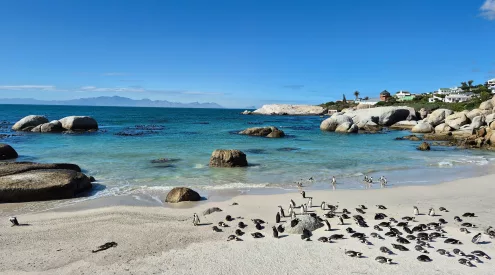


The Western Cape’s coastline is a treasure chest of stories — shipwrecks, whaling stations, fishing traditions, and cultural intersections that have shaped its character over centuries.

Grant Durr / Unsplash
Beyond its postcard-perfect beaches and charming harbours lie coastal villages steeped in legend, resilience, and maritime heritage. Whether you’re a history buff or a curious traveller, these seaside gems offer a glimpse into South Africa’s layered past and enduring coastal culture.
1. Arniston (Waenhuiskrans): a village born of shipwrecks

Bothar / Wikimedia Commons
Nestled between Bredasdorp and Cape Agulhas, Arniston is a sleepy fishing village that whispers tales of tragedy and survival. Officially named Waenhuiskrans — meaning “wagon house cave” in Afrikaans, after the enormous sea cave nearby — the village became known as Arniston after the HMS Arniston shipwreck of 1815.
The British transport ship was en route from Sri Lanka to England when it hit the reefs near Cape Agulhas, with only six survivors from more than 370 passengers. The wreck became one of South Africa’s most devastating maritime disasters, and the local community helped bury the dead and comfort the survivors.
Today, Arniston’s whitewashed, thatched fishermen’s cottages (some over two centuries old) form the Kassiesbaai Heritage Site, a national monument that offers a rare window into traditional coastal living. Wander through the narrow lanes, watch local fishermen mend their nets, and visit the sea cave at low tide, where nature and history meet in haunting harmony.
2. Paternoster: where the past still feeds the present

South African Tourism / Wikimedia Commons
One of the oldest fishing villages on the West Coast, Paternoster — meaning “Our Father” in Latin — was likely named after prayers said by shipwrecked Portuguese sailors. Its origins date back to the 1800s when fishermen first settled here, drawn by the abundant snoek, crayfish, and mussels that still define local cuisine today.
Beyond its picture-perfect blue-and-white cottages, Paternoster’s history tells a story of community and endurance. Before refrigeration, fish were salted and dried in the sun, forming the backbone of the local economy. Today, the fishing culture endures, you’ll still see traditional bokkom (dried fish) hanging on lines, and locals heading out to sea in colourful boats at dawn.
The Cape Columbine Lighthouse, built in 1936 on a rocky headland just outside the village, adds another layer of history. It was the last manually controlled lighthouse in South Africa and remains a striking reminder of maritime navigation in the pre-digital age.
3. Kalk Bay: from whaling station to cultural hotspot

Zaian / Wikimedia Commons
Kalk Bay, along the False Bay coastline, is a place where old-world charm meets contemporary creativity. Once a bustling whaling and fishing hub in the 18th and 19th centuries, it has evolved into one of Cape Town’s most eclectic seaside neighbourhoods, without losing its salty soul.
Its name comes from the Dutch kalkbaai, meaning “lime bay,” after the lime deposits used by early settlers. But Kalk Bay’s history runs deeper, it was home to Filipino fishermen in the 1800s, whose descendants helped shape the village’s vibrant multicultural identity.
Many of the original Victorian buildings still stand, housing antique shops, cafés, and art galleries. The working harbour remains active, with fishing boats bringing in daily catches of snoek and yellowtail. A stroll along the pier reveals the village’s living link between its past and present — seals sunning themselves beside fishermen mending nets, as trains rattle by on one of the most scenic coastal rail routes in the world.
4. Simon’s Town: a naval legacy anchored in time

Flashpacker Travel Guide / Wikimedia Commons
Further along the False Bay coastline lies Simon’s Town, a settlement steeped in maritime history. Established in 1680 as a winter anchorage for the Dutch East India Company’s ships, it later became a key British naval base and remains South Africa’s principal naval port to this day.
The town’s streets are lined with beautifully preserved Georgian and Victorian buildings, telling stories of explorers, sailors, and settlers. History buffs can explore the Simon’s Town Museum or the South African Naval Museum for a deep dive into its seafaring legacy.
One of its most beloved tales, however, belongs to a dog — Just Nuisance, a Great Dane who became the only dog ever enlisted in the Royal Navy. His statue still stands proudly on Jubilee Square, a tribute to loyalty and local legend.
Beyond the naval base, Simon’s Town was also home to a diverse fishing community, many of whom were forcibly removed during apartheid under the Group Areas Act. The Remembering Luyolo exhibition and heritage walks honour their memory, ensuring that Simon’s Town’s layered past is never forgotten.
A coastline etched with memory
From Arniston’s shipwrecked souls to Simon’s Town’s naval heroes, the Western Cape’s coastal villages are living archives — where every tide seems to carry a story ashore. Each village has weathered change and challenge, yet remains deeply rooted in its history.
So next time you venture down the Cape’s coastline, take a detour off the main road. Wander the cobbled lanes, listen to the ocean’s rhythm, and let the whispers of history guide you through these enduring seaside settlements.
Follow us on social media for more travel news, inspiration, and guides. You can also tag us to be featured.
TikTok | Instagram | Facebook | Twitter
ALSO READ: Find your perfect South African destination by weather and mood






.jpg)

.jpg)