Chris Smith bikepacked 4 418 km along the Continental Divide in the Rocky Mountains, from Banff, Canada, to the Mexican border, alone and self-supported. He’s legally blind. No, he didn’t have a guide, writes Lisa Abdellah.

Chris’ bike, dirty and well-worn, at an overlook in the mountains north of Seeley Lake, Montana
I grew up in a rural town, Deep River in Connecticut, US, with my parents, Neil and Sandy, and my sister, Kim. My family had lived there for several generations, and Mom and Dad owned a couple of local shops; they were hard-working. As the town’s population was 1 500 and everyone knew each other, especially my family, I couldn’t get away with anything. If someone thought they saw me doing something wrong, they’d tell my parents, even if they had no proof. My friends and I rode our bikes in the woods after school. I was in the Boy Scouts of America, and we camped in the woods. When I was older, a group of friends and I went on week-long river kayaking trips, carrying our gear in the boats.
I was 22 when I noticed something was wrong with my eyesight. Driving toward a fluorescent-yellow sign at a pedestrian crossing in Boston, Massachusetts, where I lived at the time, I had to do a double take: I could see the base of the sign, but where was the rest of it?
A doctor diagnosed me with Stargardt disease, which affects sharp, central vision. It’s genetic, yet there was no history in my family. There are an estimated 45 000 people with Stargardt in the US. He said, ‘You’re rare enough that you’ll never see any research or treatments because they’re not commercially viable.’ In other words, I had no hope.
Since then, research has shown promise for slowing Stargardt’s progression and restoring vision. Scientists have identified the cause of the disease as a variation of the ABCA4 gene, which provides instructions for making a protein in the retina. If you can treat one gene that affects another eye disease, who’s to say you can’t adapt that to target the ABCA4 gene?
But at the time, my news was shattering, and there was a lot of uncertainty. The older you are when diagnosed, the less chance you have of going fully blind, but you’ll certainly lose your central vision, which includes your ability to see detail. You don’t consistently lose vision over time; it plateaus. Life would go on as usual, but then I’d notice my sight was worsening. I had to ride the wave and see how it went without knowing how long it’d take.

Chris Smith with his 545 Velo teammate Asheem Linaval in Banff on the morning of the Grand Depart (the start of the race
As my vision deteriorated, I traded my convertible for a Land Rover, as I felt safer driving a bigger car that could absorb the impact of potential hazards I mightn’t have seen on time. I used an Amazon Kindle to read large-print books and a magnifying glass to read my mail.
Not much changed for me socially, except I tended to look to the side, above or below people I was speaking to, and they’d look over their shoulder, like, what is this guy looking at? I have no central vision, but I still have peripheral vision. If you’re sitting opposite me in a restaurant and I’m looking right at you, I can’t see you, but I can see a glass on the table, ceiling lights and people sitting at other tables.
Nine years later, I was legally blind. My vision was worse than 20/440, meaning I’d need to be 6 m away to see what most people can see from 122 m away. It also means I can barely make out the top line of an eye chart, which is often the giant E. Now that I couldn’t drive but could continue to work, I had to find a way to get to the office. The requirements for the local para-transit system are that you cannot physically walk more than 100 m, which I could. There was no other public transport available, so I was stuck. Then, I learned there were no requirements for riding a bike as there are for driving. I bought a bike and started riding to and from work.
Now that I couldn’t drive, I rode my bike to work. I was a heavy guy who’d been sedentary, cycling slowly, getting off to push his bike up hills, and I felt self-conscious. The more weight I lost, the faster I could ride, and sometimes, I didn’t see an obstruction in time – to this day, my friends joke that I ride around shadows only to hit the potholes in their centre.
Next, I challenged myself to keep up with a social group of cyclists, participate in the Pan-Mass Challenge, a fundraiser for cancer, and celebrate the 10th anniversary of being declared legally blind by competing in the gruelling Leadville Trail 100 mountain bike race. A state social worker had told me I’d need to learn Braille and use a white cane. My father passed away at 62, shortly after I was declared legally blind due to health complications – he was heavy and diabetic. The anniversary was about saying no thanks! I wanted to lead an active, healthy life.

A rocky slope on the first day, somewhere in the Flathead Range, south of Banff
Like most adults, I approached rock features more cautiously than I would’ve as a carefree child. Still, I crashed more often than most cyclists due to my eye condition – I’d miss things while scanning my environment to fill in the picture, especially in low contrast areas – so I bought a bike with adequate suspension to absorb the impact if I hit anything. I also used GPS devices with large fonts and maps.
I’d done Leadville four times, and as I mulled over how to mark the 15th anniversary, I recalled the stories of my uncles, who’d cycled across the US from coast to coast, but the idea of pedalling high mileage on the roads, worrying about whether people would be driving irresponsibly, didn’t appeal to me.
Then, I watched a documentary, Ride the Divide, about the Tour Divide, 2 745 miles (4 418 km) along the Continental Divide in the Rocky Mountains, from Banff, Canada, to the Mexican border. Something about that epic journey spoke to me. I reasoned there’d be 250 participants and satellite beacons with two-way communications and SOS buttons, so help would never be far, and people had created GPS routes for the entire tour, which was essential because I couldn’t read paper maps.
I followed a structured training programme for eight months involving interval training during the week and ever-increasing long rides of up to nine hours at the weekend. As the Tour is self-supported, I cycled on an old rail trail that started not far from my house and ended 120 miles (193 km) away at a campsite, where I’d overnight in my tent and ride back along the route the following day. I intentionally rode on cold, nasty, rainy days to test my gear and left home without food to get used to buying it en route.

Chris pitches his tent by a small stream at a campsite in Sargents, Colorado.
Despite my preparation, I had to adjust my plan to finish the Tour in 30 days. On the second night, I was cycling alone in the dark on Sulphur Mountain, Alberta, Canada, skidding and slipping on a dirt road that snow and rain had made slick. On one side of me was a cliff. It was so remote that no one would know if I went over the edge. Due to my limited vision, I decided it’d be safer not to ride at night.
Descending on my heavy bike was challenging: navigating embedded rocks and channels caused by erosion when it rained. I was constantly on my brakes – I must’ve got through nine sets of brake pads. On a mountain pass in Colorado, a thunderstorm brought hail that flooded my emergency shelter, and I had no spare clothes. When the storm had passed, I got back on my bike, but the roads were icy, and I was freezing.
I started the Tour carrying too much gear and had to send a massive box home, stripping down to the essentials, such as a tent, something to sleep on, cold-weather gear, a stove, water filtration and a bike repair kit.

His provisions for a typical day on the Tour Divide included fast food and nuts when restaurants were scarce.
Every day, I’d reach a point where I’d think, I’m done. Most of the time, I was in the middle of nowhere, so I had no choice but to continue. The hardest part was reaching a town and resisting the urge to jump on the next flight home.
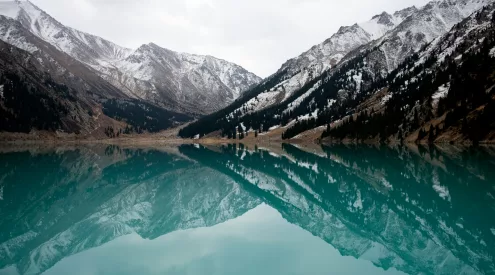
What kept me going was reminding myself of where I’d started, not as a lifelong athlete, like some of the other participants, but from being sedentary and declared legally blind. I’d chosen not to sit on the couch because of my eye condition. And I loved being out here despite the challenges. I wouldn’t see another soul for up to three days. People who experience solitude talk about reflection and making life decisions. I focused more on the unbelievable scenery: Giant granite peaks, snow and fir trees standing sentinel over glacial rivers in the Flathead Valley, Canada, where I imagined grizzly bears fishing for salmon.

Chris Smith filmed his Tour Divide journey (Blindguyonabike) to keep his friends and family up to date, as a memento for his son Jack, and to raise awareness for blindness research. He’s raised more than $30 000 for Foundation Fighting Blindness, the leading funder of research that will lead to the prevention, treatment and cure of eye diseases. Visit blindguybiking.org for more information on Chris and to support his fundraising efforts.
The final day was like a final exam: 123 miles (198 km) into a massive headwind in the Chihuahuan Desert’s flat nothingness, probably some of the most arduous riding I’d done on the Tour. I engaged my lowest gears, and eventually, the small community of Antelope Wells came into view. I’d been following a line on my GPS for 48 days, and I was at the end of it, a sign on the most remote border crossing on the US-Mexico border, which was hard to wrap my head around. Some local people will meet you there and transport you to El Paso for a fee, but my wife said, ‘Don’t bother because someone’s coming to surprise you.’ An old cycling friend of mine, Gabe, had flown to El Paso and rented a car to meet me at the end.
Article extracted from Getaway June 2025
Follow us on social media for more travel news, inspiration, and guides. You can also tag us to be featured.
TikTok | Instagram | Facebook | Twitter
ALSO READ: The beginner’s playbook for high-adrenaline experiences