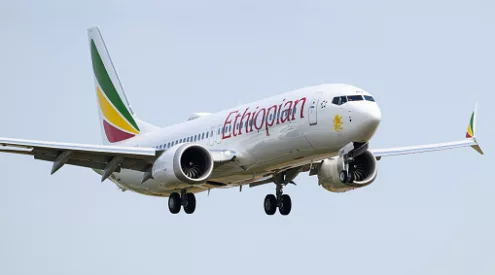







A quiet risk building in the background of global aviation
Air travel rarely stops because of one dramatic moment. More often, it slows down quietly, first through delays, then cancellations, and eventually grounded aircraft sitting idle on the tarmac.

Sourced: X{@SABCNews_Radio}
According to IOL, that possibility is now being discussed more seriously as the global aviation industry watches a growing jet fuel shortage threat linked to disrupted oil flows from the Gulf region.
If the situation continues, airlines across Europe and Asia could soon find themselves making difficult decisions about which flights can actually take off.
The Strait of Hormuz and a fragile global fuel chain
At the centre of the concern is the Strait of Hormuz, one of the world’s most critical energy corridors. Before the current geopolitical tensions escalated, roughly a fifth of global crude oil and liquefied natural gas passed through this narrow waterway.
But since late February, traffic through the route has been almost completely disrupted following military escalation involving Iran, the United States, and Israel.
That disruption has sent shockwaves through global supply chains—especially for jet fuel, which relies heavily on refined products from Gulf oil.
And while fuel has not run out, the pressure is building.
“Systemic” risk could hit within weeks
Energy analysts are now warning that the aviation sector may not have much time to adjust.
Rystad Energy economist Claudio Galimberti told CNBC that the situation could become “systemic” within three to four weeks, raising the possibility of serious cuts to flight operations in Europe as early as May or June.
His warning adds to growing concern that airlines simply do not have enough visibility to plan stable schedules.
Even if fuel is still physically available, the uncertainty alone is already forcing some airlines to rethink routes and capacity.
Conflicting signals from regulators and industry
Despite the warnings, European regulators have tried to calm fears.
A European Commission spokesperson stated that there is currently no evidence of fuel shortages in the European Union, although they acknowledged that supply issues could emerge in the near future, particularly for jet fuel.
This contrast has created a familiar tension in global crises: governments pointing to stability in the present, while industry experts warn of rapid deterioration ahead.
The International Energy Agency (IEA) has also flagged potential pressure on fuel stocks, warning that European reserves could drop to critical levels if replacement supply from the Middle East does not recover.
Not all regions are exposed equally
The risk is not evenly distributed, and that is part of what makes the situation so complex.
- Asia is considered the most vulnerable due to heavy reliance on Gulf oil imports
- Europe faces a more mixed picture depending on country and storage levels
- Japan has stronger reserves despite import dependence
- Within Europe, countries like Austria, Bulgaria and Poland are relatively well positioned
- Others, including the UK, Iceland and the Netherlands, have lower buffer capacity
This uneven exposure means the impact would not be uniform. Some airports and airlines could continue operating relatively normally, while others may be forced into partial cancellations or schedule reductions.
Airlines may be forced into “partial grounding” scenarios
Industry experts are already warning that the likely outcome is not a complete shutdown—but something more fragmented.
Economist Rico Luman of ING Bank noted that smaller, inland airports would be hit first, while major hubs would likely remain operational longer due to priority access to fuel.
The more realistic scenario, according to multiple analysts, is not a total halt—but a patchwork of cancellations across airlines and routes.
In other words, passengers may still fly, but not necessarily on the flights they booked.
Industry pressure is building behind the scenes
Airlines across Europe are increasingly vocal about the lack of clear data on fuel availability.
Aviation group Airlines for Europe (A4E), which includes major carriers such as Air France-KLM, Lufthansa, and Ryanair, has urged the European Union to provide real-time information on jet fuel stocks at airports.
However, fuel suppliers have resisted, citing commercial sensitivity.
That leaves airlines trying to plan schedules with incomplete information, a difficult position in an industry where timing and coordination are everything.
A warning from the oil industry itself
Perhaps the most striking concern comes from within the energy sector.
TotalEnergies has warned that if Gulf oil supplies remain blocked for an extended period, it may no longer be able to meet all customer demand.
Company CEO Patrick Pouyanné also noted that a prolonged blockade of more than three months could trigger serious supply problems, particularly for jet fuel.
It is a rare moment where oil producers and airlines are essentially pointing to the same risk: the system may not hold if disruption continues.
Could planes actually be grounded?
At this stage, there is no immediate fuel shortage causing widespread flight grounding. But the concern is no longer theoretical.
If supply routes remain blocked and reserves tighten further, airlines could be forced into:
- Reduced flight frequencies
- Selective route cancellations
- Longer layovers and rerouting
- Prioritising high-demand international hubs over smaller airports
For passengers, that could feel like sudden instability—even if the system technically remains operational.
A system running close to its limits
Air travel depends on precision. Fuel supply is one of its most invisible but essential foundations. When that foundation becomes uncertain, everything above it starts to shift.
Right now, the global aviation network is still flying—but with increasing caution, tighter margins, and growing concern behind the scenes.
Whether the coming weeks bring stabilisation or sharper disruption will depend heavily on how quickly fuel supply routes through the Gulf can recover.
Until then, the industry is watching closely and quietly preparing for a scenario it hopes it won’t have to fully confront.