






The Cape Floral Kingdom is the smallest of the world’s six floral kingdoms, yet it is one of the most diverse, writes Miriam Kimvangu.

Image used for illustrative images/Montseng Ntabejane/Unsplash
With thousands of endemic plant species, many found nowhere else on Earth, it is a biodiversity hotspot that thrives in nutrient-poor soils and a Mediterranean climate. Autumn is an excellent time to explore it. The cooler temperatures make hiking more comfortable, and post-summer conditions often sharpen the colours and textures of the landscape.
Table Mountain National Park

Table Mountain National Park/Dietmar Rabich/Wikimedia Commons
Start with the iconic. Table Mountain’s slopes are a living lab of fynbos diversity. In autumn, the hiking trails feel less crowded and the reduced wind makes routes like Platteklip Gorge or Skeleton Gorge more approachable. Keep an eye out for proteas, ericas and restios, the three defining plant groups of fynbos. You might notice that many plants look tough and wiry. This is no accident. Fynbos species are adapted to survive fire, drought and poor soils. Some seeds even require fire to germinate, a reminder that what looks harsh is often essential to renewal.
Kogelberg Biosphere Reserve

Often described as the heart of the Cape Floral Kingdom, this UNESCO-listed biosphere reserve boasts an astonishing concentration of plant species. Autumn here feels expansive. The air is crisp, the ocean nearby adds a salty edge and the mountains seem to fold endlessly into one another. Trails vary from gentle walks to more demanding hikes, but all offer close encounters with fynbos in its most pristine form. This is where you begin to appreciate scale, not just of the landscape but of biodiversity itself.
Jonkershoek Nature Reserve

Jonkershoek Nature Reserve/JonRichfield/Wikimedia Commons
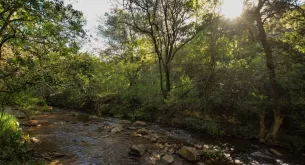
Just outside Stellenbosch, Jonkershoek offers a different perspective. Here, fynbos shares space with dramatic mountain scenery and seasonal rivers. Autumn often brings clearer skies and a golden light that makes the valley glow. The reserve is popular with trail runners and mountain bikers, but it also caters to slower exploration. Walking routes reveal how fynbos transitions across altitude and aspect. South-facing slopes may feel cooler and more sheltered, while north-facing areas show the tougher side of plant adaptation.
Cape Point Nature Reserve

Cape Point Nature Reserve/Joshua Kettle/Unsplash
At the southern tip of the peninsula, Cape Point delivers fynbos with a side of drama. Cliffs drop into the ocean, waves crash below, and the wind still has plenty to say, even in autumn. This reserve is home to a rich mix of plant life, as well as wildlife like eland and baboons. The walking trails are varied, from lighthouse climbs to coastal routes. What stands out in autumn is the clarity. With fewer summer visitors and softer light, the landscape feels both vast and intimate at the same time.
Elgin Valley

Gouldingken/Wikimedia Commons
Elgin is often associated with apples and cool-climate wines, but its surrounding landscapes are firmly rooted in fynbos. Autumn is harvest season, which means the valley hums with activity and it is also a great time to explore nearby trails and nature reserves. The combination of cultivated land and wild vegetation creates an interesting contrast. It is a reminder that conservation and agriculture often coexist in this region, sometimes uneasily, but often with thoughtful balance.
Silvermine Nature Reserve

Bernard DUPONT/Wikimedia Commons
Part of Table Mountain National Park, Silvermine is a local favourite for good reason. It is accessible, scenic, and packed with fynbos detail. Autumn mornings here can be especially beautiful, with still water in the reservoir reflecting the surrounding hills. Short walks make it ideal for a quick immersion into the Cape Floral Kingdom. You do not need to summit a peak or complete a long hike to appreciate what is here. Sometimes, the smallest details, a single flowering erica or the texture of restio reeds in the breeze, are enough.
A final note for curious explorers
If you walk through fynbos expecting towering trees or dense forests, you might initially feel underwhelmed. That is normal. But give it time. Look closer. Notice how each plant is adapted to survive in a challenging environment. Consider how many of these species exist nowhere else on Earth.
Follow us on social media for more travel news, inspiration, and guides. You can also tag us to be featured.
TikTok | Instagram | Facebook | Twitter
ALSO READ:
Travel into the heart of rewilding with these 5 destinations






,_Table_Mountain,_Crassula_coccinea_--_2024_--_2838.jpg)


_(52887816133).jpg)