



Middle East flight chaos leaves travellers stranded as Sharjah, Amman and Cairo face rolling cancellations

Posted on 17 April 2026 By Zaghrah Anthony
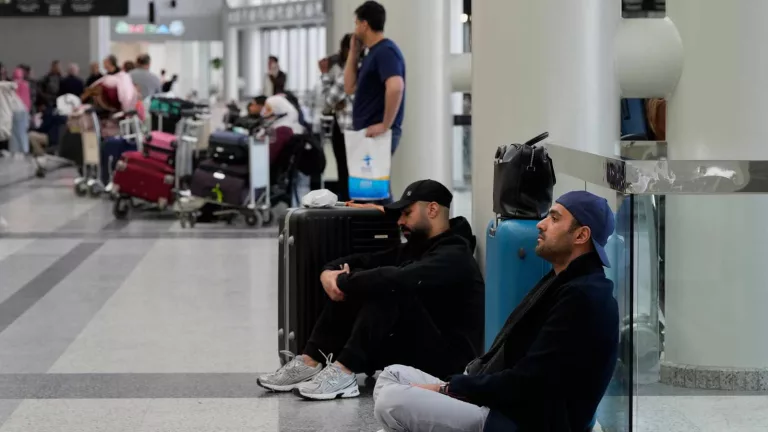
A week of travel plans unravel across the Middle East

For thousands of passengers moving through the Middle East this week, airport boards have told a frustrating story: delayed departures, cancelled flights, and very few clear answers.

Sourced: X{@pranabbaruah261}

According to The Traveler, a wave of airspace restrictions and regional tensions has triggered 19 flight cancellations and at least 62 delays, hitting major hubs in Sharjah, Amman, and Cairo. The disruption has affected major carriers including Air Arabia, Royal Jordanian, EgyptAir, and parts of the Lufthansa network.

What should have been smooth connections across some of the region’s busiest travel corridors has turned into a patchwork of last-minute changes and stranded passengers.

Sharjah, Amman and Cairo emerge as disruption hotspots

The latest disruption is not evenly spread, it is concentrated in three key aviation hubs that normally act as lifelines between continents.

At Sharjah International Airport, Air Arabia has been operating a reduced and unpredictable schedule. Flights have been suspended or rerouted as aircraft avoid high-risk airspace corridors, particularly on routes linking the UAE with North Africa, South Asia, and the Levant.

In Jordan, Queen Alia International Airport continues to function, but with key regional routes still suspended or delayed. Flights connecting Jordan with parts of the Gulf remain heavily restricted, forcing airlines to rely on longer and less efficient routings.

Meanwhile, Cairo International Airport is experiencing knock-on delays after EgyptAir scaled back or suspended multiple regional services during earlier phases of the crisis. While operations have partially resumed, reduced frequency means fewer alternatives for stranded passengers.

A ripple effect from shifting airspace restrictions

At the heart of the disruption is a wider regional aviation challenge: ongoing airspace restrictions introduced across parts of the Middle East since late February.

These measures — linked to escalating security concerns in the region — have forced airlines to reroute flights, extend journey times, or cancel services entirely.

Even when airports remain fully operational, aircraft often cannot follow normal paths. That creates a domino effect: one rerouted flight delays the next rotation, and a single cancellation can ripple across entire daily schedules.

Airlines stretched by unstable schedules

The impact is especially visible for airlines built around tight, high-frequency networks.

Air Arabia’s Sharjah-based operations depend on quick turnaround times and dense short-haul routes. When flights are rerouted or delayed for hours, that entire system slows down, forcing cancellations further down the schedule.

Royal Jordanian faces a similar challenge. It has kept Amman open as a functioning hub, but several routes to Gulf destinations remain suspended or inconsistently operated. The airline has repeatedly urged passengers to check flight status before travelling, reflecting how quickly conditions can change.

Even Lufthansa operations into the region have been affected, with extended suspensions and adjustments limiting connectivity into key Middle Eastern hubs. These changes don’t just affect Europe–Middle East travel — they also reduce onward connections across Asia and Africa.

Passengers caught in the middle of uncertainty

For travellers, the numbers — 19 cancellations and 62 delays — translate into something far more personal: missed weddings, extended layovers, and sudden overnight stays in unfamiliar cities.

Reports from airports and travel assistance services describe crowded terminals, long queues at help desks, and passengers scrambling for alternative routes after discovering cancellations only upon arrival.

Some airlines have managed to reroute passengers through hubs in Turkey, Saudi Arabia, or North Africa, but these detours often come with longer travel times and unexpected hotel costs.

On social media, frustration is building, especially among frequent regional travellers who rely on predictable short-haul connections. Many describe the experience as “guesswork travel,” where confirmation today doesn’t guarantee departure tomorrow.

Why the disruption is spreading beyond the region

The impact isn’t limited to the Middle East.

Because Sharjah, Amman, and Cairo sit on major transit corridors, delays there are now affecting passengers flying between Europe, Asia, and Africa. When aircraft are repositioned or schedules consolidated, even long-haul travellers far from the region can miss connections.

This has created a fragile network effect: fewer flights, fuller planes, and less flexibility to absorb disruption when it occurs.

What travellers are being advised

Travel authorities and airlines are urging passengers to adapt to a more cautious approach when flying through affected hubs.

Key advice includes:

  • Checking flight status repeatedly before heading to the airport
  • Allowing extra time between connections
  • Considering alternative routing options where possible
  • Reviewing refund and rebooking policies carefully

Many airlines are offering flexible changes on affected tickets, but conditions vary depending on fare type and carrier.

A region where schedules can shift overnight

Aviation analysts expect continued instability as long as airspace restrictions remain in place. While some routes may stabilise temporarily, sudden changes are still likely depending on security developments.

For now, the situation across Sharjah, Amman, and Cairo highlights a new reality in regional travel: even the most routine flight can be reshaped overnight.

And for passengers trying to navigate it all, certainty has become the hardest ticket to book.

Source: The Traveler

Follow us on social media for more travel news, inspiration, and guides. You can also tag us to be featured.

TikTok | Instagram Facebook Twitter

ALSO READ: 


yoast-primary - 1004431
tcat - Travel news
tcat_slug - travel-news
tcat2 - Travel news
tcat2_slug - travel-news
tcat_final -