




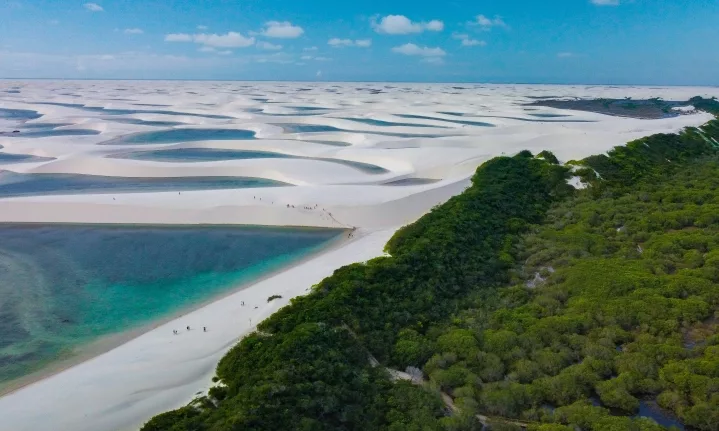
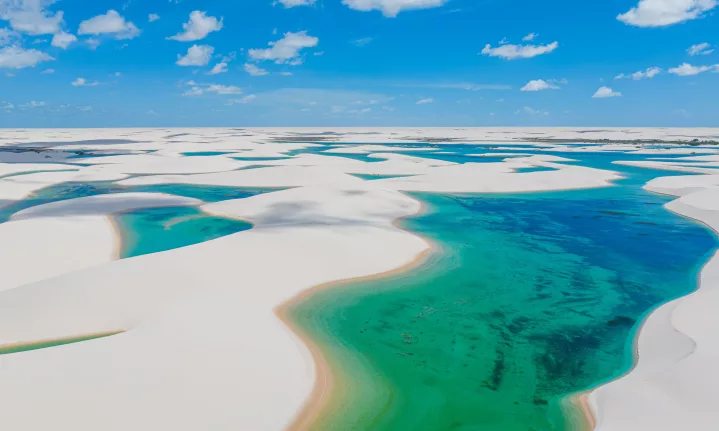
At first glance, Lençóis Maranhenses looks like a desert that has somehow found its way to Brazil’s Atlantic coast. Endless white dunes stretch towards the horizon, broken only by brilliant blue and green lagoons.
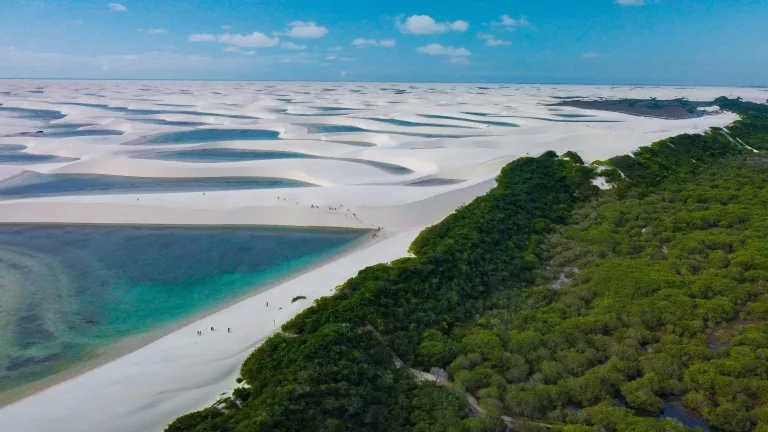
Parque Nacional dos Lençóis Maranhenses, Barreirinhas, Brasil / Léo Castro / Unsplash
But there is something rather ironic about this landscape, it isn’t a desert at all.
Located in Maranhão in northeastern Brazil, Lençóis Maranhenses is a vast coastal landscape shaped by wind, rain, sand and the Atlantic Ocean. During the rainy season, freshwater gathers between the dunes, transforming the seemingly barren landscape into something that feels almost otherworldly.
For a few months of the year, the desert fills with water.
Where the lagoons come from
The name Lençóis Maranhenses roughly translates to “bedsheets”, a fitting description for the sweeping dunes that ripple across the landscape.
The national park covers more than 156,000 hectares, with around 90,000 hectares of dunes. Some rise to around 30 metres, while the dune fields stretch for tens of kilometres along the coast. Yet calling it a desert is misleading.
The region has a distinct rainy season, and the heavy rainfall collects in the depressions between the dunes. As the water table rises beneath the sand, hundreds of temporary freshwater lagoons begin to form. The result is extraordinary. White sand rolls in every direction, and between it sit pools of clear water in shades of blue and green.
It feels almost too perfect to be natural. But it is.
A landscape that refuses to stay still
The dunes themselves are constantly moving. Wind carries sand inland from the coast, shaping it into the sweeping crescent-shaped dunes that define the park. Some dunes can migrate more than 20 metres a year, slowly changing the landscape around them.
The lagoons are just as temporary. They are primarily filled by rainfall and groundwater rather than rivers, and as the dry season arrives, evaporation causes many of them to shrink and disappear. Then the rains return, and the cycle begins again.
That is perhaps the most fascinating thing about Lençóis Maranhenses. The landscape you see today may not look quite the same next year.
The dunes move. The water comes and goes. Nature quietly redesigns the scene.
Far from lifeless
From a distance, the park appears almost empty. But beneath the endless stretches of sand is a surprisingly diverse ecosystem.
Lençóis Maranhenses sits where the Cerrado, Caatinga and Amazon biomes meet, creating a mix of dunes, freshwater environments, mangroves, rivers and coastal habitats. Even the temporary lagoons support life, while plants growing among the dunes have adapted to an environment where both water and sand are constantly shifting.
It may look like a place where nothing could survive but it is quite the opposite.
Experiencing Lençóis Maranhenses
Barreirinhas, Santo Amaro and Atins are among the main gateways into the park.
From Barreirinhas, visitors can reach some of the best-known lagoon areas, while Santo Amaro offers access to other parts of the dunes. Atins, once a small fishing village, sits near the mouth of the Preguiças River and has become another popular base for exploring the landscape.
For those wanting something more immersive, the multi-day Travessia dos Lençóis crosses the park between Atins and Santo Amaro. It’s a different way of seeing the landscape. Rather than simply arriving, taking a photograph and moving on, you walk through the dunes, swim in the lagoons and spend nights within the park, with local communities providing accommodation along the route.
For a place this vast, slowing down feels like the right way to experience it.
When the desert turns blue
The landscape changes dramatically throughout the year.
The lagoons are generally at their fullest after the rainy season, with May to September often offering some of the best conditions for seeing them filled with water. Exact conditions vary according to rainfall each year. By the later dry season, some lagoons may have receded or disappeared completely. And somehow, that makes the landscape even more fascinating.
What you see in a photograph is only one moment in the life of Lençóis Maranhenses.
A landscape worth protecting
Declared a national park in 1981, Lençóis Maranhenses was added to the UNESCO World Heritage List in 2024 for its exceptional natural beauty and geological significance.
The park is carefully managed, with visitor access and vehicle use regulated to protect its fragile dune and lagoon ecosystems.
It’s easy to understand why. This is not a landscape that was created to remain still. It’s shaped by rain and wind, continuously shifting beneath your feet and changing with the seasons.
Where the impossible feels natural
There is something wonderfully strange about Lençóis Maranhenses. A landscape that looks dry is brought to life by rain. Dunes that appear permanent are constantly moving. Freshwater lagoons appear between the sand, stay for a while, and eventually disappear.
Nothing here is quite as fixed as it first seems. And perhaps that’s what makes this corner of Brazil so captivating. It’s an extraordinary reminder that nature doesn’t always follow the rules we expect it to.
Follow us on social media for more travel news, inspiration, and guides. You can also tag us to be featured.
Instagram | Facebook | Twitter | Spotify
ALSO READ: