
There is something deeply unsettling about watching a river disappear. You follow the Brule River through the forest, expecting the usual soundtrack of rushing water, and then suddenly the river splits in two. One half crashes over a 15-metre waterfall. The other pours into a dark hole in the rock and seems to vanish completely.
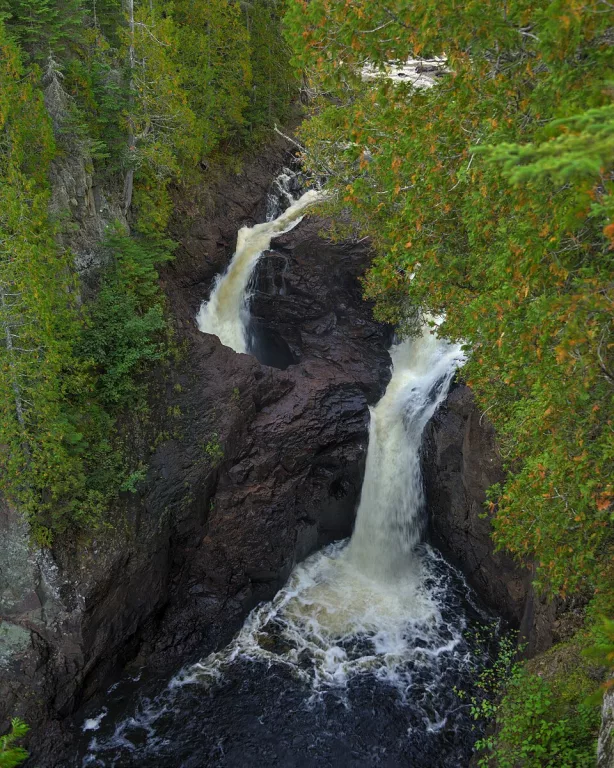
The Devil’s Kettle, an odd formation at a waterfall on the Brule River a little ways above Lake Superior / August Schwerdfeger / Wikimedia Commons
It’s the sort of thing that makes you stop, stare and wonder where on earth the water is going. This is the Devil’s Kettle, one of Minnesota’s strangest natural attractions, and for years nobody had a convincing answer.
Where does the river go?
The Devil’s Kettle sits inside Judge C.R. Magney State Park on Minnesota’s North Shore, about 23 kilometres northeast of Grand Marais. The park is an easy addition to a North Shore road trip, although reaching the waterfall takes a little effort. The trail follows the Brule River through forest before descending roughly 175 stairs towards the falls. The Devil’s Kettle Trail is about 1.6 kilometres one way, and the Minnesota Department of Natural Resources recommends allowing 1½ to 2 hours for the hike.
Then the river splits. The rock here is ancient rhyolite, part of a volcanic flow complex created around 1.1 billion years ago. One half of the Brule continues downstream. The other plunges into a massive pothole. From the overlook, it looks almost impossible.
It’s easy to understand why the Devil’s Kettle became a local legend. For years, people wondered whether the water disappeared into some vast underground passage, perhaps eventually reaching Lake Superior. Objects were also thrown into the kettle in the hope that they would resurface downstream. They did not, then scientists stopped looking for the missing water and simply measured it.
The disappearing act explained
In 2016, Minnesota DNR (Department of Natural Resources) hydrologists measured the amount of water flowing above the falls and compared it with the amount downstream.
The difference was remarkably small. About 123 cubic feet of water per second was measured above the falls, compared with roughly 121 cubic feet per second downstream. Within the margin of error, the figures matched. So, no, half the Brule River had not vanished. The water pouring into the Devil’s Kettle was finding its way back into the river downstream.
The objects that disappear into the pothole are a little easier to explain. The plunge pool creates powerful, turbulent currents that can pull objects underwater and keep them circulating rather than sending them neatly downstream. The DNR considered using fluorescent dye to trace the water’s exact route, but the test was never completed. The flow measurements had already established the important part: the water was returning to the Brule.
The mystery, at least in the grand sense, was solved.
Why it is worth the detour
Knowing the answer does not make the Devil’s Kettle any less fascinating. If you’re exploring Minnesota’s North Shore, the waterfall makes an atmospheric stop along Highway 61, with Grand Marais nearby. The park also connects with the Superior Hiking Trail, so it can easily become part of a longer hiking day rather than a single waterfall visit.
There is more to explore within the park, too. The Brule River runs through the landscape, while shorter trails offer a chance to spend more time among the birch, spruce and cedar forest. For those who want to stay longer, the park has 27 drive-in campsites and a seasonal campground.
The practical bit is worth knowing before you go. The Devil’s Kettle trail is rocky and uneven, with a long, steep staircase, so proper walking shoes are a good idea. Vehicle permits are required at the park, and the DNR recommends allowing enough time for the return climb rather than treating it as a quick viewpoint stop.
And there’s definitely something satisfying about having to work a little for the view. You walk through the trees with the Brule rushing beside you, descend deeper into the forest and eventually hear the falls before you see them.
Still worth seeing
Standing above the Devil’s Kettle, the science does not quite prepare you for the sight. One half of the river continues on its way. The other disappears into the rock, swallowed by a dark pool that still looks like it should lead somewhere far more mysterious.
The river may not actually be disappearing, but the landscape has a way of making you question what you are seeing. And perhaps that is the real magic of the Devil’s Kettle. You arrive expecting a mystery and leave with something better: a reminder that nature can be completely explainable and still feel wonderfully strange.
Sometimes, that is reason enough to take the detour.
Follow us on social media for more travel news, inspiration, and guides. You can also tag us to be featured.
Instagram | Facebook | Twitter | Spotify
ALSO READ: