





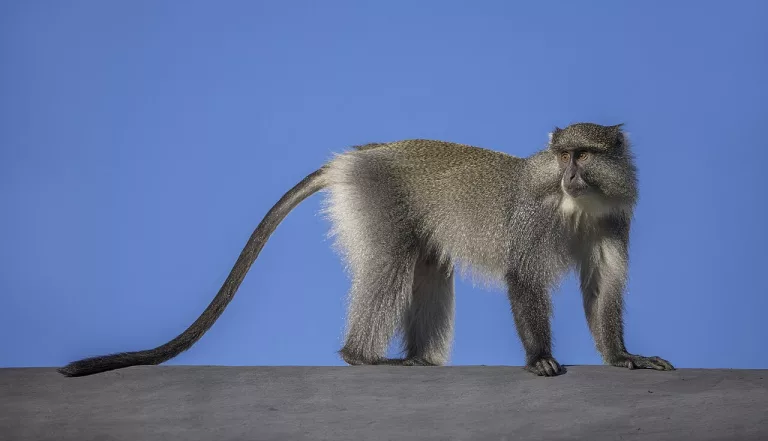
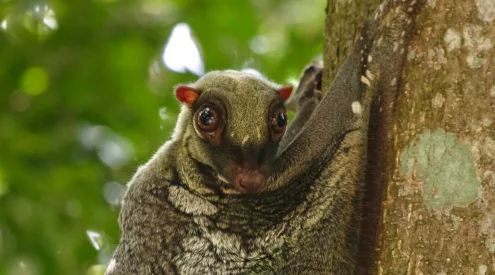
High in the canopy of South Africa’s indigenous forests, a samango monkey moves through a world most of us barely notice.
Charles J. Sharp/Wikimedia Commons
Leaves, branches and vines form a network of feeding sites, shelter and pathways. From the forest floor, it may look like a continuous wall of green. From above, however, the gaps matter.
A road. A cleared field. A plantation. A growing town. For an animal that spends much of its life in the treetops, these interruptions can transform a once-connected forest into a collection of isolated islands. The samango monkey offers a fascinating way to understand one of the biggest challenges facing forests today: habitat fragmentation.
Life in the canopy
Samango monkeys are South Africa’s forest-dwelling primates, occurring in fragmented patches of indigenous forest from the Eastern Cape through KwaZulu-Natal and into Mpumalanga. They are highly arboreal, spending much of their time above the ground and feeding on fruit and various plant material.
Their lives are closely tied to the structure and diversity of the forest. For a samango, a forest is a three-dimensional landscape. Branches provide routes between feeding and sleeping areas, while the vegetation offers food and shelter. A forest can still look lush from the ground while becoming increasingly isolated from other patches of suitable habitat. When large areas of indigenous vegetation are divided into smaller fragments, animals can find themselves living in ecological islands.
When forests become islands
Habitat fragmentation happens when a large, continuous area of habitat is divided into smaller pieces. Roads, agriculture, commercial forestry, urban development and other changes to the landscape can all contribute. A small forest patch may still contain plenty of trees, but it may be separated from another patch by a road or open land. For a species that depends on continuous vegetation, crossing that gap can be difficult or impossible.
Fragmentation can also increase what ecologists call edge effects. Conditions at the boundary of a forest can differ from those deeper inside it, with changes in light, temperature, vegetation and exposure. Over time, isolated populations can face additional challenges. If animals cannot move between forest patches, opportunities for dispersal and genetic exchange may become more limited.
The samango therefore provides a very visible example of a much larger ecological question: ‘How do we keep wildlife populations connected in landscapes that are increasingly shared with people?’
Building bridges between forests
The answer does not always mean creating enormous new reserves. Conservationists can also focus on connectivity by protecting existing vegetation, restoring degraded areas and maintaining corridors between important habitat patches. Indigenous vegetation along rivers and other natural features can sometimes contribute to these connections.
The idea is simple: instead of treating every forest patch as an isolated green island, conservation planning can consider how those patches function together as part of a larger landscape. This matters beyond samango monkeys. Many plants and animals depend on connected habitats to move, find food, reproduce and respond to environmental changes. Protecting corridors can therefore benefit an entire ecological community.
Sharing the landscape
South Africa’s conservation challenges cannot always be solved by keeping people and wildlife apart. People need homes, roads, farms, forestry and other infrastructure. Towns expand, industries operate and landscapes change. The challenge is finding ways to plan these activities while maintaining the ecological connections that wildlife needs.
For an arboreal monkey, a line drawn across a map can have a very different meaning on the ground. A road through forest may represent a significant break in its habitat. A plantation may provide vegetation while offering a very different ecological environment from indigenous forest. A town can gradually surround a forest patch until what was once part of a larger ecosystem becomes increasingly isolated. This is why conservation increasingly considers the wider landscape rather than focusing only on protected areas.
Look up
The health of a forest is not always obvious. A green canopy can conceal fragmentation, invasive plants, declining connectivity or changes in the composition of the vegetation. Ecologists therefore look at much more than whether trees are present. They consider the diversity and structure of the forest, regeneration, habitat quality and whether wildlife can move between suitable areas.
The samango monkey gives these complicated ideas a face.
Next time you walk through an indigenous forest in South Africa, look up. There may be a samango moving quietly through the branches above you, navigating a landscape of leaves, fruit and tangled canopy.
Its world offers a reminder that forests are living networks, and keeping those networks connected could help ensure that the forest remains a home for far more than one remarkable little monkey.
Follow us on social media for more travel news, inspiration, and guides. You can also tag us to be featured.
Instagram | Facebook | Twitter | Spotify
ALSO READ:
Penguins, peaks and petals: Five wheelchair-friendly CPT adventures






_Mount_Sheba.jpg)