




An updated survey has revealed that Aldabra Atoll in Seychelles is home to an estimated 180,000 giant tortoises, making it the largest known population of free-roaming giant tortoises in the world.
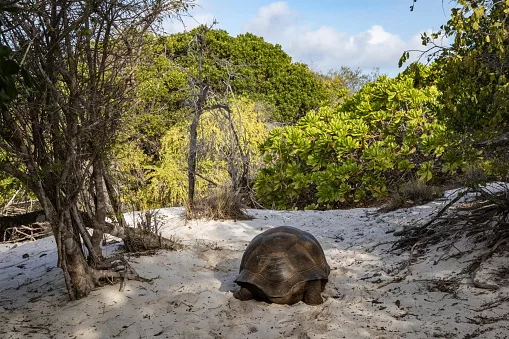
Aldabra giant tortoise (Aldabrachelys gigantea) walks along beach, Aldabra Atoll, Outer Seychelles, Seychelles/By: Holger Leue/Getty Images
According to The Guardian, researchers from the Seychelles Islands Foundation (SIF) and the University of Exeter analysed five years of population counts collected between 2018 and 2022. The findings, published in the journal Ecology and Evolution, provide the first major update to the widely cited estimate of 100,000 tortoises recorded in the late 1990s.
The latest survey puts the population at approximately 183,000 adult and sub-adult tortoises, confirming the success of decades of conservation efforts.
From endangered species to conservation success
Aldabra Atoll, a remote island group in the Indian Ocean, is one of only two places where giant tortoises occur naturally in the wild. The other is the Galápagos Islands.
The species faced severe pressure during the 19th century, when exploitation reduced the Aldabra giant tortoise population to fewer than 1,000 animals.
Conservation efforts helped turn the tide. Aldabra became a strict nature reserve in 1981 and was designated a UNESCO World Heritage Site in 1982.
Today, its thriving tortoise population is regarded as a major conservation achievement in the Indian Ocean.
Seychelles Islands Foundation chief executive Frauke Fleischer-Dogley said the growing population demonstrated what sustained conservation work could accomplish.
ALSO READ:
Counting thousands of tortoises in dense vegetation
Estimating the population was not straightforward. Aldabra’s dense vegetation makes it difficult for researchers to spot every tortoise during field surveys.
The team used population modelling to account for animals that were not observed directly, producing a more reliable estimate for future monitoring.
According to co-author Nancy Bunbury, the findings establish an important baseline that conservationists can use to track population changes over the coming decades.
Although the population remained relatively stable during the survey period, researchers say continued monitoring will be essential to protect the species.
Climate change and invasive species remain threats
Despite the encouraging numbers, Aldabra’s giant tortoises continue to face environmental pressures.
Climate change is expected to bring longer and more frequent droughts, potentially reducing the food and shade available to the animals. Rising sea levels also threaten the atoll’s low-lying areas.
Invasive mammals, including feral cats and black rats, pose an additional risk by preying on tortoise eggs and hatchlings.
Researchers say removing these invasive species could help strengthen the population’s resilience and support its continued recovery.
The new estimate is an important milestone, but conservationists stress that it is not the end of the work. Maintaining long-term monitoring and addressing emerging threats will be crucial to ensuring that Aldabra’s giant tortoises continue to thrive.
Follow us on social media for more travel news, inspiration, and guides. You can also tag us to be featured.
Instagram | Facebook | Twitter | Spotify
ALSO READ:
The Western Cape’s underwater forests: the strange world beneath the kelp