

The vast Sahara Desert holds a remarkable sight in northwestern Mauritania: a giant circle of rocky ridges that resembles an eye when viewed from space. Known as the Richat Structure, this extraordinary formation stretches roughly 40 kilometres across the desert, drawing attention to a landscape that looks almost unreal from above.
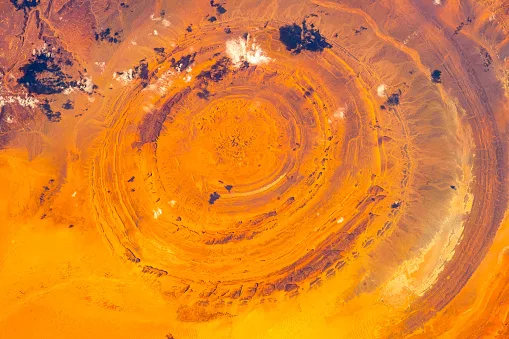
Digital enhancement of a NASA image/By: Roberto Machado Noa/Getty Images
On the ground, the scene shifts to rugged rock formations, sweeping desert views and layers of ancient stone. Once thought to be a possible meteorite impact site, the Eye of the Sahara has a different story to tell — one shaped by ancient geological activity and millions of years of erosion. For travellers fascinated by Earth’s natural wonders, it offers a glimpse into a landscape where science and scenery meet.
A giant eye in the desert
Where the Sahara forms a remarkable circle
The Richat Structure lies in Mauritania’s Adrar region, within the sedimentary basin of Taoudenni. Here, the desert is interrupted by a vast circular formation of exposed rock, its alternating ridges and depressions creating the appearance of an enormous target.
The structure’s concentric rings are not perfectly uniform. Some form prominent ridges, while others are lower and less distinct, and the central area contains depressions and unusual rock formations. Together, they create a pattern that is difficult to appreciate fully from ground level but immediately recognisable in satellite images.
The scale is part of what makes the formation so extraordinary. At roughly 40 kilometres in diameter, it is far larger than a landscape feature that a visitor could take in at a glance. Its circular pattern becomes much clearer from high above the Earth, where the surrounding desert provides a contrasting backdrop.
The nickname Eye of the Sahara captures this perspective particularly well. The rings suggest an iris, while the central depression gives the formation an apparent focal point. It is a visual resemblance rather than a literal eye, but one that has helped make the Richat Structure famous.
Why it stands out from space
The Eye’s distinctive appearance comes from the arrangement of its rock layers and the way they have weathered over geological time.
Harder sandstone and quartzitic sandstone resist erosion more effectively than the softer rocks between them. As surrounding material wears away, the more resistant layers remain as ridges. Viewed from above, these ridges form the concentric bands that define the structure.
Differences in colour, texture and elevation further emphasise the pattern. Against the broad, relatively uniform expanse of the Sahara, the rings become especially visible in satellite imagery.
The formation has been photographed from orbit by several Earth-observation missions, including NASA’s Landsat programme and astronauts aboard the International Space Station. These images do more than provide spectacular views: they help scientists study the structure’s shape, topography and relationship to the surrounding terrain.
The Eye is therefore not a single enormous crater or a circular hole in the desert. It is a complex geological formation whose layered architecture becomes visible because of the way the landscape has been exposed.
ALSO READ:
The science behind the Eye of the Sahara
Was it created by a meteorite?
For a time, the Richat Structure’s circular shape encouraged scientists to consider whether it might be an impact crater. Large meteorite impacts can produce circular geological features, and the Eye’s resemblance to a giant bull’s-eye made the idea an appealing possibility.
However, its appearance alone was not enough to establish an impact origin. Researchers needed to examine the rocks, the structure’s internal arrangement and the evidence of geological processes that might have produced it.
Subsequent research moved away from the meteorite hypothesis. The Richat Structure is now understood as an eroded geological dome associated with igneous activity — the movement and emplacement of magma within the Earth’s crust.
How ancient magma helped shape the rings
The formation’s history is more complicated than a simple account of a dome rising and wearing away.
A 2024 study published in the journal Lithos, titled How old is the Eye of Africa? A polyphase history for the igneous Richat Structure, Mauritania, examined the ages and composition of the structure’s igneous rocks.
The researchers identified evidence of two distinct magmatic episodes separated by approximately 100 million years. Their analysis suggests that gabbroic intrusions formed around 230 to 200 million years ago, although the precise ages remain uncertain. A later episode of alkaline magmatic activity occurred roughly 100 million years afterwards.
That later activity is thought to have contributed to the uplift of the surrounding rock layers, creating a broad dome approximately 40 kilometres across. As the uplifted structure was gradually eroded, different layers of rock were exposed, producing the circular ridges visible today.
This is a crucial part of the Eye’s story: the rings are not simply the outline of an ancient underground explosion. They reflect the structure of the rocks themselves and the unequal rates at which those rocks weather and erode.
The geological processes took place over immense stretches of time, long before humans could have witnessed them. What remains is a landscape that preserves clues to multiple episodes of activity deep within the Earth.
A landscape written in stone
The Richat Structure also illustrates how erosion can reveal features that were once hidden beneath the surface.
The rocks around the Eye include sedimentary layers dating from the late Proterozoic and early Palaeozoic eras, periods spanning hundreds of millions of years. These layers were affected by later igneous activity and uplift, before erosion exposed their present arrangement.
The harder sandstone and quartzitic sandstone form prominent ridges, while softer rocks have been worn down into lower areas. The result is a series of rings that follow the underlying geological structure.
In the centre, researchers have identified a breccia — a rock made up of broken fragments cemented together — alongside other distinctive geological materials. These features provide additional evidence of the complex processes involved in the structure’s development.
Discovering the Eye beyond the satellite image
What the landscape looks like on the ground
From orbit, the Richat Structure appears as a striking geometric pattern. On the ground, the experience is different. The enormous circle gives way to ridges, rocky slopes, depressions and stretches of desert, with the overall shape becoming much less obvious at human scale.
This difference between the aerial view and the ground-level landscape is part of what makes the formation so fascinating. A visitor standing among the rocks cannot simply look up and see the giant eye that appears so clearly in satellite photographs. The full pattern emerges through distance and perspective.
The wider Adrar region offers a dramatic desert environment, with rocky plateaus, sandstone formations and expansive views across the Sahara. The landscape also holds traces of human history, including prehistoric rock art, stone tools and evidence of former settlement in a region that has supported human activity for thousands of years.
These archaeological remains belong to the wider region and should not all be attributed directly to the Richat Structure itself. They nevertheless provide an important reminder that the Sahara is not simply an empty wilderness. Its landscapes have long been shaped by both natural processes and human movement.
Planning an expedition into Mauritania’s Sahara
The Eye of the Sahara is remote, and reaching it requires more preparation than visiting a well-developed tourist attraction. Travellers generally need to organise transport and local guidance, with journeys through the Adrar region often involving long stretches of desert terrain.
A visit is best approached as part of a broader exploration of Mauritania rather than as a quick stop. The surrounding region’s rocky landscapes and historic settlements offer opportunities to understand the setting in which the Richat Structure sits.
Anyone planning a trip should check current travel advisories, local security conditions, transport arrangements and seasonal weather before departure. A qualified local guide and a suitable desert vehicle are important considerations, particularly where routes are remote and services are limited.
It is also worth managing expectations. The famous circular formation is most dramatic in satellite imagery, aerial photography and other elevated views. Travelling there offers a chance to experience the geology and scale of the landscape, but it does not necessarily provide the same complete view of the rings seen from space.
For travellers drawn to geological wonders, however, that contrast can be part of the appeal: the opportunity to stand among rocks whose arrangement tells a story that only becomes fully legible from far above.
A reminder of Earth’s extraordinary history
The Eye of the Sahara is compelling because it seems to occupy the boundary between the familiar and the improbable. Its circular rings look almost deliberately designed, yet their appearance is the product of natural processes operating over geological time.
Research has replaced the idea of a meteorite crater with a more intricate explanation involving ancient igneous activity, uplift and erosion. New work continues to refine the chronology of those events, showing that even a landscape photographed from space for decades can still offer scientific questions worth investigating.
The Richat Structure also challenges the way we perceive the desert. From a distance, the Sahara can appear uniform and unchanging. The Eye reveals something very different: a landscape built from layers of deep time, shaped by forces that are difficult to imagine on a human scale.
Seen from orbit, it resembles an enormous eye watching over the desert. Seen through the lens of geology, it is a record of the Earth’s restless interior and the patient work of erosion.
Follow us on social media for more travel news, inspiration, and guides. You can also tag us to be featured.
Instagram | Facebook | Twitter | Spotify
ALSO READ:
The African landscapes that look nothing like the safari stereotype