



South Africa’s salt pans are known for their stark landscapes, where white salt crusts meet dry earth beneath enormous skies. But under the right conditions, some take on unexpected shades of pink, orange and red.
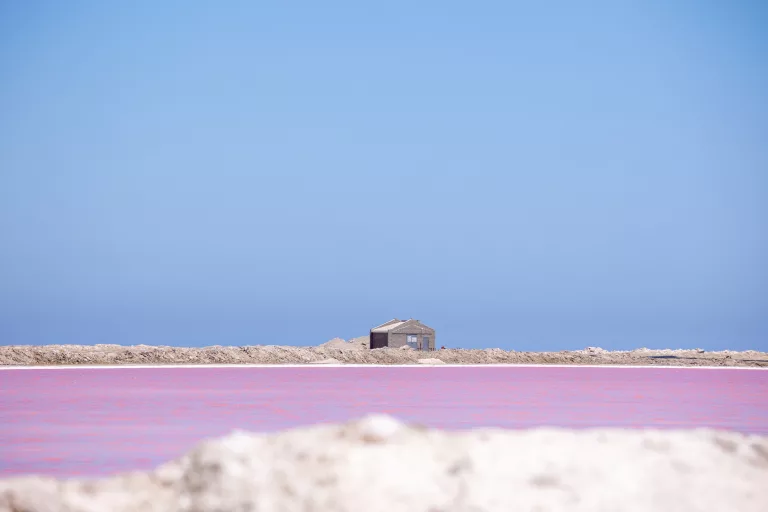
Jörg Hamel / Pexels / Illustrative purposes only
The colours look almost unreal, yet the science behind them is fascinating. From microscopic organisms that thrive in salty water to minerals left behind by evaporation, several factors can transform these seemingly barren landscapes.
The catch? The colours are not permanent, and not every salt pan turns pink. What you see depends on the water, the weather and the tiny organisms living within it.
The science behind the colours
Salt pans form in shallow depressions where water collects and eventually evaporates, leaving salts and minerals behind. In South Africa’s drier regions, some pans remain dry for much of the year, while others fill temporarily after rainfall.
When the salt concentration becomes high enough, certain microorganisms can flourish. Known as halophiles, these salt-loving organisms include bacteria and archaea that produce pigments, sometimes turning the water pink, orange or red.
Another contributor is Dunaliella salina, a microscopic alga that produces beta-carotene, the pigment that gives carrots their orange colour. Under highly saline conditions, it can accumulate large amounts of this pigment, adding to the warm hues seen in some salt lakes.
The result is a landscape coloured by life too small to see with the naked eye.
Why the colours change
Salinity, rainfall, sunlight and the organisms present all influence a salt pan’s appearance.
As water evaporates, salt concentrations rise, creating conditions that favour certain microorganisms. Different species produce different pigments, which helps explain why some pans appear pink while others take on deeper orange or red tones.
Rainfall can change the picture, too. A dry pan may fill with shallow water after rain, only to change again as the water evaporates. The balance of salts, minerals and microorganisms shifts with these conditions.
That is why a brightly coloured salt pan can look completely different a few months later. The colours are a natural response to changing conditions, not a permanent feature of the landscape.
Where to find salt pans in South Africa
You don’t have to travel overseas to explore these unusual landscapes. South Africa has salt pans across it’s drier interior, from the Free State to the Northern Cape and parts of the Western Cape.
Soutpan, Free State
North of Bloemfontein, Soutpan is a salt-mining town with a pan that has been studied for it’s salt-loving microorganisms. Research published in Molecules in 2017 documented the diversity of bacteria living in it’s highly saline water.
Pretoria Salt Pan, Gauteng
Around 40km northwest of Pretoria, this near-circular crater is a geological curiosity. Research has examined it’s unusual formation and long history, making it an interesting stop for anyone fascinated by South Africa’s landscapes.
Yzerfontein, Western Cape
About 80km north of Cape Town, this West Coast village has a history tied to nearby salt pans, where salt was once transported to the coast for shipment. It offers a coastal detour with a little local history along the way.
These locations are examples of South Africa’s salt-pan landscapes, not guaranteed spots to see bright pink water. Check access arrangements before visiting, and remember that the colours depend on conditions at the time.
A landscape shaped by life
What makes these pans remarkable is that their apparent emptiness can be deceptive. Beneath the surface, microorganisms are adapting to conditions that would be challenging for many other forms of life. Some produce pigments that change the colour of their surroundings, while others play a role in the chemistry of these saline environments.
The next time you come across a salt pan, look beyond the cracked earth and white crust. These landscapes are more than remnants of evaporated water. They are living environments, shaped by the constant interplay between weather, minerals and microscopic life.
And when the conditions are just right, that hidden activity can turn an otherwise ordinary stretch of earth into something extraordinary.
Follow us on social media for more travel news, inspiration, and guides. You can also tag us to be featured.
Instagram | Facebook | Twitter | Spotify
ALSO READ: