
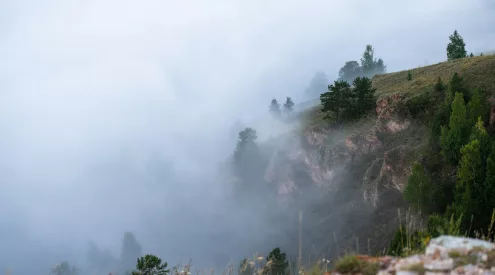
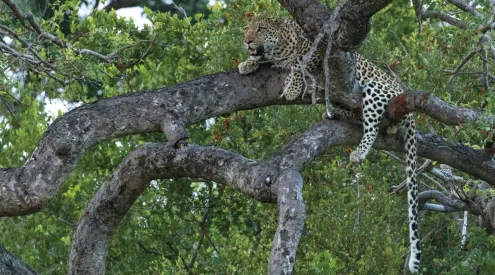
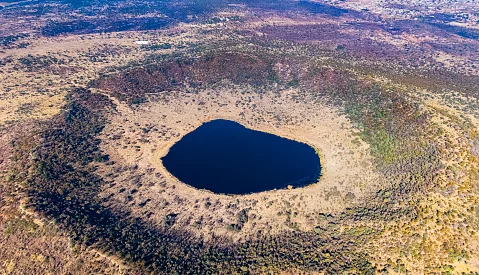
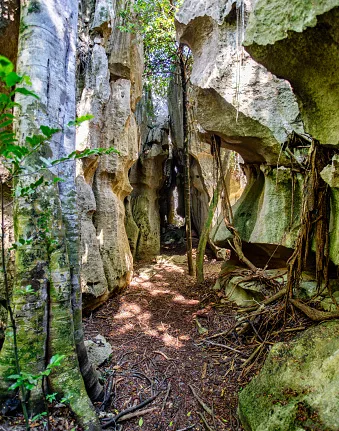
In western Madagascar, millions of years of erosion have created a surreal landscape of jagged limestone pinnacles, hidden canyons and extraordinary wildlife.
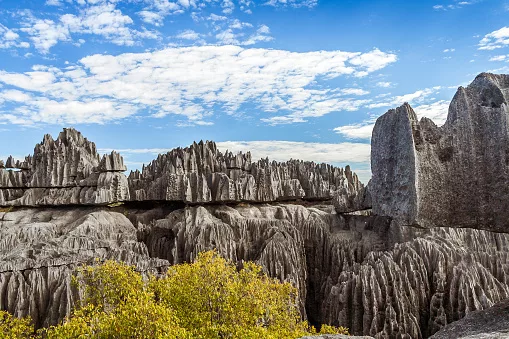
The great Tsingy de Bemaraha of Madagascar in the Tsingy de Bemaraha Integral Nature Reserve of UNESCO/By: pierivb/iStock
Thousands of sharp stone blades rise from the ground, forming a natural labyrinth unlike almost anywhere else on Earth. This is Tsingy de Bemaraha, a remarkable landscape where ancient limestone has been carved into towering pinnacles, narrow passages and deep fissures. Recognised for its geological beauty and biodiversity, it forms part of the Andrefana Dry Forests UNESCO World Heritage property.
How millions of years created a stone forest
Water is the architect
The secret behind Tsingy de Bemaraha lies in a geological process known as karstification. Slightly acidic rainwater gradually dissolves limestone along cracks and fractures. Over immense periods, these openings widen into channels, crevices, caves and deep fissures.
At Bemaraha, this process has created a spectacular limestone massif divided into narrow ridges and towering pinnacles. Some rise as high as 100 metres, resembling natural cathedrals.
Rather than forming through one dramatic event, the landscape developed through the cumulative effects of erosion and water moving through the rock. Rain gradually wore away exposed surfaces, leaving behind the intricate network of blades and ridges visible today.
A labyrinth of ridges, caves and canyons
The formations resemble an enormous field of grey needles. Up close, the landscape reveals narrow passages, overhanging rock, hidden cavities and abrupt drops. Patches of green vegetation contrast with the exposed limestone, creating a striking pattern of stone and forest.
The Manambolo River gorge adds another dimension to the terrain. Its steep walls and caves reveal how water has shaped the wider region, creating habitats that differ from the exposed rock above.
The result is more than a collection of unusual rock formations. It is a complex landscape where shade, moisture, elevation and access to water determine what can grow and which animals can survive.
The wildlife living among the blades
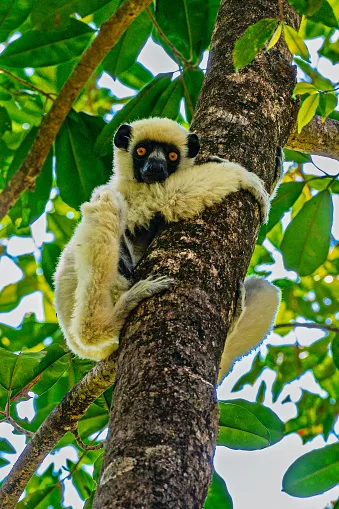
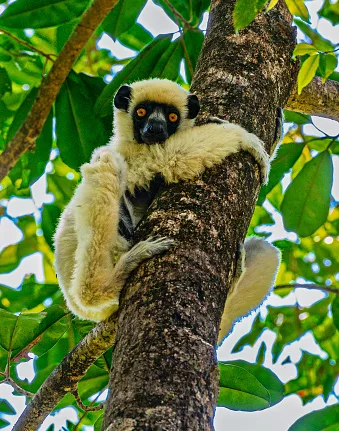
The critically endangered Decken’s Sifaka, in the harsh landscape of the Tsingy de Bemaraha National Park/By: SHANE P WHITE/iStock
A refuge for Madagascar’s unique species
At first glance, Tsingy de Bemaraha seems an unlikely place for wildlife. Yet the gaps between the stones conceal sheltered habitats, including forested gullies, caves and shaded crevices.
Among the animals associated with the protected area is Decken’s sifaka, a lemur found in western Madagascar. These agile primates move through the trees and across rocky terrain, using powerful hind legs to leap between branches and surfaces.
The park also supports distinctive reptiles, including the armoured ground chameleon (Brookesia perarmata) and Henkel’s leaf-tailed gecko (Uroplatus henkeli). Their unusual appearances help them blend into their surroundings.
Bird life adds another dimension to the ecosystem. Madagascar’s long geographical isolation has allowed many plants and animals to evolve along distinct evolutionary paths, making the protection of these habitats particularly important.
Life in the spaces between the stones
Plants adapted to dry conditions grow on exposed limestone, while sheltered areas support denser vegetation. Caves and low-lying channels can retain moisture, creating a contrast with the sunlit rock above.
These differences explain why the tsingy is a living ecosystem rather than a barren geological spectacle. Its biodiversity depends on the relationship between the limestone, surrounding dry forest and pockets of protection created by the terrain.
Madagascar’s endemic wildlife is vulnerable when habitats become fragmented or degraded. Protecting Bemaraha therefore means conserving the interconnected environments that sustain its species, not merely preserving its striking rock formations.
ALSO READ:
The African landscapes that look nothing like the safari stereotype
Exploring the tsingy on foot
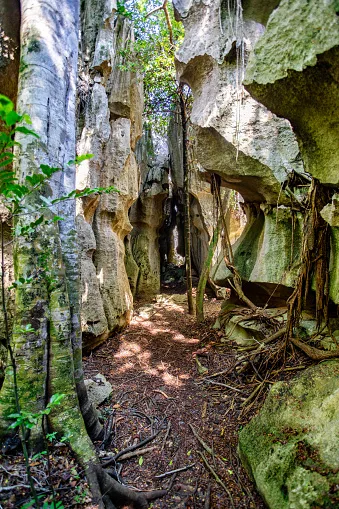
Narrow path between rocks in Petit Tsingy de Bemaraha, Strict Nature Reserve/By: Artush/iStock
An adventure through a natural maze
For visitors, Tsingy de Bemaraha offers more than a landscape to admire from a viewpoint. Guided routes lead through limestone corridors, across exposed rock and into canyons where towering stone formations rise in every direction.
Some demanding circuits include ladders, safety cables and suspension bridges connecting sections of the rocky maze. Other routes offer a less strenuous introduction, with opportunities to appreciate the geology and surrounding vegetation.
The experience requires concentration. Footing can be uneven, passages narrow and drops steep. What appears from above to be a continuous field of stone becomes a three-dimensional world of ridges, hollows and concealed openings.
Suitable footwear, a reasonable level of fitness and a knowledgeable local guide are important, particularly on routes involving exposed rock or heights.
The view from above
From a high lookout, hundreds of limestone blades create a dense pattern across the plateau, interrupted by green forest and deep shadows. The ridges appear to extend almost endlessly, their surfaces catching the light at different angles.
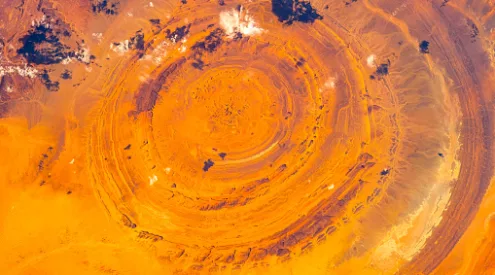
Satellite imagery helps scientists examine this unusual terrain, revealing patterns that can be difficult to recognise from the ground. Yet aerial views tell only part of the story. The visible pinnacles connect to a larger system of fractures, underground cavities and water pathways.
A landscape with cultural significance
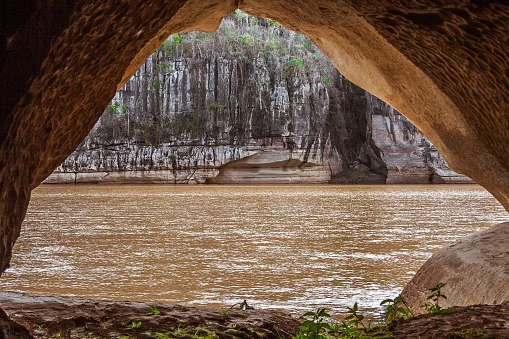
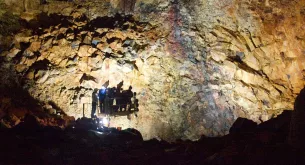
View from a cave in the Manambolo River/By: pierivb/iStock
More than a geological wonder
Tsingy de Bemaraha is not an empty wilderness. The wider Bemaraha massif contains places of cultural and historical importance to local communities, including the Sakalava and Vazimba peoples.
The Manambolo River gorge contains tombs associated with the Vazimba, reflecting the area’s significance beyond its natural scenery. These sites form part of a cultural landscape that visitors should approach with respect.
Local knowledge and customs are also important to the way the protected area is understood and managed. Conservation involves recognising cultural heritage, supporting surrounding communities and maintaining the ecological systems on which local livelihoods depend.
Responsible tourism can contribute when it respects local guidance, supports legitimate local services and follows protected-area rules.
Protecting Madagascar’s stone forest
The pressures facing a fragile ecosystem
Despite its dramatic appearance, Tsingy de Bemaraha is not immune to environmental pressures. Fire, forest clearing, illegal logging, hunting and invasive species threaten the wider ecosystem. Habitat degradation can affect animals that depend on particular forest conditions, even when the limestone formations remain intact.
These risks are particularly significant for species with restricted ranges. Changes to forest cover and vegetation can disrupt the microhabitats on which many of Madagascar’s unique animals depend.
Fire management, habitat protection, ecological restoration and community involvement all have roles to play in maintaining biodiversity. Conservation efforts must protect the surrounding forests as well as the stone formations themselves.
Why World Heritage protection matters
Tsingy de Bemaraha was inscribed on the UNESCO World Heritage List in 1990. In 2023, the listing was expanded and renamed Andrefana Dry Forests, incorporating additional protected areas in western and southern Madagascar.
The designation recognises the importance of conserving the region’s dry forests, limestone landscapes and endemic wildlife. It also places the tsingy within a broader ecological story shaped by Madagascar’s long isolation, changing climatic conditions and the evolution of species found nowhere else.
The sharp pinnacles may be the most recognisable feature, but their long-term protection depends on safeguarding surrounding habitats and the communities living alongside them.
Planning a visit to Tsingy de Bemaraha
Getting to this remote corner of Madagascar
The park’s remoteness is part of its appeal, but reaching it requires careful planning. Bekopaka is the principal southern gateway, and the overland journey from Morondava involves rough roads and river crossings. A four-wheel-drive vehicle is generally necessary.
The dry season, broadly from May to October, is generally the most practical period to visit. During the rainy months, roads can become difficult or impassable, and access may be disrupted.
Travellers should confirm current conditions, park access and route availability before departure.
Choosing the right walking circuit
Madagascar National Parks offers several circuits with different levels of difficulty, including shorter introductory walks and more demanding routes with suspension bridges and steep sections. The right choice depends on fitness, comfort with heights and available time.
Visitors should arrange a suitable guide, wear sturdy footwear, carry enough drinking water and follow instructions around exposed rock and narrow passages. Allowing time to appreciate the surrounding dry forest and wildlife makes the experience more rewarding.
A landscape shaped by time
Tsingy de Bemaraha shows how extraordinary landscapes can emerge through processes that unfold over geological time. Ancient marine deposits became limestone, which water exposed and gradually transformed into a maze of pinnacles, caves, and canyons.
What emerged is a place where geology and biology are inseparable. The sharp formations provide the setting for dry forests, sheltered vegetation and wildlife shaped by Madagascar’s remarkable evolutionary history.
For all its apparent hostility, the stone forest is full of life. Its significance lies not only in the spectacle of its razor-sharp peaks, but also in the delicate ecological relationships hidden between them.
Exploring Tsingy de Bemaraha is like entering a world where stone becomes architecture, erosion becomes art, and an apparently inhospitable landscape reveals an extraordinary capacity to sustain life.
Follow us on social media for more travel news, inspiration, and guides. You can also tag us to be featured.
Instagram | Facebook | Twitter | Spotify
ALSO READ:
The poisonous plants hiding in plain sight across Southern Africa