

Beneath the distinctive volcanic landscapes of Cappadocia in central Türkiye lies a remarkable settlement that takes the idea of living off the land to another level.
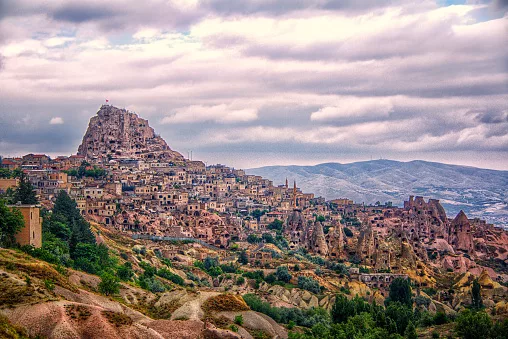
View of the Derinkuyu underground city/By: Zu Sanchez Photography/Getty Images
Derinkuyu Underground City descends deep into the earth, revealing a network of narrow tunnels, rock-cut rooms, storage chambers and ventilation shafts carved into the region’s soft volcanic rock.
A city carved into volcanic rock
How Cappadocia’s landscape made it possible
Cappadocia’s unusual terrain owes much to ancient volcanic activity. Eruptions from volcanoes in the surrounding region blanketed the landscape in ash, which eventually hardened into a relatively soft rock known as tuff. Over time, erosion shaped the region’s distinctive valleys, pillars and fairy chimneys, while the rock itself provided an accessible material for carving homes, churches and underground spaces.
For the communities who settled here, this geology offered an opportunity to build beyond the surface. Instead of constructing everything from stone or timber, people could excavate rooms directly into the rock, gradually creating interconnected spaces beneath their settlements.
Derinkuyu is among the largest and deepest underground complexes in Cappadocia. The Turkish Ministry of Culture and Tourism records a depth of approximately 85 metres, although only a portion of the extensive complex is accessible to visitors today.
The underground city forms part of a wider network of subterranean settlements across Cappadocia, where underground architecture became an important response to the region’s environmental conditions and periods of insecurity.
Life beneath the surface
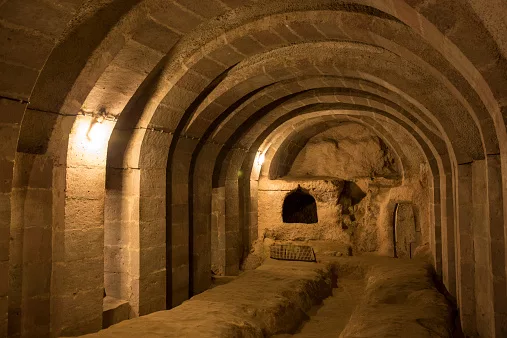
A chapel inside the The Underground City at Derinkuyu, Nevsehir, Cappadocia/By: David Clapp/Getty Images
More than a hiding place
Derinkuyu was not simply a maze of escape tunnels. Its chambers reveal the practical requirements of a community that needed to retreat underground for extended periods.
The excavated spaces include stables, cellars, food-storage rooms, kitchens, communal areas and religious spaces. A missionary school is among the features identified by Turkish museum authorities, while a church, baptismal area and other religious facilities reflect the importance of Christianity in the settlement’s history.
The arrangement of these spaces suggests that the underground city was developed to support everyday activities as well as emergencies. Animals could be brought into designated areas, food and supplies could be stored, and communal spaces allowed people to gather away from the exposed landscape above.
The design also reflects a practical understanding of movement. Stables and other functional spaces were positioned on upper levels, making it easier to bring animals underground. Kitchens and storage areas were similarly arranged to accommodate the transport of food and other necessities.
Although popular accounts sometimes describe Derinkuyu as a city where thousands of people could live underground for months, its precise capacity and the circumstances of its use remain difficult to establish. What is clear is that its scale and facilities made it considerably more sophisticated than a simple refuge.
ALSO READ:
Coober Pedy: The Australian town where people live underground
Engineering designed for survival
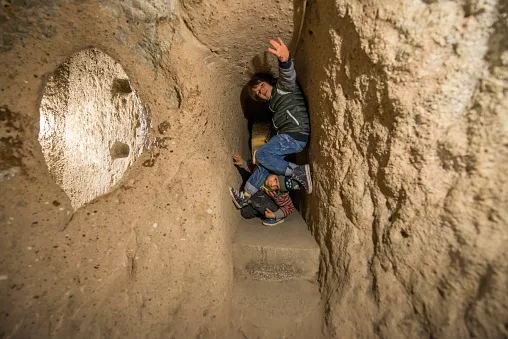
Little kids playing inside Underground City of Derinkuyu/By: Paul Biris/Getty Images
Ventilation and water underground
One of Derinkuyu’s most impressive features is its ventilation system. A major shaft extends towards the surface, helping circulate air through the underground levels. The system was essential in a complex where enclosed chambers and narrow passages could otherwise become difficult to occupy for long periods.
The principal ventilation shaft also served as a water well. Access to water would have been crucial for anyone sheltering underground, particularly when leaving the settlement was unsafe. Turkish museum information describes a shaft approximately 55 metres deep that connects with the surface and serves this dual purpose.
The wider network includes numerous passages and shafts, although the precise arrangement and number of ventilation openings vary across published accounts. Together, these features demonstrate how the settlement’s builders worked around the challenges of living below ground.
Stone doors and narrow passages
Security was another central consideration. Large, circular stone doors were positioned at strategic points along some of the passageways. These heavy barriers could be rolled into place from within, helping residents block access to sections of the settlement when danger threatened.
The tunnels themselves were often narrow, with some passages allowing only one person to move through at a time. While this layout can make the complex challenging to navigate today, it also helped restrict movement through its interior.
The combination of concealed entrances, winding corridors and defensible barriers created a network in which access could be controlled. Rather than relying on a single fortified wall, the underground city used its layout and the surrounding rock to provide protection.
The people who sought refuge underground
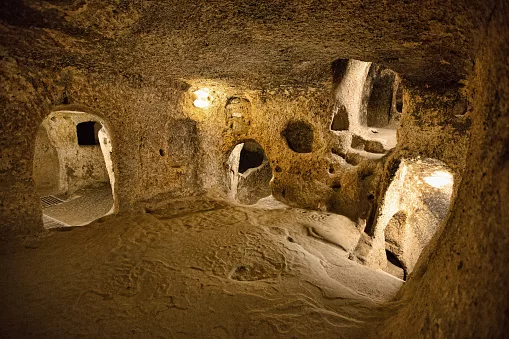
Derinkuyu cave city in Cappadocia/By: Pakhnyushchyy/iStock
A history shaped by successive communities
The exact origins of Derinkuyu remain uncertain. Some accounts trace the earliest phases of Cappadocia’s underground settlements to antiquity, while later communities expanded and adapted them over many centuries. It is therefore more accurate to understand Derinkuyu as a place shaped by successive generations than as a city built in a single period.
Christian communities played an important role in the region’s underground history. UNESCO notes that Cappadocia’s rock-cut settlements and subterranean towns, including Derinkuyu and nearby Kaymaklı, served as places of refuge during periods of Arab incursions into Byzantine territory.
These underground spaces offered protection from raids and other threats, allowing residents to retreat with supplies and, where necessary, livestock. Their use was not necessarily continuous: people could enter the underground complex when circumstances demanded it and return to surface settlements when it was safer to do so.
The settlement’s religious spaces provide further evidence of the communities who used and adapted it. Yet the history is more complex than a single story of persecution or a single group of builders. Derinkuyu’s development reflects the changing needs of people living in a region that experienced successive political, cultural and religious shifts.
Rediscovered beneath a modern home
From hidden rooms to a major attraction
For centuries, parts of Cappadocia’s underground world remained out of sight. Derinkuyu was brought to modern attention in 1963, when a local resident reportedly uncovered a hidden room while renovating a house. Further investigation revealed that the chamber connected to a much larger underground network.
The discovery helped draw attention to the scale of the subterranean settlement and the extent of its surviving architecture. The site was subsequently excavated and opened to visitors during the 1960s.
Today, only a fraction of Derinkuyu is accessible to the public. According to Turkish museum authorities, approximately 10% of the underground city has been opened for visitors, giving a glimpse of a complex that extends far beyond the areas explored on a typical tour.
Its rediscovery also highlights how much of Cappadocia’s history is preserved beneath the modern landscape. The region’s archaeological heritage is not limited to the structures visible from its valleys and roads; it also lies within the rock itself.
Exploring Derinkuyu today
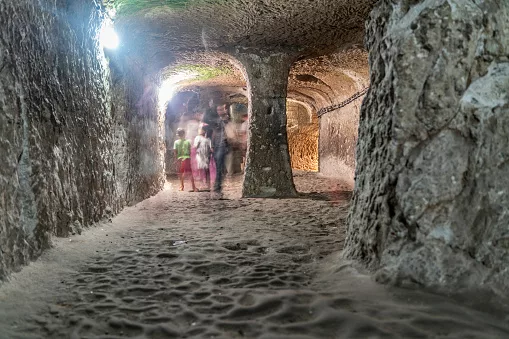
Tourists Walking Through Ancient Tunnels of Derinkuyu/By: CihatDeniz/
iStock
What visitors can expect
Visiting Derinkuyu offers a very different experience from exploring Cappadocia’s open valleys and hilltop viewpoints. The route leads through dimly lit chambers, sloping passages and stairways that descend into the rock. Along the way, visitors can see evidence of the settlement’s organisation, including its narrow corridors, storage spaces and distinctive stone barriers.
The atmosphere is part of the experience. The temperature, restricted light and close confines create a sharp contrast with the bright, open landscapes above ground. Looking along a passage or down a shaft also offers a sense of the labour involved in carving and maintaining such a vast network by hand.
The experience is not suitable for everyone. Some tunnels are narrow and steep, and visitors who are uncomfortable in enclosed spaces or have limited mobility may find parts of the route challenging. Those who do visit should follow marked routes and any instructions from site staff.
Derinkuyu is located in Nevşehir province, approximately 30 kilometres from the city of Nevşehir. It can be combined with visits to other Cappadocian attractions, including the region’s rock-cut churches, cave settlements and distinctive volcanic landscapes.
An extraordinary legacy beneath Cappadocia
Derinkuyu offers a reminder that some of the most remarkable feats of architecture are not designed to dominate a landscape, but to disappear into it. Its interconnected chambers, ventilation shafts and defensive passages reveal how communities transformed soft volcanic rock into a place capable of providing shelter, storing supplies and supporting daily life.
The underground city is also a reminder of the uncertainty surrounding much of the past. Its precise origins, full extent and patterns of occupation continue to invite investigation, while the surviving spaces offer tangible evidence of the ingenuity required to live beneath the surface.
For travellers exploring Cappadocia, Derinkuyu adds another dimension to a region celebrated for its extraordinary scenery. Beyond the fairy chimneys and cave-carved hillsides lies a hidden world shaped by geology, ingenuity and the enduring human need for safety.
Follow us on social media for more travel news, inspiration, and guides. You can also tag us to be featured.
Instagram | Facebook | Twitter | Spotify
ALSO READ: