



Off the coast of Mozambique, the Bazaruto Archipelago is often associated with powder-white beaches, turquoise water and idyllic island escapes. But beneath its postcard-perfect surface lies an extraordinary marine wilderness, where coral reefs, seagrass meadows and mangrove forests support some of the Indian Ocean’s most remarkable wildlife.
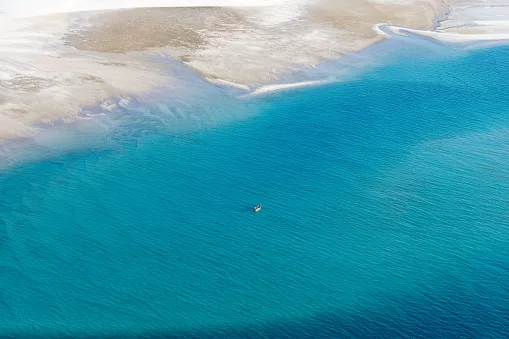
Aerial images of Mozambique Coastline, Bazaruto and Benguerra Islands/By: Ignacio Palacios/Getty Images
Stretching across a protected landscape in southern Mozambique, this collection of islands is home to dugongs, dolphins, sea turtles, manta rays and an incredible diversity of marine life. Its underwater ecosystems are not only important for biodiversity but also help sustain coastal communities whose livelihoods are closely connected to the ocean.
While tourism has helped put Bazaruto on the map, the archipelago’s greatest significance may lie beneath the waves. Protecting these waters means safeguarding a complex network of habitats that supports wildlife, fisheries and the ecological health of Mozambique’s coastline.
A protected archipelago off Mozambique’s coast
Located off the coast of Inhambane Province, near the mainland towns of Vilankulo and Inhassoro, the Bazaruto Archipelago consists of five islands: Bazaruto, Benguerra, Magaruque, Santa Carolina and Bangue.
The islands form part of the Bazaruto Archipelago National Park, established in 1971 to protect the area’s exceptional marine and terrestrial biodiversity. The protected landscape encompasses coral reefs, seagrass beds, mangroves, coastal dunes, sandbanks and surrounding ocean habitats.
These environments are closely connected, creating a network of ecosystems that supports marine species at different stages of their lives. Fish use seagrass beds and mangroves as nursery grounds, coral reefs provide shelter and feeding areas, while sandy beaches offer important nesting sites for sea turtles.
The archipelago’s location along the Mozambique Channel also makes it an important part of the wider Western Indian Ocean ecosystem. Its waters support resident marine wildlife as well as migratory species that travel along the East African coastline.
Although its islands and beaches attract visitors from around the world, Bazaruto’s protected status reflects something much bigger than its tourism appeal: the need to conserve one of the region’s most valuable marine environments.
The underwater meadows keeping dugongs alive
Among Bazaruto’s most important natural assets are its extensive seagrass meadows. Growing in shallow coastal waters, these underwater grasslands provide food and shelter for numerous marine species and play an essential role in maintaining the health of the archipelago.
They are particularly important for one of the region’s most vulnerable marine mammals: the dugong.
Sometimes called sea cows, dugongs are herbivorous marine mammals that feed almost exclusively on seagrass. They spend much of their time grazing along the seabed, making healthy seagrass meadows essential to their survival.
Bazaruto is recognised as an important stronghold for dugongs in the Western Indian Ocean and is home to one of the region’s last significant viable populations. Their presence is also an indication of the ecological value of the surrounding waters, as dugongs depend on relatively healthy and accessible seagrass habitats.
The importance of these meadows extends well beyond dugongs. They provide nursery and feeding grounds for fish, crustaceans and other marine organisms, supporting food webs that eventually benefit larger predators and coastal fisheries.
Seagrass also helps stabilise sediments, reduce coastal erosion and capture and store carbon in the seabed. This makes the underwater grasslands important not only for marine biodiversity but also for climate resilience.
Protecting Bazaruto’s dugongs therefore involves protecting an entire ecosystem. Damage to seagrass beds through destructive fishing practices, coastal development or other human activities can have consequences that extend throughout the marine environment.
ALSO READ:
Coral reefs and a remarkable diversity of marine life
Beyond the seagrass meadows, Bazaruto’s coral reefs form another essential part of its marine environment. These underwater structures provide shelter, feeding grounds and breeding habitats for an extraordinary range of species.
The archipelago sits in an interesting position along the East African coastline, with its reefs forming an important, relatively isolated link between the more limited reef systems of southern Mozambique and South Africa and the extensive coral reefs further north.
Its marine biodiversity is impressive. More than 2,000 fish species and 500 marine and coastal mollusc species have been recorded in the archipelago’s wider marine environment. Its waters also support nine marine mammal species, including dolphins and whales, while manta rays, whale sharks and other large marine animals move through this productive stretch of the Indian Ocean.
The reefs are particularly important for maintaining this diversity. Their complex structures offer protection to smaller fish and invertebrates, while supporting larger predators that depend on healthy marine food webs.
For divers and snorkellers, these ecosystems offer an opportunity to experience a remarkable underwater world. However, their importance extends far beyond recreational activities. Healthy reefs help sustain fisheries, support marine biodiversity and contribute to the resilience of coastal ecosystems.
A network of habitats supporting marine wildlife
Bazaruto’s marine biodiversity is not confined to its reefs and seagrass beds. Mangroves, coastal lagoons, sandy beaches and offshore waters all contribute to an interconnected system that supports wildlife throughout its life cycle.
Mangroves provide shelter for juvenile fish and crustaceans, while helping to stabilise coastlines and protect them from erosion. Coastal lagoons and shallow-water habitats offer feeding grounds for numerous species, and the archipelago’s beaches are important nesting sites for marine turtles.
In fact, Bazaruto is particularly significant for sea turtle conservation. It is the only known location in the Western Indian Ocean where all five regionally resident turtle species nest: leatherback, loggerhead, green, olive ridley and hawksbill turtles.
The surrounding waters also form part of important migratory routes. Humpback whales travel through the region, while whale sharks and manta rays move through its productive offshore waters. Dolphins are another familiar presence, adding to the diversity of marine mammals found around the islands.
These movements connect Bazaruto to a much larger marine environment. Protecting the archipelago therefore contributes to conservation efforts that extend beyond the boundaries of the national park and into the wider Mozambique Channel.
The communities whose lives depend on the ocean
While Bazaruto’s marine ecosystems support remarkable wildlife, they are equally important to the people who live alongside them.
Three of the archipelago’s five islands are inhabited, with approximately 7,000 people living within the protected landscape. For many families, fishing and other marine resources remain important sources of food and income.
This creates a close relationship between conservation and community livelihoods. Healthy fish populations and productive coastal habitats help sustain local fisheries, while the protection of marine resources is essential to maintaining these opportunities for future generations.
The challenge is ensuring that conservation measures do not overlook the needs of the people who depend on the ocean. Restrictions on fishing, for example, need to be accompanied by engagement with local communities and opportunities to develop more sustainable sources of income.
Management of the national park is shared by Mozambique’s National Administration of Conservation Areas (ANAC) and conservation organisation African Parks, which entered a long-term management partnership in 2017.
Their work includes supporting conservation employment, environmental education, sustainable enterprise development and community initiatives. According to African Parks, 20% of the park’s annual tourism revenue is directed towards projects benefiting local people.
One example is the Basisa Programme, which employs residents to transform waste collected during coastal clean-ups into durable construction materials. Conservation agriculture initiatives also provide technical support to community members seeking to improve farming practices.
These programmes demonstrate how protecting a marine environment can create opportunities beyond tourism, while recognising that local communities are important partners in safeguarding the archipelago.
Protecting a fragile marine wilderness
Despite its protected status, Bazaruto faces ongoing environmental pressures. Illegal and unsustainable fishing practices, accidental entanglement of marine animals in fishing nets, unregulated tourism and damage to sensitive habitats all pose challenges.
Dugongs are particularly vulnerable because they can become entangled in fishing gear and depend on healthy seagrass beds for food. Sea turtles also face threats from fishing activities and disturbance at nesting sites.
To address these pressures, park management has strengthened marine patrols, wildlife monitoring and collaboration with local authorities. African Parks reports that more than 80 rangers conduct approximately 10,000 patrols each year, helping to reduce illegal activities and improve protection across the park.
Scientific research is another important part of this work. In 2024, African Parks, the Mozambican government and James Cook University launched a satellite-tagging initiative to better understand dugong movements and identify areas requiring additional protection. The project involved tagging 11 dugongs with transmitters, providing valuable insights into how these animals use the wider seascape.
The information helps conservationists identify important feeding areas, understand movements between habitats and make better-informed decisions about protecting the species.
New research is revealing more about Bazaruto’s ocean
Understanding a marine ecosystem as complex as Bazaruto requires more than occasional wildlife surveys. Long-term scientific monitoring is essential for identifying environmental changes, understanding biodiversity and measuring the effectiveness of conservation efforts.
An important development in this area is the Bazaruto Center for Scientific Studies (BCSS) Ocean Observatory, which provides a long-term monitoring platform for the archipelago and surrounding waters.
Established in 2017, the observatory brings together information from coral reefs, seagrass meadows, mangroves, lagoons, offshore habitats and the open ocean. Its monitoring network includes 14 fixed stations and has generated more than 22 million environmental measurements, alongside biodiversity records and underwater sound recordings.
In October 2026, a research paper published in Frontiers in Marine Science documented the observatory’s work, describing it as Africa’s first long-term, multi-ecosystem ocean observatory.
The research highlights how continuous monitoring can help scientists understand changes in ocean conditions, marine biodiversity and pollution across interconnected habitats. It also provides valuable information for conservation planning, climate research and the sustainable management of marine resources.
By building a longer-term scientific picture of the archipelago, the observatory is helping to address an important gap in marine research across the Western Indian Ocean.
Why protecting Bazaruto matters
Bazaruto’s appeal may begin with its beaches, but its importance extends far beyond the shoreline. Its seagrass meadows sustain dugongs, its coral reefs support extraordinary marine diversity, and its mangroves and coastal habitats provide shelter for species that depend on healthy ecosystems.
Just as importantly, the archipelago demonstrates how marine conservation and community livelihoods are closely connected. Protecting its waters means preserving resources that support local families, sustain fisheries and create opportunities through responsible tourism.
As environmental pressures and climate change continue to affect marine ecosystems around the world, places such as Bazaruto offer an important reminder of what is at stake.
Its future will depend on maintaining the delicate relationships between wildlife, habitats and the people who call these islands home. The real treasure of the Bazaruto Archipelago is not only what visitors see from its beaches, but the extraordinary marine wilderness that lies beneath the waves.
Follow us on social media for more travel news, inspiration, and guides. You can also tag us to be featured.
Instagram | Facebook | Twitter | Spotify
ALSO READ:
The N9 road trip: Four mountain passes, rooftop dragons and a fossil treasure trove