






Namibia is often associated with vast dunes, desert-adapted wildlife, and long stretches of empty road. But in the Erongo region, the landscape takes on a different character.
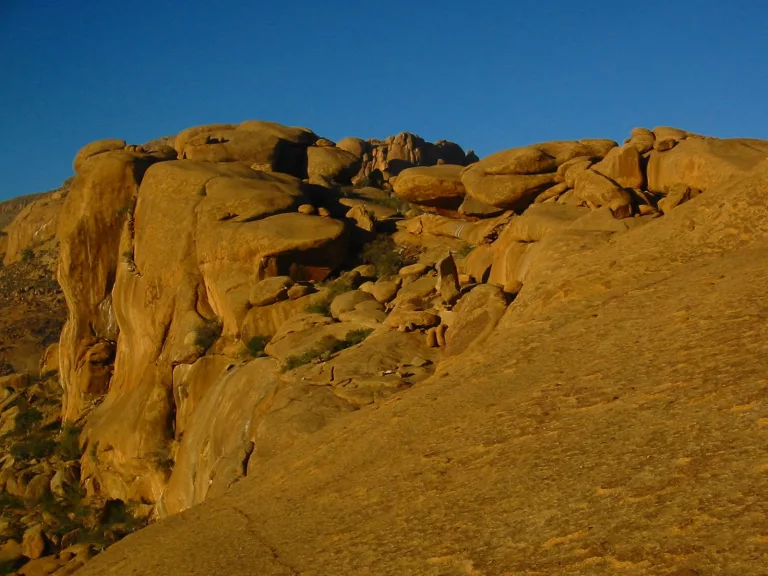
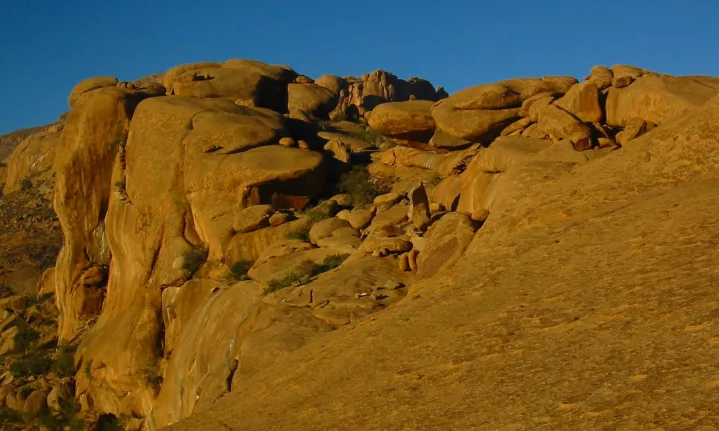
Erongo Region, Namibia/mroszewski/Wikimedia Commons
Here, enormous granite formations rise from dry valleys, ancient San rock art is tucked into caves and overhangs, and wildlife moves through a landscape shaped by an ancient volcanic complex. The Erongo Mountain Nature Sanctuary now protects 180 000 hectares of this mountain wilderness, with conservation areas connected across what is largely a fence-free landscape.
The region is also well suited to a short road trip. In 72 hours, you can combine the small town of Omaruru with guided walks, rock-art sites, wildlife viewing and nights beneath dramatic granite formations before finishing at Spitzkoppe.
This is not a traditional safari itinerary. Instead, it is a journey into one of Namibia’s most fascinating landscapes, where geology, archaeology, wildlife and living culture overlap.
Day 1: Omaruru and the Erongo Mountains
View this post on Instagram
Start in Omaruru
Use Omaruru as your gateway into the Erongo Mountains. The town is a useful place to stock up before heading into the more remote mountain landscape, where distances between attractions and accommodation can be considerable.
From Omaruru, the road begins to trade town scenery for open bushveld and granite outcrops. The further you travel towards the mountains, the more dramatic the landscape becomes.
The Erongo Mountains are the remains of an ancient volcanic complex, with weathered granite boulders and unusual rock formations dominating the scenery. At Ai Aiba Rock Painting Lodge, for example, these formations are estimated to be about 130 million years old.
Check into a lodge among the boulders
Make your first night about the landscape itself.
One option is Ai Aiba – The Rock Painting Lodge, dramatically positioned among granite boulders in the foothills of the Erongo range. Its accommodation, hiking opportunities, nature drives, and rock-art experiences make it particularly well-suited to a first introduction to the region.
Other accommodation options within the Erongo Mountain Nature Sanctuary include Ameib Guesthouse and Camping, Erongo Rocks, Omandumba Guest Farm, Ombu Guest and Hunting Farm, Omukutu Nature Farm and Black Rock Campsite.
Spend the afternoon looking for wildlife
Don’t expect the landscape to be empty just because it is dry.
The Erongo Mountains support a surprising range of mammals, including Hartmann’s mountain zebra, kudu, oryx, springbok, klipspringer, steenbok, aardwolf, brown hyena, leopard, cheetah, and the near-endemic black mongoose. More than 200 bird species have also been recorded in and around the mountains.
A guided nature drive is a good way to start. At Ai Aiba, wildlife viewing can be combined with rock-art stops, making the experience feel less like a conventional game drive and more like an exploration of the entire ecosystem.
End with a granite sunset
As the afternoon heat fades, head out for a walk or a sundowner.
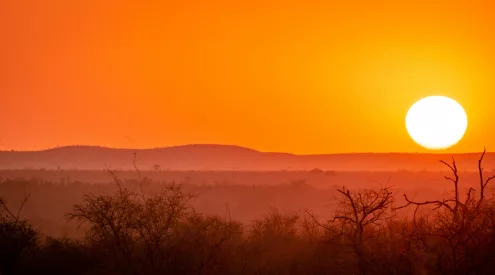
The Erongo landscape is particularly striking late in the day, when shadows stretch across the boulders, and the mountains become silhouettes against the sky. Guided morning and sundowner walks are among the activities available at Ai Aiba.
Spend the night in the mountains and let the silence become part of the experience.
Day 2: Follow the trail of ancient rock art
Start with a guided rock-art walk
Make archaeology the focus of your second morning.
The Erongo Mountains contain extensive collections of ancient paintings and engravings, with some sites estimated to be thousands of years old. Ai Aiba alone has more than 200 documented San rock-art sites, with guided drives taking visitors to selected examples.
Rather than simply treating the paintings as photographic stops, take a guided tour. Interpretation helps explain what you are seeing and places the artwork within the wider landscape.
At Ai Aiba, a dedicated rock-art and nature drive takes around three hours and combines selected painting sites with the surrounding mountain scenery.
Meet the San community at Omandumba
Continue to Omandumba for a different perspective on the history of the Erongo Mountains.
The Living Museum of the San was established on Omandumba in 2008 and is run by the San. Visitors can learn about traditional hunter-gatherer culture through activities including bush walks, traditional hunting demonstrations, craft-making, dancing and explanations of medicinal plants.
The experience also connects directly to the surrounding landscape. Omandumba is home to rock paintings and archaeological evidence associated with San communities who lived and hunted in the region in the past.
It is worth allowing several hours rather than rushing through the visit. The cultural experience gives context to the rock art you have already encountered and makes the mountains feel less like an untouched wilderness and more like a lived-in landscape with a long human history.
Take the afternoon slowly
After a morning of walking and exploring, resist the urge to pack in another major attraction.
The Erongo region rewards slow travel. Have lunch, rest at your accommodation or take a shorter guided walk. Omandumba offers activities including walks, rock-art excursions and sundowners, while Ai Aiba has guided walks and mountain activities.
This is also a good opportunity to look for some of the smaller details of the landscape: lizards warming themselves on rocks, birds moving between thorn trees and tiny plants surviving in the cracks between granite boulders.
Sleep under the Erongo sky
For the second night, choose an accommodation option that keeps you close to the landscape.
If you prefer comfort, a lodge such as Ai Aiba offers private chalets set against the granite formations. If you are travelling independently, the sanctuary also has camping and farm accommodation options.
Keep the evening simple. Dinner, a drink, a blanket and a sky filled with stars are enough.
ALSO READ:
Inside ‘Lion’: The new National Geographic series following a Maasai Mara cub
Day 3: Drive towards Spitzkoppe
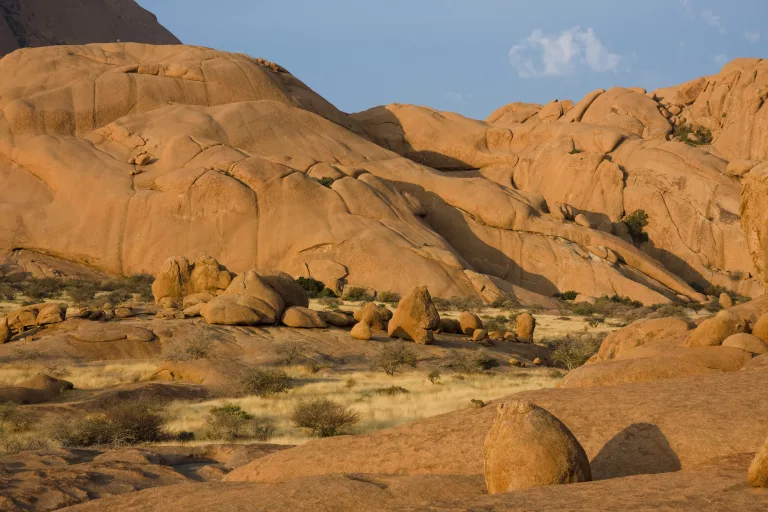
The campsite at the foot of Spitzkoppe/Ikiwaner/Wikimedia Commons
Make an early start
On your final morning, head towards Spitzkoppe.
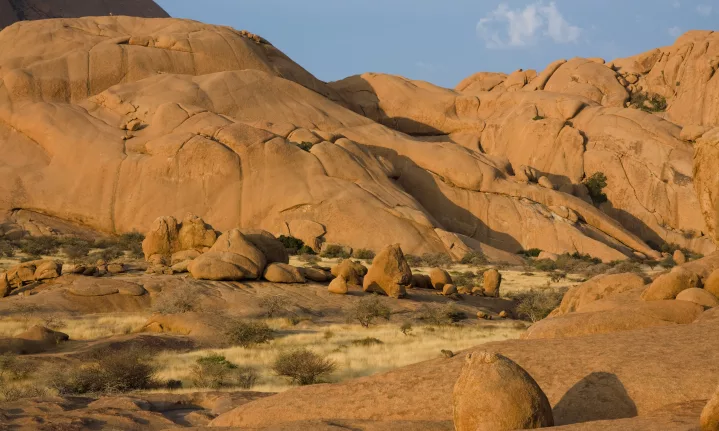
The landscape changes again as the distinctive granite peaks of Spitzkoppe emerge from the surrounding plains. The journey is part of the attraction: Namibia’s roads make the transition between landscapes feel almost cinematic.
Aim to arrive with enough time to explore rather than simply stop for a photograph.
Explore Spitzkoppe’s granite formations
Spitzkoppe is one of Namibia’s most recognisable geological landmarks, but there is more to the area than its dramatic silhouette.
Ancient rock art, unusual rock formations, hiking routes and desert scenery make it an ideal final chapter to an Erongo road trip. Guided activities around Spitzkoppe can include visits to rock-art sites, the rock arch and other geological features, while more active travellers can tackle guided mountain hikes.
Start early if you want to walk, particularly during warmer months. Carry plenty of water, wear suitable shoes and avoid treating the rocky terrain as a quick roadside attraction.
Stay for sunset
View this post on Instagram
Give yourself time to simply watch the landscape change.
As the sun drops, the granite formations become increasingly dramatic, making Spitzkoppe one of the best places on this itinerary to end the trip.
For an overnight stay, Spitzkoppen Lodge offers 15 private chalets, each with its own bathroom and outdoor viewing deck.
If you can extend the trip by one night, do it. Watching the stars emerge over the granite peaks is a fitting finale to three days spent travelling through one of Namibia’s most atmospheric regions.
What makes the Erongo region worth the detour?
It combines several sides of Namibia in one trip
The appeal of Erongo is the variety.
You have ancient geology, desert wildlife, San rock art, contemporary cultural experiences, hiking, and distinctive accommodation without needing to cover enormous distances between completely different parts of the country.
The Erongo Mountain Nature Sanctuary’s conservation model is another reason to visit. The sanctuary brings together privately owned properties into a large conservation landscape, with fences removed in many areas so wildlife can move more freely.
It is about more than ticking off attractions
A three-day Erongo trip works best when you resist the temptation to see everything.
Spend time looking at the mountains. Walk rather than drive when conditions allow. Take a guided rock-art tour. Listen to the stories connected to the landscape. Watch for wildlife between the granite boulders.
The reward is a slower, more layered experience of Namibia, one where the desert is not merely something you drive through, but a landscape to understand.
Planning your 72 hours in Erongo
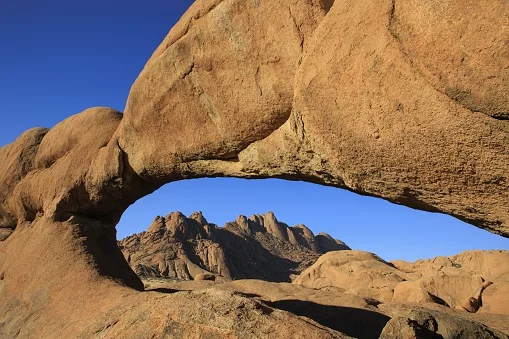
Rock Arch with the Spitzkoppe in the background/By: imageBROKER/Andreas Edelmann
When to go
Erongo can be visited throughout the year, but conditions vary considerably between seasons. Winter generally brings cooler days and cold nights, while summer can be hotter and may bring rainfall.
Whatever time of year you visit, plan outdoor activities around the heat, carry sufficient water and follow local guidance when hiking or exploring remote areas.
Allow time for the roads
This is a road-trip itinerary, not a race.
Some attractions and accommodation are reached via gravel roads, so allow more time than a map’s straight-line distance might suggest. A suitable vehicle, good navigation and enough fuel and water are important when travelling beyond the main towns.
Book guided experiences in advance
Rock-art sites and cultural experiences are best experienced with guides. They provide interpretation, help visitors navigate the terrain and make it possible to approach sensitive archaeological sites responsibly.
The Living Museum of the San, for example, offers several structured experiences, while Ai Aiba runs dedicated rock-art and nature drives.
Pack for the landscape
Bring sturdy walking shoes, sun protection, a hat, binoculars, a reusable water bottle and layers for chilly mornings and evenings.
A camera is useful, but don’t forget the binoculars. With more than 200 bird species recorded around the Erongo Mountains, the region is particularly rewarding for birders.
From the granite boulders of the Erongo Mountains to the ancient San paintings at Omandumba and the towering formations of Spitzkoppe, this is Namibia at its most varied. Wildlife is part of the story, but so are geology, archaeology, culture and the simple pleasure of watching the desert change colour as the sun moves across the sky.
If Namibia’s famous safari destinations and desert icons are already on your list, put Erongo alongside them. It offers something different, where the mountains themselves are the destination.
Follow us on social media for more travel news, inspiration, and guides. You can also tag us to be featured.
Instagram | Facebook | Twitter | Spotify
ALSO READ:




.jpg)
