

Africa’s endangered wild dogs need more than protected reserves. As roads, fences and expanding human settlements divide the continent’s wild spaces, their future increasingly depends on keeping vital wildlife corridors open.
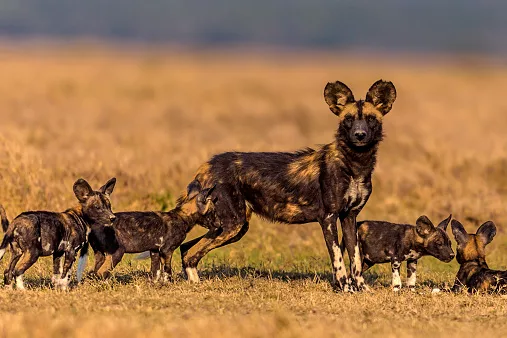
African wild dog with puppies/By: Manoj Shah/Getty Images
A predator that cannot live by park boundaries alone
The African wild dog (Lycaon pictus) is one of the continent’s most distinctive predators. Recognisable by its patchwork coat, large rounded ears and slender build, it lives in social packs that cooperate to hunt, raise pups and defend their territories.
But one of the species’ greatest challenges lies beyond its remarkable hunting ability: its need for space.
Wild dogs travel across large areas in search of prey and suitable habitat. As young adults mature, some leave their original packs to find unrelated mates and establish new groups. These journeys can take them far beyond the reserves where they were born, sometimes crossing international borders.
For a species already threatened by habitat loss, persecution and disease, this movement is essential. Protecting a single reserve may provide a safe home for a pack, but it cannot guarantee that the animals will be able to reach other suitable habitats or populations.
Why connected landscapes matter
The importance of dispersal
When young wild dogs leave their natal packs, they search for partners and opportunities to establish new groups. Successful dispersal allows populations to expand, recolonise areas and maintain genetic diversity.
However, travelling animals face unfamiliar territory, roads, settlements and other obstacles. A route that looks suitable on a map may be dangerous or impassable on the ground.
Research tracking dispersing wild dogs in the Kavango–Zambezi Transfrontier Conservation Area (KAZA) found that landscape connectivity varied considerably across the region. Human activity and natural barriers influenced where animals could move, highlighting the need to protect important corridors between habitats. https://besjournals.onlinelibrary.wiley.com/doi/10.1111/1365-2664.13868
Space to hunt and raise pups
Wild dogs rely on cooperation and endurance to hunt prey such as impala and other antelope. Their space requirements vary according to prey availability, habitat and pack size.
When suitable habitats become isolated, packs may have fewer opportunities to find food, establish territories or encounter potential mates. Connected landscapes provide more options, allowing animals to move as environmental conditions change.
For wild dogs, connectivity is not simply a conservation bonus. It is part of the ecological foundation that allows populations to persist.
ALSO READ:
Astronomers may have found a green star, and it’s unlike most others
The barriers dividing Africa’s wild spaces
When fences become obstacles
Fences can help protect livestock, manage wildlife and reduce human–wildlife conflict. However, they can also obstruct the movement of wide-ranging predators.
Research published in the Journal for Nature Conservation in 2022 examined African wild dogs leaving fenced protected areas in South Africa. The study found that fence management influenced escape patterns, while animals outside reserve boundaries faced risks including persecution and conflict with livestock owners.
The answer is not necessarily to remove every fence. Some serve important conservation and agricultural purposes. Instead, planners must consider where barriers are necessary, where they can be modified and how animals can move safely between suitable habitats.
Roads and expanding settlements
Roads can fragment habitat, increase disturbance and expose wildlife to vehicle collisions. Settlements, agricultural land and other development can further restrict movement.
When natural routes become blocked, animals may be funnelled into smaller areas or pushed towards roads and farms. This increases the likelihood of dangerous encounters and can make coexistence with people more difficult.
The effects extend beyond individual animals. If dispersal routes are interrupted, populations can become increasingly isolated, reducing opportunities for genetic exchange and recolonisation.
Conservation beyond reserve boundaries
KAZA: connecting five countries
One of southern Africa’s most significant landscape-scale conservation initiatives is the Kavango–Zambezi Transfrontier Conservation Area, or KAZA.
Spanning parts of Angola, Botswana, Namibia, Zambia and Zimbabwe, KAZA covers approximately 520,000 square kilometres. Its purpose includes supporting ecological connectivity across national borders while creating opportunities for communities to benefit from sustainable land use and tourism.
Research tracking dispersing wild dogs found that predicted landscape permeability within KAZA was more than twice that of areas outside its boundaries. However, connectivity varied considerably between participating countries, and some movement routes remained unprotected.
The findings demonstrate both the value and the limitations of transfrontier conservation. Establishing a connected conservation area is an important step, but corridors must still be identified, protected and managed against growing development pressures.
Protecting the spaces between protected areas
National parks and reserves remain essential refuges, but the land connecting them can be just as important to mobile wildlife.
Some corridors cross farmland, grazing areas or land used by local communities. Others encounter roads, fences and settlements. Conservation planning must account for these realities rather than assuming that unprotected land is empty or unused.
GPS tracking, camera traps and field observations can help researchers identify important routes and areas where movement is restricted. This evidence can inform land-use decisions, road planning and fence management before vital connections disappear.
The objective is not necessarily to turn every corridor into a protected reserve. It is to ensure that wildlife can continue moving through landscapes shared with people.
Living alongside wild dogs
Conservation must work for communities
In many parts of Africa, wildlife shares space with people who depend on farming, livestock and natural resources for their livelihoods.
When wild dogs kill livestock, the financial losses can be serious. If these costs are not addressed, communities may become less willing to tolerate predators near their homes and farms.
Practical measures can help reduce conflict. Secure nighttime livestock enclosures, attentive herding and appropriate livestock management can reduce opportunities for attacks. Compensation programmes and community-based conservation initiatives may also help address the costs of living alongside wildlife.
Conservation therefore requires more than protecting animals. It also means involving communities in decisions about land use and ensuring that they have meaningful opportunities to benefit from wildlife-friendly livelihoods.
Keeping corridors open
Protecting wildlife connectivity requires coordinated action, including:
- Wildlife-sensitive planning: Identifying important movement routes before development fragments them.
- Careful fence management: Assessing where barriers can be modified to improve safe movement.
- Safer roads: Considering wildlife crossings and appropriate speed management where necessary.
- Community partnerships: Supporting livestock owners and reducing the costs of human–wildlife conflict.
- Long-term monitoring: Tracking animal movements to assess whether conservation measures are effective.
No single solution will work everywhere. Each landscape has different ecological conditions, infrastructure and community needs. Effective conservation must respond to these differences and adapt as new evidence becomes available.
A future measured in more than protected hectares
The survival of the African wild dog depends on more than the number of animals living within protected areas. It also depends on whether packs can find mates, whether young adults can disperse and whether populations remain connected across suitable habitat.
Initiatives such as KAZA provide a framework for protecting these connections across national borders. Research into wild dog movements helps identify where corridors remain functional, where they are threatened and where conservation efforts may have the greatest impact.
The work requires cooperation between governments, conservationists, landowners and local communities. It also requires recognising that wildlife protection cannot be separated from the way surrounding landscapes are managed.
For a species built to roam, a protected reserve is only part of the picture. Keeping African wild dogs alive means protecting not just the places where they live today, but also the routes that allow them to move, reproduce and establish new generations tomorrow.
Follow us on social media for more travel news, inspiration, and guides. You can also tag us to be featured.
Instagram | Facebook | Twitter | Spotify
ALSO READ:
Canada’s rescued beluga whales face an uncertain new chapter