





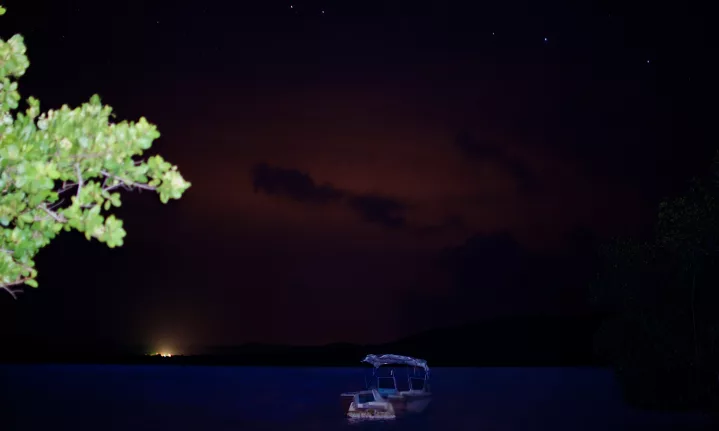
Imagine standing on a dark beach as a wave rolls towards the shore, its crest flickering electric blue before dissolving into the sand. A few steps through the shallows leave trails of light, while every breaking wave seems to set the ocean sparkling beneath the night sky.
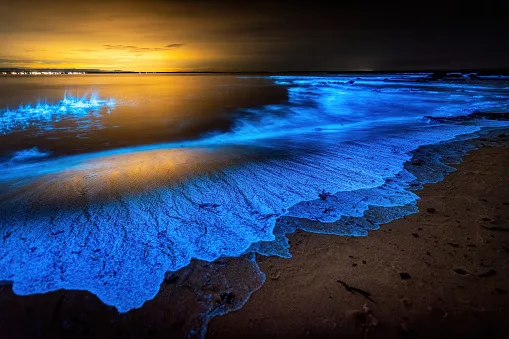
Bioluminescence in Jervis Bay, Australia/By: Petar Belobrajdic / 500px/Getty Images
It might look like something from a fantasy film, but this extraordinary spectacle is real. Known as bioluminescence, it occurs when living organisms produce their own light through chemical reactions. In coastal waters, microscopic marine life can transform ordinary waves into a luminous display that draws curious travellers to beaches around the world.
The phenomenon is beautiful, fleeting and difficult to predict. Understanding what causes it, and why it appears on some nights but not others, reveals a fascinating side of the ocean that often goes unnoticed.
What causes the sea to glow?
Meet the microscopic organisms behind the glow
One of the best-known causes of glowing shorelines is a group of microscopic organisms called dinoflagellates. These single-celled plankton are found in marine environments worldwide, where they form part of the ocean’s complex food webs.
One species, Noctiluca scintillans, is particularly associated with the phenomenon often called sea sparkle. When large numbers accumulate in coastal waters, the sea can appear to flash blue as waves break or the water is disturbed.
The light is not a reflection of the moon, nor is it caused by the sea absorbing sunlight during the day. Instead, it is produced by a chemical reaction inside the organisms. This process, known as bioluminescence, converts chemical energy into visible light.
Why the light is usually blue
Blue is the colour most commonly associated with marine bioluminescence because blue wavelengths travel efficiently through seawater. Depending on the organism and its chemistry, however, bioluminescent light can range from violet and blue to greenish-yellow, with other colours occurring in some marine species.
For dinoflagellates, the glow often appears as tiny sparks that combine into luminous streaks when the water moves. A wave may look almost ordinary as it approaches the beach, only to burst into blue light when it breaks.
The effect can be especially striking in photographs taken with long exposures, although these images may make the glow appear more intense or continuous than it looks to the naked eye.
What purpose does the light serve?
For many bioluminescent marine organisms, producing light is thought to be a survival strategy. Some species use it to deter predators, attract prey or communicate with other members of their species.
In certain dinoflagellates, a flash of light may startle a small predator or draw attention to it, potentially attracting a larger predator in turn. Scientists continue to investigate the precise functions of bioluminescence across different organisms, and its role varies between species.
For travellers watching a glowing shoreline, this means the spectacle is more than a visual curiosity. It is also a glimpse into the ways marine life has adapted to survive in an environment where light can be a valuable resource.
ALSO READ:
Yuanyang’s rice terraces: China’s mountains turned into living landscapes
Why do some shorelines glow and others stay dark?
The right conditions must come together
Bioluminescent plankton can be present in the ocean without producing a visible display from the beach. The intensity of the glow depends partly on how many light-producing organisms are concentrated in a particular area and whether their light can be seen in the surrounding darkness.
Environmental conditions influence where these organisms accumulate and whether their populations grow. Water temperature, nutrient availability, currents and wind can all play a role, although the precise combination differs between species and locations.
In South Africa, periods of relatively calm weather have been associated with visible coastal displays. Gentle conditions can allow plankton to accumulate in bays, while stronger winds and mixing may disperse them. Even when conditions appear favourable, however, a glowing shoreline is never guaranteed.
The connection between red tides and blue light
Some of the most memorable displays are associated with algal blooms, which occur when microscopic algae or other plankton become abundant in the water.
During daylight, a bloom involving Noctiluca scintillans can give the sea a reddish, rusty or brownish appearance. After dark, the same organisms may produce blue flashes when disturbed by waves.
This connection is useful for understanding why some glowing shorelines appear seemingly overnight. A visible daytime bloom may offer a clue that bioluminescence could occur after sunset if conditions remain favourable, but it is not a reliable forecast.
It is also important to distinguish between different types of blooms. Not every bloom is bioluminescent, and not every bloom is harmless. Some harmful algal blooms produce toxins or contribute to environmental problems, so unusual water discolouration should be treated with caution.
Why darkness matters
Even when plankton are abundant, artificial lighting and bright moonlight can make the glow harder to see. Dark skies help the blue flashes stand out against the surrounding sea.
This is one reason visitors are often encouraged to seek out sheltered beaches away from streetlights and illuminated buildings. A quiet shoreline with minimal artificial light can offer a better chance of observing the spectacle, provided the organisms are present.
The darkness does not create the bioluminescence. It simply makes the light easier to see.
Where to see glowing shorelines around the world
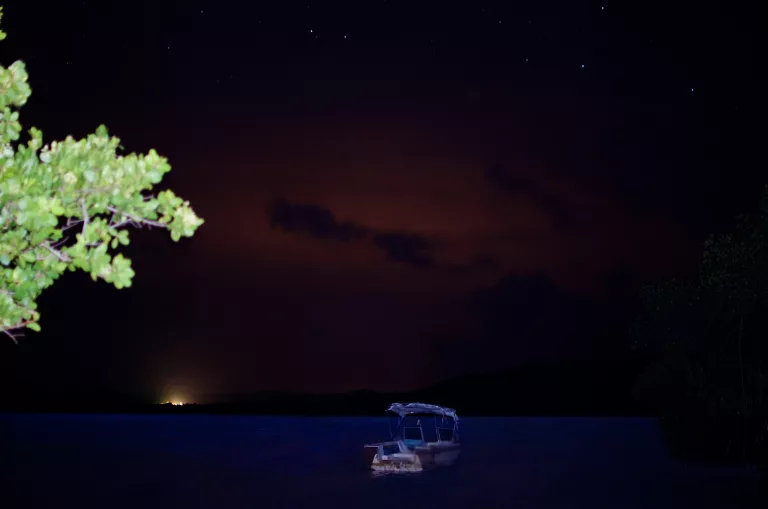
Bioluminescent bay, Vieques/Edgar Torres/Wikimedia Commons
Bioluminescence has been documented in coastal waters across the globe, from tropical lagoons to sheltered bays and temperate beaches. Some destinations are particularly well known for their glowing waters, although the intensity and timing of displays vary.
False Bay and the Western Cape, South Africa
South Africa’s coastline offers opportunities to witness this phenomenon without travelling overseas. False Bay, on the Cape Peninsula, has experienced striking displays of blue bioluminescence, including along Muizenberg beach in January 2024.
During that event, waves glowed as they broke along the shoreline, drawing crowds of people hoping to see the unusual spectacle. Marine researchers linked the display to a bloom of microscopic organisms associated with Noctiluca scintillans.
Other sightings have been reported around Fish Hoek, Gordon’s Bay and Simon’s Town. The broader southern and eastern coastlines, including sections of the Garden Route and KwaZulu-Natal, have also experienced occasional displays.
For Cape Town residents and visitors, the appeal lies in the unpredictability. A familiar beach can become an extraordinary place after dark, sometimes for only a few nights before the glow fades.
There is no single beach where bioluminescence can be guaranteed. Following recent local sightings and paying attention to marine advisories can help visitors decide whether an evening excursion is worthwhile.
Mosquito Bay, Puerto Rico
For travellers planning a trip specifically around bioluminescence, Puerto Rico is one of the best-known destinations. The island has three recognised bioluminescent bays: Mosquito Bay on Vieques, Laguna Grande in Fajardo and La Parguera in Lajas.
These sheltered waters support microscopic organisms that illuminate the water when disturbed. Kayaking through the darkness can reveal blue flashes around paddles and in the trails left behind by moving boats.
Mosquito Bay is particularly famous for its intense displays and has been recognised as the world’s brightest bioluminescent bay. The experience is carefully managed to help protect the delicate ecosystem, with restrictions on activities such as swimming in certain bays.
Visitors should book with responsible local operators, check the rules for their chosen bay and aim for a night with little moonlight.
Jervis Bay, Australia
On Australia’s southeastern coast, Jervis Bay is known for its white-sand beaches, sheltered coves and occasional displays of glowing blue plankton.
The phenomenon is most commonly associated with the warmer months, particularly spring and summer, although it can occur outside these periods. When conditions align, the water can shimmer as waves move through the shallows, creating a striking contrast against the pale sand.
The bay is also an appealing destination for travellers who want to combine a potential nighttime sighting with daytime beach walks, wildlife watching and exploring the surrounding coastal landscapes.
As elsewhere, sightings depend on natural conditions rather than a fixed seasonal schedule. Travellers should check recent reports before making special arrangements.
Krabi, Thailand
Thailand’s Krabi coastline offers another opportunity to experience glowing water. Around Railay Beach and nearby coastal areas, bioluminescent plankton can sometimes create blue flashes in the sea after dark.
The region’s limestone cliffs, tropical beaches and warm waters make it an attractive setting for a nighttime boat excursion. Local operators offer trips intended to give visitors a chance of seeing the phenomenon, particularly on darker nights.
The period from roughly November to April is commonly promoted as a favourable time for visiting Krabi, although the appearance of glowing plankton remains unpredictable.
Travellers should confirm current tour availability and ask operators about recent sightings rather than assuming that every excursion will include a glowing display.
How to improve your chances of seeing bioluminescence
Choose a dark night
Low levels of ambient light make the glow easier to see. If possible, plan your visit around a new moon, when the night sky is darker, and choose a beach away from streetlights, brightly lit buildings and busy promenades.
Allow your eyes time to adjust to the darkness, and keep phone screens and torches switched off when it is safe to do so.
Check for recent sightings
Because bioluminescence is difficult to predict, local knowledge is particularly valuable. Check recent reports from reputable local news outlets, marine researchers, coastal communities and experienced guides.
If a reddish or brownish bloom has been reported during the day, it may be worth checking whether bioluminescence has been observed after dark. However, not all blooms glow, and a visible bloom does not guarantee a nighttime display.
Give yourself more than one night
If seeing bioluminescence is a major reason for visiting a destination, avoid building an entire trip around a single evening. Staying for several nights gives you more opportunities to encounter favourable conditions.
Even then, the display may not appear. Treating it as a possible bonus rather than a guaranteed attraction makes the experience more rewarding.
Observe responsibly
The best way to appreciate bioluminescence is to minimise your impact on the environment. Follow local access rules, avoid trampling dunes and sensitive coastal habitats, and choose guided excursions that respect marine life.
Do not assume that glowing water is safe for swimming. Some displays occur alongside algal blooms that can be harmful, and water conditions can change. Heed official warnings, avoid discoloured water when advisories are in place, and never collect or consume marine life from an affected area.
A reminder of how extraordinary the natural world can be
Bioluminescent shorelines offer a rare perspective on the ocean. Beneath the apparent simplicity of a breaking wave is a world of microscopic organisms, chemical reactions and environmental conditions that scientists are still working to understand.
For a few nights, a familiar stretch of coastline can become something almost unrecognisable. Waves leave luminous trails, water flickers beneath the darkness and the boundary between sea and sky seems to disappear.
South Africa’s own sightings show that this experience does not always require an international journey. Sometimes, all it takes is a little patience, a dark night and the right conditions along a familiar beach.
Follow us on social media for more travel news, inspiration, and guides. You can also tag us to be featured.
Instagram | Facebook | Twitter | Spotify
ALSO READ:
Chimanimani: Zimbabwe’s mountain wilderness of waterfalls and rare plants