


Slovenia’s Alpine landscape has lost one of its most striking natural features, with the last remaining ice of the Triglav glacier disappearing after a summer of extreme heat.
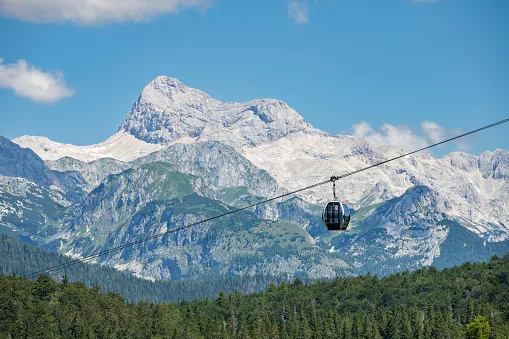
A summer view of the highest peak in Slovenia’s Julian Alps, Triglav mountain with a small cable car in the foreground/By: James Rowland / 500px/Getty Images
The loss marks another significant change in Europe’s mountain environments, where rising temperatures are accelerating glacier retreat.
Located beneath Mount Triglav, Slovenia’s highest peak, the glacier was once a much larger mass of ice. Its disappearance is also a cultural loss for a country where the mountain holds deep national significance and climbing to its summit is a longstanding tradition.
A glacier that survived decades of retreat
Historical photographs and documents suggest that the Triglav glacier covered approximately 40 hectares in the mid-19th century. By the time formal measurements began in 1946, its area had already declined to around 14 hectares.
The retreat accelerated during the following decades. Between 1983 and 2003, the glacier lost 93% of its surface area, eventually shrinking to less than one hectare of exposed rock and scattered ice.
Despite predictions that it would disappear, small remnants survived for another two decades. However, the remaining ice continued to diminish, particularly over the past five years, as exceptionally hot conditions placed further pressure on the Alpine environment.
According to The Guardian, photographs taken before and after recent snowfall confirmed that the final remnants of the glacier’s main body had disappeared.
The impact of rising temperatures on the Alps
The loss of the Triglav glacier highlights the growing impact of climate change on Europe’s mountain landscapes. Prolonged heatwaves, higher temperatures and declining snow cover are contributing to faster ice loss across the Alps.
Researchers who have monitored the glacier have witnessed the transformation firsthand. Matija Zorn, director of Slovenia’s Anton Melik Geographical Institute, recalled how a section of ice measuring about five metres deep in 2002 had become bare rock by the following year.
The glacier’s disappearance represents more than a change in the mountain’s appearance. Long-term observations of glaciers provide valuable information about environmental conditions and help scientists understand how the climate is changing over time.
With the ice gone, researchers have lost an important source of data that has helped document the region’s changing environment.
Why Mount Triglav matters to Slovenia
Rising 2,864 metres above sea level, Mount Triglav is Slovenia’s highest mountain and a defining feature of its national identity. The mountain attracts hikers and climbers, while its surrounding landscapes form part of the wider Julian Alps, a region known for dramatic peaks, alpine valleys and outdoor adventures.
The glacier’s disappearance carries particular significance for those who have watched it change over decades. Glaciologist and mountain guide Miha Pavšek told The Guardian that the loss felt personal, reflecting the close connection between the landscape and the people who have grown up alongside it.
Although the glacier no longer exists as a surface ice mass, researchers have found ice in caves beneath Triglav, where the glacier’s retreat has exposed previously hidden openings.
Slovenia’s remaining glacier is also shrinking
Triglav is not the only Slovenian glacier affected by rising temperatures. The country’s remaining glacier, on Mount Skuta in the Kamnik-Savinja Alps, has also become smaller and thinner.
Its more sheltered position provides some protection from direct sunlight, potentially allowing it to survive for a few more years. However, its continued retreat reflects the wider challenges facing glaciers throughout the European Alps.
For travellers, these changes offer a reminder that mountain environments are not static. The landscapes that draw visitors for their snow-covered summits, dramatic scenery and outdoor experiences are being reshaped by changing climatic conditions.
The disappearance of the Triglav glacier marks the end of a natural feature that endured for generations. Its loss also leaves behind a record of how dramatically a mountain landscape can change within a human lifetime.
Follow us on social media for more travel news, inspiration, and guides. You can also tag us to be featured.
Instagram | Facebook | Twitter | Spotify
ALSO READ: