


Spain’s latest deadly train crash has raised serious questions about the safety of its high-speed rail network, with officials and railway unions offering differing explanations for what went wrong. According to a follow-up report by AP News, investigators are examining whether human error, ageing safety technology and pressure on railway staff contributed to Wednesday’s collision in Toledo province, which claimed 69 lives.
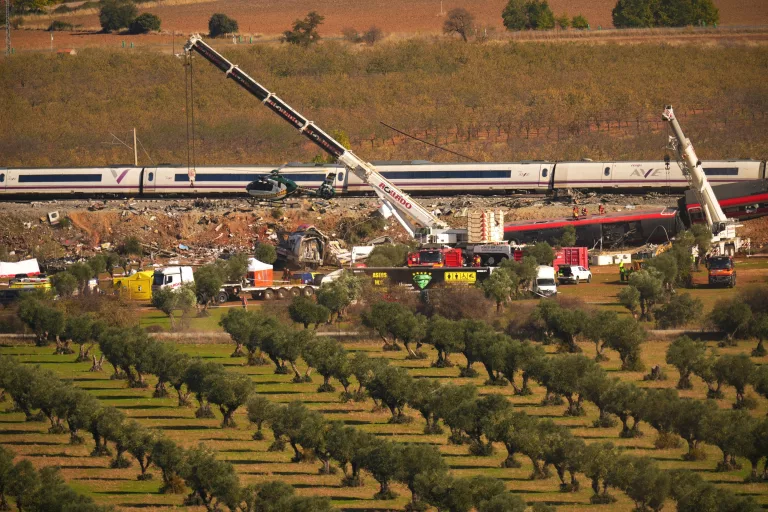
Photo by AP Photo/Manu Fernandez
The country’s transport minister, Óscar Puente, has pointed to a traffic controller’s decision to allow one train to resume travelling at normal speed while another remained stopped on the same stretch of track. Railway unions, however, argue that the incident highlights wider problems within the system, including recurring safety equipment failures and increasing workloads for staff.
Investigators examine what caused Spain’s deadly train collision
Investigations into the crash were continuing on Friday, 30 October, with police and sniffer dogs still searching through the wreckage for evidence. Investigators from a special rail accident committee removed the trains’ black boxes on Thursday and handed them to Spain’s Civil Guard for examination.
A judge and a separate government-appointed commission are investigating the circumstances surrounding the collision. Prime Minister Pedro Sánchez has also pledged to establish exactly what happened.
The crash occurred on Wednesday morning, 28 October, when two trains collided on the Madrid-Seville line. Initial findings from independent investigators indicate that the RENFE train was travelling at between 160 and 200km/h when it struck the IRYO train.
It was the second major rail disaster in Spain this year. In January, another collision on the same route killed 46 people after a train derailed and struck a train travelling in the opposite direction.
A safety system failure preceded the collision
According to the timeline provided by Spanish authorities, the chain of events began at approximately 8.30am on Wednesday, when a communications system linked to the railway’s safety technology stopped working.
The system, known as LZB, monitors train positions and can automatically apply brakes to prevent collisions. When it malfunctioned, traffic controllers at a control centre in Madrid took over responsibility for monitoring trains along a 63km stretch of the Madrid-Seville line.
Authorities believe six trains were operating on the affected section at the time.
Six minutes after the system failure, a controller instructed a RENFE train to resume travelling at normal speed. An IRYO train further along the line also attempted to restart, but its driver could not override the automatic stop and alerted the controller.
At approximately 8.53am, the two trains collided.
The sequence of events has become central to the investigation, particularly the decision to allow one train to continue while the other remained stationary.
Transport minister points to a controller’s decision
Transport Minister Óscar Puente has described the instruction to restart the RENFE train as both ‘inexplicable’ and ‘erroneous’.
He said the train should not have been authorised to move while a stop signal remained active on the line. His comments have placed considerable scrutiny on the decisions made inside the Madrid control centre in the minutes before the collision.
However, the minister’s explanation has been challenged by railway unions, which say it is too simplistic to attribute the disaster to one worker’s decision without examining the conditions under which railway staff operate.
Railway unions raise concerns about staffing and ageing technology
Raquel Ayllón, spokesperson for Spain’s railway traffic controllers’ union, SCF, told AP News that controllers have been dealing with excessive workloads and insufficient staffing for years.
She argued that railway employees are being expected to manage increasingly demanding responsibilities while dealing with safety systems that regularly malfunction.
The union has also questioned the government’s decision to place responsibility on an individual controller rather than address what it sees as long-standing problems within the rail network.
Spain’s train engineers’ union, SEMAF, has raised similar concerns about the LZB system. The technology has been in use for approximately three decades on the Madrid-Seville route and is being phased out, but union representatives say it should have been replaced much sooner.
According to SEMAF spokesperson Diego Martín, the system has experienced repeated outages in the past, leaving human operators responsible for managing train movements when automated safeguards are unavailable.
The concerns have renewed calls for improvements to railway safety and working conditions. Train workers also went on strike on Thursday in an action that had been planned before the latest collision, demanding that the government honour commitments to improve safety following January’s disaster.
Questions raised over the impact of railway privatisation
Another issue being considered is whether the increased use of Spain’s high-speed rail network has placed additional pressure on its infrastructure.
Until 2021, high-speed passenger services were operated exclusively by the state-owned RENFE. The opening of the market to private operators introduced additional services, including those run by IRYO.
Both major train collisions in Spain this year involved a RENFE train and a privately operated IRYO train.
Railway traffic has increased since the market opened to competition. According to figures cited by the SCF union, the average number of daily services between Madrid and Barcelona rose from 56 in 2019 to 89 in 2024.
Union representatives have questioned whether the maintenance and investment needed to support the additional services have kept pace with the growth in passenger numbers.
They have not established privatisation as a cause of either collision, but argue that increased demand and pressure on existing infrastructure should form part of the wider investigation.
Spain’s high-speed rail reputation faces scrutiny
Spain has long been regarded as a leader in high-speed rail, with a network second in size only to China’s. Its railway system was widely considered a success of state investment and infrastructure development.
Until the two deadly incidents this year, the country’s high-speed rail network had gone more than three decades without a fatal crash since its introduction.
The latest disaster has therefore raised difficult questions about how the network is maintained, how safety systems are monitored and whether staffing levels are sufficient to manage growing passenger numbers.
King Felipe VI, who visited injured passengers in hospital in Toledo on Thursday alongside Queen Letizia, described the collision as a severe blow to Spanish society.
He said the investigation needed to establish how the catastrophe happened and what measures would be necessary to prevent another tragedy.
For now, investigators are working to establish the precise sequence of events. Whether the collision was the result of an individual decision, wider operational failures or a combination of factors remains to be determined.
ALSO SEE: Deadly high-speed train crash in Spain kills at least 68