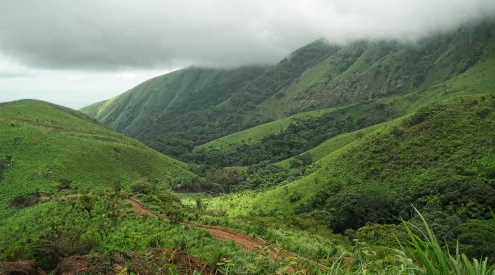


We traded the tar just outside of Citrusdal for thirty kilometres of gravel, the ochre track unspooling between us and one of the Western Cape’s most quietly magnificent campsites. A corrugated brown corridor flanked by fynbos that eventually drops into Suikerbossie Guest Farm. A kilometre further, Waterfall Camp.

Image: Oliver Keohane
In our late teens and early twenties, a week was an infinite amount of time to make plans, and who knew what the end of the year held, let alone the next day. Now, our group is at the stage of life where we’ve checked the dates of long weekends the year before, made bookings and planned whose cooking on each night. We had been anticipating this trip for a long time, and at the turn of the season we waved a contented farewell to summer from the comfort of camp chairs along the banks of our own private rockpool.
We pulled into the farmhouse in the long, fading light of a Friday evening in March, the last proper heat of late summer still radiating off the Koue Bokkeveld rock faces that tower above the property.
To get to Waterfall Camp, you drive past the main riverside sites — past the Tarzan swing dangling over the river, rows of impeccably manicured lawns where families had already settled into their braai routines — and keep going, up a rougher track that climbs away from the noise of people and deeper into the canyon.

Image: Oliver Keohane
I have stayed in many camps over the years, but never one so secluded and seemingly personal. Wrapped up in sandstone folds, far from the other campsites, Waterfall Camp sits on a shelf of rock above a series of crystal pools fed by a cascade that drops maybe five meters into a private rock pool. Often, a rock pool is the destination at the end of a long, hot hike on these sorts of trips. But with a body of water never further than a few meters away, we spent so much time relaxing in our camping chairs, playing catch-up and watching the days unfold in slow motion. Life is busy, and the luxury of fourteen friends around the same fire for three days was lost on nobody.
ALSO READ: East Side Story – One week in Hackney
The camp itself sleeps up to twelve in six double beds. Thick timber benches, shutter windows that fold open to frame the mountains, a gas stove, a fridge and oil lamps create a convenient and comfortable centre piece to the activity of a day. We pitched a tent on the surrounding grass as well, with the rest of the patch filled by our Front Runner Awning and a Ford Ranger bakkie, where our tallest friend slept, feet dangling out the tailgate for three nights.

Gear: Front Runner Dometic Easy Out Awning and The Dometic GO Compact Camp Chairs
As most of the couples quietly slipped to bed after a festive first evening, a handful of us loudly continued the festivities, moving from the fire to the waterside. The stillness of the night muted us to a mumble, under the star-filled midnight sky of the Cederberg and the steady flow of the waterfall. You fall asleep to the sound of water and wake up to it too. Despite a late first night, we were up early on Saturday, half the group having already scrambled down the rocks to swim in the lower pool, while others adventured the surrounding trails. The canyon above the camp invites exploration – rock faces streaked orange and grey, indigenous bush pressing in from both sides.

Image: Oliver Keohane
The activities list at Suikerbossie is generous for a farm this remote, though I must confess the majority of my time was spent bum in chair and tongs in hand. There is a 4×4 trail and mountain biking route threading through the 1,400 hectares of land that surrounds the small fruit-farming operation. The Donkey Trail offers a proper hike into the broader landscape. Somewhere on the property, partially obscured and carefully protected, are Bushman paintings.
The farm sits within the Cederberg Leopard Conservation area, which means you are, technically, sharing space with one of the continent’s most elusive cats. Suikerbossie takes its conservation obligations seriously, and in doing so gives its guests something that no amount of glamping infrastructure can manufacture: genuine wildness.

Image: Oliver Keohane
So much of the Waterfall’s camp allure lies in its privacy, and while we could choose the sound of silence or the inoffensive hum of a Bluetooth speaker, that decision lay with us. We were never subjected to the noise of other camp sites. While there is no reason to leave calm of the waterfall camp, there is a public path to the main river, which is wide and shaded, its banks thick with river bush, the current gentle enough for small bodies and strong enough to remind you that it comes from the mountains and is heading for the land.
By Monday we had not once heard music, nor been woken by a vehicle. The farm’s strict rules, which might read as severe on paper, are much of the reason the place works. The experience designed around quiet, around nature, around the idea that the best thing a campsite can offer you is the ability to forget what day it is. Again, you pay for the isolation of the Waterfall camp in particular.
ALSO READ: 48 Hours in the Iron City
We finished three epic days with an adventure into the canyons. We didn’t go too far, but our 4x4s were necessary. The morning stretched into a day as we wallowed in the shallow rockpools under the baking heat, grudgingly pulling ourselves back to the cars, an eye on the drive back to Cape Town. It never gets easier saying goodbye to the Cederberg.

Image: Oliver Keohane
GEAR SPOTLIGHT: Front Runner Dometic
Fitted to our Land Rover, the Front Runner Dometic Easy-Out Awning transformed a patch of grass into a proper outdoor living room. Measuring 2.5m wide and extending 2.1m out from the vehicle, it deploys in under 60 seconds and is built from water-repellent, UV-resistant fabric — exactly what the harsh Kouebokkeveld afternoons – be that summer or winter – demand. Telescopic aluminium twist-lock poles extend to 2.4m and include ground spikes and reflective guidelines for stability in wind.

Image: Oliver Keohane
Given that Waterfall Camp offers only a communal farm fridge, the Dometic CFX3 was an epic asset. Powered by the VMSO3 variable speed compressor, it freezes down to -22°C while drawing less power than a 60W lightbulb – remarkable off-grid performance. Temperature is managed via a colour display or the Dometic app over Wi-Fi or Bluetooth. Cooler boxers could be reserved for drinks, while our meat and fresh produce stayed cooled. We would power it via the 12v with the ignition on during the day, and overnight, with the ignition off, the fridge held the cold very well.

Image: Oliver Keohane
The Dometic GO Compact Camp Chairs rounded things out. Built from heavy-duty 600D fabric, lightweight aluminium, and beechwood armrests, they’re as stylish as they are sturdy and comfortable

Image: Oliver Keohane
Waterfall Camp important information
Waterfall Camp costs R2,000 per night for up to five guests, with rates scaling per additional person. The closest shop is 30km away in Citrusdal. Bring everything you need, take everything out when you leave, and put a shade net under your tent.
Getting There: Suikerbossie Guest Farm lies on the R303 between Ceres (90km) and Citrusdal (30km). The last stretch from Citrusdal is gravel road — a decent set of tyres is recommended.
Contact: 022 921 3537 | bookings@
Rates: Waterfall Camp from R2,000/night (sleeps up to 12 in beds, plus camping)
Note: This is a leopard conservation area. Dogs are permitted with prior arrangement and subject to a fee.
Follow us on social media for more travel news, inspiration, and guides. You can also tag us to be featured.
Instagram | Facebook | Twitter
ALSO READ: