

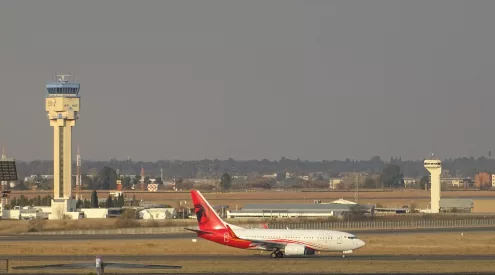






More people are flying through Cape Town, and the airport is making plans to give them more room. Airports Company South Africa has earmarked more than R10 billion for the Cape Town airport upgrade, which includes a new runway and expanded domestic and international terminals to ease pressure during busy travel periods.

Airlink at Cape Town International Airport / Olga Ernst / Wikimedia Commons
The investment forms part of Airports Company South Africa’s (ACSA) wider R21.7 billion infrastructure programme across its airport network.
The proposed works are intended to increase the airport’s capacity, improve aircraft movements and address pressure on facilities during busy travel periods.
The expansion comes as plans for a second international airport in the Western Cape move forward. The proposed Cape Winelands Airport, near Durbanville, is being developed as an additional aviation gateway for the region, with its own passenger, cargo and commercial infrastructure.
A previous update on the Cape Winelands Airport project explored the development’s ambitions and its potential role in the province’s aviation network.
A R6.39 billion runway for larger aircraft
The largest part of the Cape Town International Airport programme is a new main runway, estimated to cost R6.39 billion.
ACSA plans to appoint a contractor in December 2026, according to the Daily Investor. The proposed runway will measure 3 500m long and 60m wide, with its alignment shifted 11.5 degrees eastwards.
The realignment is intended to improve air traffic efficiency while creating additional space within the airport precinct for future terminal development.
The project also includes rapid-exit taxiways and a partial parallel taxiway, as these features are designed to reduce the time aircraft spend occupying the runway, helping improve turnaround times and the movement of flights during peak periods.
The runway will meet Code F requirements, allowing it to accommodate larger next-generation aircraft.
What’s changing at the domestic and international terminals
Domestic passengers are also expected to see changes, with construction planned for both the arrivals and departures areas.
The new domestic arrivals terminal is estimated to cost R2.39 billion, while the extension to the departures terminal is budgeted at R500 million.
Construction is expected to begin in April 2027, subject to regulatory approvals and procurement processes.
The work is intended to increase passenger-processing capacity and improve movement through the terminal. Plans include additional domestic contact gates, more airbridges and expanded apron space to accommodate aircraft parking.
The international terminal is also included in the programme, with phased improvements estimated at R863 million.
Planned work includes additional aircraft parking stands, upgraded immigration facilities, improved bus gates and expanded retail and lounge areas.
Other improvements are expected to include more security screening capacity, better baggage reclaim facilities, upgraded bathrooms and additional family and prayer spaces.
ACSA says the projects will be phased to limit disruption to passengers and airlines while construction takes place.
Why Cape Town airport needs more capacity
Cape Town International Airport accounts for 27.6% of passenger traffic across ACSA’s airport network, according to the company’s 2025/2026 integrated annual report.
The airport has experienced growing demand, with pressure becoming particularly visible in terminal facilities during peak travel periods and in the availability of flight slots.
The recovery in international tourism, alongside the introduction of new routes and increased airline capacity, has contributed to passenger growth.
Cape Town Air Access, a partnership involving tourism, trade and government organisations, has also worked to attract new international routes and encourage airlines to expand existing services.
The growth brings economic opportunities for the Western Cape, but it also places additional demands on infrastructure, as limited flight slots and terminal congestion can restrict the airport’s ability to accommodate further expansion.
Improved capacity could support tourism, business travel and trade, while making it easier for airlines to introduce additional routes.
A new airport hotel and more cargo space
The runway and terminal projects are not the only developments planned for the airport precinct.
ACSA has also begun expanding cargo facilities at Cape Town International Airport, with the first three cargo warehouse sites awarded through a public tender.
An on-site airport hotel has also been approved and is progressing through a design, build and operate framework.
The longer-term vision includes aerotropolis development, which would integrate transport infrastructure with commercial and property developments in and around the airport.
Where Cape Winelands Airport fits in
While Cape Town International Airport prepares for its expansion, the privately owned Cape Winelands Airport is being developed at the former Fisantekraal Airfield, approximately 13 km northeast of Durbanville.
The site currently operates as a general aviation facility, including flight training. Its owner and operator is RSA. Aero, plans to transform it into an international commercial airport through a multi-billion-rand development previously valued at around R10 billion.
The proposed development includes a new 3 500m runway, passenger terminal, cargo facilities, aircraft hangars and upgraded fuelling infrastructure. Hotel accommodation, a heliport, warehousing and logistics facilities are also part of the plans.
The developers intend for the airport to serve tourism and business travel while supporting commercial activity in the northern part of the Western Cape.
Cape Winelands Airport director Mark Wilkinson has previously said that a second airport could help ease congestion at Cape Town International Airport and reduce carbon emissions.
However, the project remains at a different stage from ACSA’s confirmed infrastructure programme. Planning and preparation work includes airport design, engineering, environmental processes, road connectivity and commercial development.
The first phase of operations has been targeted for 2028, although the eventual timeline and scale of the development will depend on the progress of the required processes.
Originally published via Cape {town} Etc
Follow us on social media for more travel news, inspiration, and guides. You can also tag us to be featured.
Instagram | Facebook | Twitter | Spotify
ALSO READ:
NSPCA to lay criminal charges against Western Cape ostrich farms