




Beachgoers at Westbrook, north of Durban, were treated to a rare and unforgettable spectacle on Friday afternoon when a female leatherback turtle came ashore to nest — an event seldom witnessed during daylight hours.

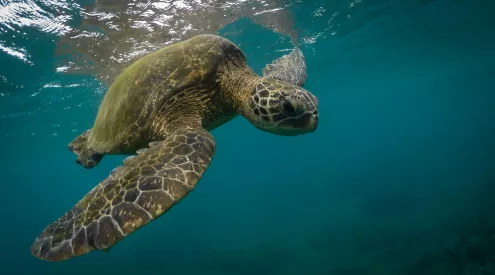
Image of Leatherback sea turtle hatchling used for illustrative purposes/Max Gotta/Unsplash
Leatherback turtles typically nest at night and are more commonly seen further north along the iSimangaliso Wetland Park coastline. This sighting marks an extraordinary deviation from their usual behaviour.
A rare natural event
The massive marine reptile hauled itself onto the beach around midday and spent over two hours carefully nesting near the dune forest before returning to the ocean. Lifeguards and residents quickly alerted the KwaZulu-Natal Sharks Board, which arrived within 25 minutes to secure the area. Spectators were kept behind a cordon roughly 50 metres away, watching in quiet awe.
Leatherbacks are the largest of all sea turtles, reaching up to 900 kilograms. Unlike other species, their shells are leathery and ridged rather than hard. With dark blue-grey, mottled skin and powerful front flippers, these gentle giants are unmistakable.
A nesting success
Female leatherbacks usually nest at night during high tide, laying up to 1 000 eggs per season in multiple batches of 80–140 eggs, spaced about 8–12 days apart. Hatchlings are just 5 to 6 centimetres long and emerge after roughly two months, though few survive to adulthood.
Among the first to witness the nesting was Salome Botes, founder of the Westbrook Better Together community initiative.
“It was absolutely amazing — an experience of a lifetime,” said Botes. “I’ve never seen a turtle nest before. It was so moving to see how calm she was despite the crowd. My friend kept saying, ‘This is so awesome!’”, as told by Citizen.
Expert insight
According to Ezemvelo KZN Wildlife marine ecologist Santosh Bachoo, the turtle was likely on its way to its usual nesting site further north.
“She probably had a batch of eggs ready to lay before reaching iSimangaliso,” explained Bachoo. “Instinct and hormones would have prompted her to stop at the nearest suitable beach.”
The turtle successfully laid her eggs and returned safely to the sea. Although she carried no identification tags, the nest has since been carefully disguised to protect it from disturbance. Ezemvelo staff and local conservation volunteers will monitor the site over the coming weeks to ensure the eggs’ safety.
Protecting a threatened species
Leatherback turtles feed almost exclusively on jellyfish and other soft-bodied plankton. They reach sexual maturity in just 4–5 years, much faster than other turtle species, but face growing threats from fishing gear entanglement, plastic pollution, and historical egg harvesting.
Bachoo reminded beachgoers to immediately contact lifeguards, the beach manager, or the KZN Marine Strandings Network when encountering a turtle.
“Sometimes a turtle may appear stranded because it’s sick or injured,” he said. “Alerting the right authorities ensures the animal gets the care it needs.”
If all goes well, the Westbrook nest could see tiny hatchlings make their first journey to the sea in about two months — a hopeful sign for this ancient and endangered ocean wanderer.
Follow us on social media for more travel news, inspiration, and guides. You can also tag us to be featured.
TikTok | Instagram | Facebook | Twitter
ALSO READ: Ancient crocodile-like predator unearthed in Egypt’s western desert