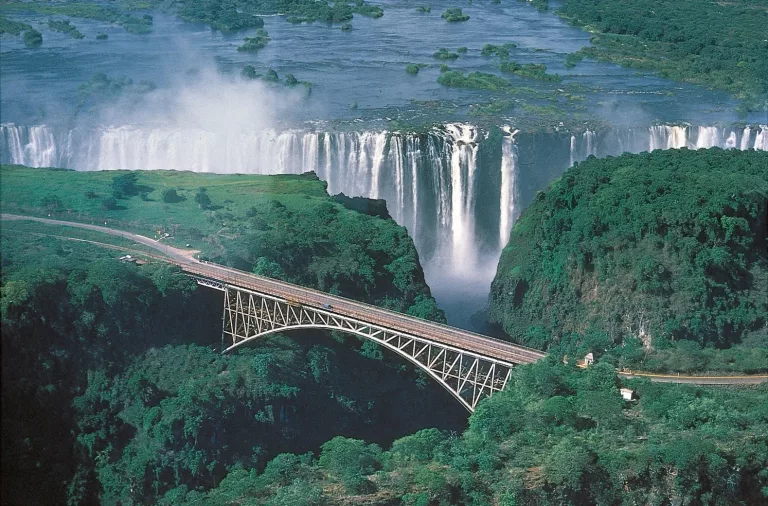

The roar of heavy trucks crossing the iconic Victoria Falls Bridge may soon become a thing of the past. In a major infrastructure shift, Zambia and Zimbabwe are preparing to restrict heavy freight traffic on the historic structure and replace it with a modern alternative designed for today’s demands.
Sourced: X{@AfricaisHOME2}
According to the south african, the announcement came from Zambian President Hakainde Hichilema during an engineering conference in Livingstone, where he confirmed that both countries are moving toward a long-term solution: a new bridge and railway crossing built for modern transport volumes.
It’s a significant turning point for one of Southern Africa’s most famous crossings and a clear signal that the region’s trade routes are under pressure to evolve.
A century-old bridge reaching its limits
The Victoria Falls Bridge has stood since 1905, linking Zambia and Zimbabwe across the Zambezi River. For more than a century, it has carried road traffic, rail, and pedestrians in one narrow, shared structure.
But what once worked for early 20th-century transport is now struggling under the weight of modern logistics.
Today’s freight includes 60-tonne mining trucks and long cargo trains — far beyond what the original engineers ever imagined. Over time, restrictions have already been introduced, including reduced train speeds and strict weight limits for trucks.
Even a rehabilitation effort in 2006 only extended its lifespan rather than solving its core structural limitations.
Now, officials are in agreement: the bridge is no longer fit for the demands placed on it.
Why heavy trucks are being diverted
The decision to phase out heavy freight on the bridge is not just about safety — it’s about efficiency.
Upgrading the existing structure to handle modern loads would cost almost as much as building an entirely new crossing. That reality has pushed both governments toward a more practical solution.
A new bridge would be designed specifically for today’s transport needs, easing pressure on the ageing structure while improving regional logistics.
For everyday travellers and tourists, this means the Victoria Falls Bridge could finally shift into a quieter role — focused on light vehicles, pedestrians, and sightseeing traffic near one of Africa’s most visited natural landmarks.
A new trade artery for Southern Africa
The planned crossing is expected to play a major role in easing congestion along the North-South Corridor, a key trade route linking Zambia’s copper belt and the Democratic Republic of the Congo with South African markets.
Freight demand across the region continues to rise, driven by mining exports and agricultural trade. But the current infrastructure is struggling to keep up, leading to delays and rising transport costs.
A modern dual-purpose road and rail bridge would help unlock smoother movement of goods while strengthening regional trade integration.
Connecting rail and road networks across the region
The new project is also expected to support wider infrastructure developments, including the Mosetse-Kazungula-Livingstone Railway.
Planners believe a dual-track rail bridge could significantly boost cross-border rail capacity, building on momentum from recent regional projects like the Kazungula Bridge, which has already improved traffic flow since opening in 2021.
Together, these upgrades point toward a more connected Southern Africa — one where rail and road systems are increasingly aligned across borders.
Funding challenges and what comes next
Despite strong political backing from both Zambia and Zimbabwe, the project still faces major hurdles.
Financing remains the biggest question mark, especially for Zimbabwe, where debt challenges could complicate international funding arrangements. However, ongoing economic reforms may help unlock support from global lenders.
If funding is secured, the new bridge could become one of the most important infrastructure projects in the Southern African Development Community in years — reshaping how goods move across the region.
A turning point for a historic crossing
For many, the Victoria Falls Bridge is more than just infrastructure, it’s a symbol of history suspended above one of the world’s natural wonders. But even symbols eventually have to adapt.
As Zambia and Zimbabwe prepare for a new era of transport, the message is clear: heritage will be preserved, but trade will move forward.
And in Southern Africa, that balance between the past and the future is becoming more important than ever.
This website uses cookies to improve your experience while you navigate through the website. Out of these, the cookies that are categorized as necessary are stored on your browser as they are essential for the working of basic functionalities of the website. We also use third-party cookies that help us analyze and understand how you use this website. These cookies will be stored in your browser only with your consent. You also have the option to opt-out of these cookies. But opting out of some of these cookies may affect your browsing experience.
Necessary cookies are absolutely essential for the website to function properly. These cookies ensure basic functionalities and security features of the website, anonymously.
Cookie
Duration
Description
cookielawinfo-checkbox-analytics
11 months
This cookie is set by GDPR Cookie Consent plugin. The cookie is used to store the user consent for the cookies in the category "Analytics".
cookielawinfo-checkbox-functional
11 months
The cookie is set by GDPR cookie consent to record the user consent for the cookies in the category "Functional".
cookielawinfo-checkbox-necessary
11 months
This cookie is set by GDPR Cookie Consent plugin. The cookies is used to store the user consent for the cookies in the category "Necessary".
cookielawinfo-checkbox-others
11 months
This cookie is set by GDPR Cookie Consent plugin. The cookie is used to store the user consent for the cookies in the category "Other.
cookielawinfo-checkbox-performance
11 months
This cookie is set by GDPR Cookie Consent plugin. The cookie is used to store the user consent for the cookies in the category "Performance".
viewed_cookie_policy
11 months
The cookie is set by the GDPR Cookie Consent plugin and is used to store whether or not user has consented to the use of cookies. It does not store any personal data.
Functional cookies help to perform certain functionalities like sharing the content of the website on social media platforms, collect feedbacks, and other third-party features.
Performance cookies are used to understand and analyze the key performance indexes of the website which helps in delivering a better user experience for the visitors.
Analytical cookies are used to understand how visitors interact with the website. These cookies help provide information on metrics the number of visitors, bounce rate, traffic source, etc.
Advertisement cookies are used to provide visitors with relevant ads and marketing campaigns. These cookies track visitors across websites and collect information to provide customized ads.