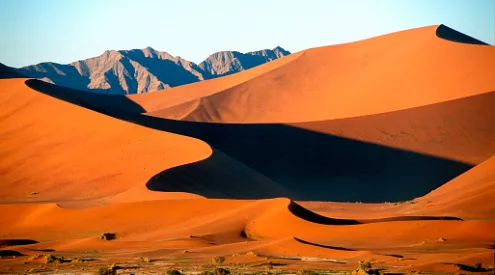

Across Africa’s wide and whispering deserts, art doesn’t hang on walls—it emerges from the land itself. Wind-sculpted dunes, cracked salt pans, and rocky plains have become creative spaces where artists and ancient storytellers leave their mark.
Some works are as old as humanity’s earliest dreams; others are fleeting, shaped by modern hands using stone, sand, and imagination.
This is a continent where the desert itself curates the exhibition.
Ancient open-air galleries

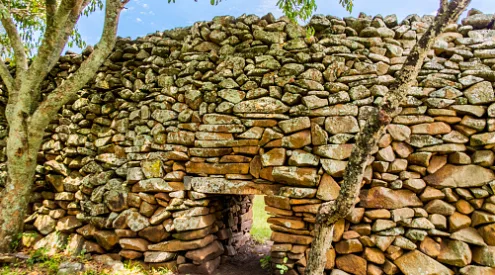
Twyfelfontein rock paintings/Sara&Joachim/Wikimedia Commons
Long before the idea of “land art” existed, Africa’s first artists were painting the stories of their lives across cave walls and cliffs.
In the Drakensberg Mountains of KwaZulu-Natal, roughly 30,000 San paintings bring to life the spiritual and everyday world of Southern Africa’s First People. Declared a UNESCO World Heritage Site, this natural gallery offers a journey into ancient cosmology—where eland dances and trance rituals unfold in ochre and white.
Further north, Twyfelfontein in Namibia tells another story in stone. Thousands of rock engravings, thought to be over 6,000 years old, depict giraffes, rhinos, and mysterious human figures. As one of Africa’s most concentrated rock art sites, it stands as a silent archive of early creativity and spiritual life.
The Maloti-Drakensberg Park, a transboundary site linking Lesotho and South Africa, preserves even more of this heritage. Here, sandstone caves form natural amphitheatres of art, layered with centuries of human expression.
In the Cederberg Mountains, ochre figures appear among sandstone spires, their pigments mixed from earth and ash. And at Bushmans Kloof Wilderness Reserve, visitors can walk between more than 130 rock art sites—some over 10,000 years old—guided by the delicate lines that once linked the human and the divine.
These ancient masterpieces remind travellers that Africa’s first galleries were never bound by walls but by wonder.
The desert as a modern gallery
While time has preserved the stories of the ancients, a new generation of artists is finding ways to continue the conversation—this time using deserts themselves as both studio and subject.
In the Tankwa Karoo, the annual Tankwa Artscape brings artists from across the world into South Africa’s arid heartland. There are no crowds, no power tools, and no gallery walls. Each installation is created using what the desert offers—rock, dust, sunlight—and then left to the elements. Visitors who make the journey discover artworks that appear and disappear, blending into the environment as naturally as mirages.
Nearby, the Stone Folk series by artist Ryno Greeff, hidden in the Karoo’s hills near Nieu-Bethesda, is a pilgrimage for travellers who love discovery. The sculptures—silent stone figures scattered across the veld—stand like guardians of forgotten stories. Finding them feels like stumbling across ancient sentinels who have simply been waiting for you to arrive.
Across the border in southern Namibia, the Wild Horse Geoglyph at Klein-Aus Vista spreads 150 metres across the desert floor. Created by land artists Anni Snyman and PC Janse van Rensburg, it celebrates Namibia’s iconic wild horses and the fragile balance of life in the desert. Seen from above, it’s a monumental reminder that art can honour conservation as much as creativity.
Even in the winelands, the idea of open-air art thrives. Grande Provence in Franschhoek and Cavalli Estate in Stellenbosch both feature sculpture gardens that invite guests to wander among bronzes and stone works between vineyards. While not desert-based, these curated outdoor spaces echo the same philosophy—art that breathes, interacts with light, and shifts with the seasons.
At Samara Private Game Reserve, art takes a subtler form. Here, the land itself is the installation: a vast Karoo canvas where silence, space, and natural detail invite reflection.
Where art meets the elements
What binds these diverse sites together is the idea of art existing within, not apart from, nature. Each piece—whether ancient rock painting or modern geoglyph—is shaped by wind, sun, and erosion. Over time, some fade entirely, their disappearance becoming part of the artwork itself.
These open-air galleries invite travellers to slow down, to look closer, and to see Africa’s deserts not as empty but as alive with stories written in stone and sand.
If you go
- Best time to visit: Autumn and winter (April to August) for cooler, clearer conditions.
- What to bring: A camera with good light control, sturdy shoes, and curiosity. Many sites require guided access—especially those with rock art, which are protected.
- Travel tip: Combine cultural exploration with desert lodges or reserves that support local artists and conservation projects.
Follow us on social media for more travel news, inspiration, and guides. You can also tag us to be featured.
TikTok | Instagram | Facebook | Twitter
ALSO READ: Off the grid, not off the map: Africa’s best digital detox stays