

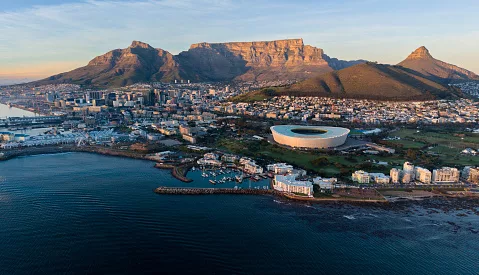


Overlooking Cape Town’s historic harbour, the Time Ball Tower at the V&A Waterfront is a reminder of a time when ships relied on mechanical signals and precise timekeeping to navigate the oceans.

Time Ball Tower/NegativeC/Wikimedia Commons
Once an important part of maritime life in Table Bay, this distinctive landmark has been restored, bringing an unusual piece of the city’s harbour history back to life.
Today, visitors can discover how the tower helped sailors navigate long before GPS and modern communication systems, while enjoying one of the V&A Waterfront’s lesser-known heritage attractions.
A landmark with a maritime history
The story of Cape Town’s time ball dates back to 1836, when the first installation was established at the Royal Observatory in Observatory. Its purpose was practical: to provide ships in Table Bay with an accurate time signal so that navigators could check their marine chronometers.
As Cape Town’s harbour developed and the surrounding settlement expanded, the original installation became increasingly difficult for ships to see. A new time ball was eventually established closer to the harbour, with the present landmark erected in 1894.
The tower became part of the city’s maritime infrastructure, helping vessels arriving at and departing from the Cape establish accurate time at sea. It also reflects Cape Town’s historical importance as a major stop along international shipping routes.
How the time ball helped ships navigate
Before satellite navigation and modern positioning technology, sailors depended on marine chronometers to determine their longitude at sea.
These precision timepieces allowed navigators to compare the time at a known reference point with local time, helping them calculate their position. However, chronometers could gain or lose time during long voyages, making regular adjustments essential.
This is where the time ball came in.
A large ball was mounted on a mast and raised before being released at a predetermined time. Ships within sight of the tower could observe its descent and use the signal to check their chronometers against the correct time.
At the Cape Town installation, the ball was originally operated mechanically, with the system later incorporating electrical controls. The signal was particularly valuable to vessels anchored in Table Bay, where an accurate time reference could make a difference to safe navigation.
The system eventually became obsolete as radio time signals offered a more reliable way of distributing accurate time. By 1934, the traditional time-ball service had been replaced by radio signals.
A historic mechanism restored
After years of standing as a reminder of the harbour’s past, the Time Ball Tower has received a new lease on life.
Following an extensive restoration project, the landmark was officially reopened on 13 November 2025. The work brought its original time-signalling mechanism back into operation, preserving an important part of Cape Town’s maritime heritage.
The restored mechanism is manually cranked at 12:55, before an electronic signal from the South African Astronomical Observatory triggers the ball’s descent at precisely 13:00.
The time ball now operates twice a week, on Mondays and Thursdays, allowing visitors to witness the historic ritual for themselves.
The restoration involved the V&A Waterfront, engineers, architects and heritage specialists, who worked to preserve the tower’s character while returning its mechanism to working order.
Visiting the Time Ball Tower
Located beside the Dock House Boutique Hotel at the V&A Waterfront, the tower is an easy addition to a day spent exploring Cape Town’s historic harbour precinct.
Visitors can take a closer look at the structure, learn about its role in maritime navigation and, if they time their visit correctly, watch the ball drop at 13:00 on Mondays or Thursdays.
The experience also offers an interesting reason to explore the Waterfront beyond its restaurants, shops and popular attractions. Its history is closely connected to Cape Town’s development as a working harbour and an important stop for international shipping.
For a broader look at the area’s past, visitors can also explore the V&A Waterfront’s free self-guided audio walking tour, Reinventing the Tavern of the Seas, which introduces some of the precinct’s heritage sites and maritime stories.
The Time Ball Tower may no longer guide ships across the Atlantic, but its restored mechanism offers a fascinating glimpse into the ingenuity that once kept sailors on course. It is a small but significant piece of Cape Town history, and one worth making time for when exploring the Waterfront.
Follow us on social media for more travel news, inspiration, and guides. You can also tag us to be featured.
Instagram | Facebook | Twitter | Spotify
ALSO READ:
Trafalgar Beach: The ancient fossils hidden along KwaZulu-Natal’s coastline