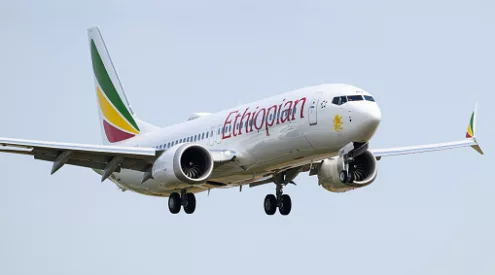






South African Airways, South Africa’s oldest airline and a national symbol in aviation history, is once again under the spotlight. Founded in 1934 after the government absorbed Union Airways, the carrier has long carried both prestige and controversy in equal measure.
Sourced: X{@cgtnafrica}
According to BusinessTech, today, however, that legacy is being tested not just by financial pressures, but by leadership instability and troubling security revelations that have sparked fresh concern about whether the airline can truly sustain its recovery.
The airline’s modern struggles are well documented. In 2019, it entered voluntary business rescue after years of financial distress and mounting debt. At the time, it had not posted a profit since 2011 and was considered technically insolvent.
Operations resumed in 2021 after a major restructuring, but with a significantly reduced footprint. From just a handful of aircraft and routes, the airline slowly rebuilt itself, eventually expanding to a larger fleet and a broader regional network.
A rare moment of optimism came when SAA announced a R155 million profit for the financial year ending March 2025, suggesting the turnaround strategy was finally gaining traction.
That optimism was short-lived.
In April 2026, CEO John Lamola announced his resignation, effective 30 April, with little public explanation. The timing alone has triggered concern across aviation and economic circles, with analysts questioning whether internal disagreements or deeper structural issues may be at play.
Transport economist Joachim Vermooten described the exit as a sign of instability, suggesting it may point to unresolved tensions over strategy, funding, or governance direction within the airline.
While SAA has reported improved financial results, questions are now being raised about how sustainable those gains really are.
Some analysts argue that reported profits may be influenced by historical state support and complex accounting structures rather than consistent operational performance. Others note that while the airline appears compliant with reporting standards, its long-term earnings stability remains uncertain.
In simple terms, the concern is not whether SAA can report profit in a single year — but whether it can maintain it without continued intervention.
Another challenge lies in the economics of flying itself. Industry benchmarks suggest airlines now need extremely high load factors — around 82% — to break even.
That leaves little room for error, especially for a carrier still rebuilding its network.
On regional routes, competitors such as Airlink have been praised for using smaller, fuel-efficient aircraft that better match passenger demand. Analysts argue that this flexibility gives private operators a structural advantage over larger state-linked carriers.
Beyond finances and operations, governance issues are now part of the conversation.
The airline has confirmed incidents involving organised criminal syndicates targeting valuable aircraft components. These revelations have raised serious questions about internal controls and security oversight.
In one high-profile case, a former avionics technician was convicted and sentenced to 18 years in prison for stealing high-value aircraft parts linked to a wider syndicate. The investigation involved cooperation between airline security teams and the South African Police Service, spanning several years.
Avionics systems — the electronic “nervous system” of an aircraft — are among the most sensitive and expensive components, making the thefts particularly alarming for aviation safety experts.
Concerns about internal theft and governance are not new. As far back as 2018, parliamentary oversight bodies warned that corruption and asset theft were contributing factors in the airline’s financial decline.
That history now casts a long shadow over current recovery efforts, especially as the airline tries to convince both investors and the public that it has truly turned a corner.
On social media, reactions have been mixed — ranging from frustration to cautious concern. Many South Africans see SAA as more than just an airline; it is a national institution tied to pride, connectivity, and economic mobility.
But repeated cycles of crisis and recovery have also created fatigue. Each new setback fuels the same question: is this a temporary disruption, or a sign of deeper structural instability?
SAA’s journey is no longer just about returning to profitability. It is about rebuilding trust — in leadership, governance, and operational integrity.
With leadership uncertainty, competitive pressure, and ongoing security concerns all converging at once, the airline’s next chapter may prove to be one of its most defining yet.
Whether it stabilises or slips back into crisis will depend not only on financial performance, but on whether it can finally resolve the governance and structural weaknesses that have followed it for years.
Source: BusinessTech
Follow us on social media for more travel news, inspiration, and guides. You can also tag us to be featured.
TikTok | Instagram | Facebook
ALSO READ:
Necessary cookies are absolutely essential for the website to function properly. These cookies ensure basic functionalities and security features of the website, anonymously.
| Cookie | Duration | Description |
|---|---|---|
| cookielawinfo-checkbox-analytics | 11 months | This cookie is set by GDPR Cookie Consent plugin. The cookie is used to store the user consent for the cookies in the category "Analytics". |
| cookielawinfo-checkbox-functional | 11 months | The cookie is set by GDPR cookie consent to record the user consent for the cookies in the category "Functional". |
| cookielawinfo-checkbox-necessary | 11 months | This cookie is set by GDPR Cookie Consent plugin. The cookies is used to store the user consent for the cookies in the category "Necessary". |
| cookielawinfo-checkbox-others | 11 months | This cookie is set by GDPR Cookie Consent plugin. The cookie is used to store the user consent for the cookies in the category "Other. |
| cookielawinfo-checkbox-performance | 11 months | This cookie is set by GDPR Cookie Consent plugin. The cookie is used to store the user consent for the cookies in the category "Performance". |
| viewed_cookie_policy | 11 months | The cookie is set by the GDPR Cookie Consent plugin and is used to store whether or not user has consented to the use of cookies. It does not store any personal data. |
Functional cookies help to perform certain functionalities like sharing the content of the website on social media platforms, collect feedbacks, and other third-party features.
Performance cookies are used to understand and analyze the key performance indexes of the website which helps in delivering a better user experience for the visitors.
Analytical cookies are used to understand how visitors interact with the website. These cookies help provide information on metrics the number of visitors, bounce rate, traffic source, etc.
Advertisement cookies are used to provide visitors with relevant ads and marketing campaigns. These cookies track visitors across websites and collect information to provide customized ads.
Other uncategorized cookies are those that are being analyzed and have not been classified into a category as yet.