


Eight years ago, Blue’s future looked very different.
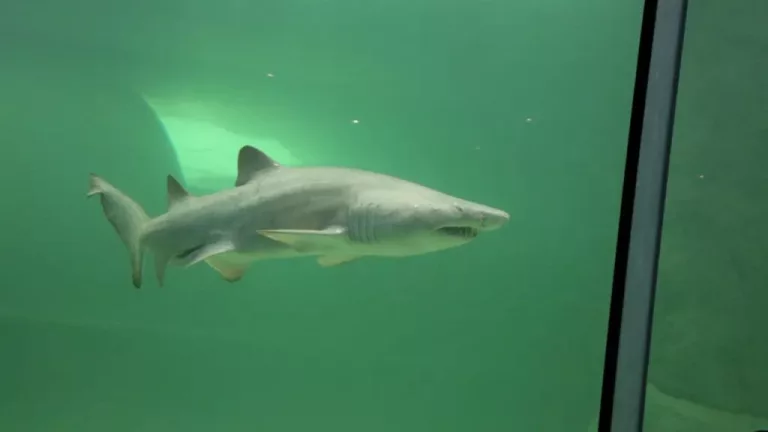
Picture: Two Oceans Aquarium
The ragged-tooth shark was among four sharks intercepted by South African authorities at Cape Town International Airport in May 2018 after they were found in an illegal shipment bound for the Netherlands.
According to the Department of Forestry, Fisheries and Environment (DFFE), the sharks had been captured in Port Alfred in the Eastern Cape and were being exported without the permits required under South African law. Ragged-tooth sharks are protected in South Africa, with their capture, possession, transport and export subject to strict controls.
Instead of continuing their journey overseas, the sharks were taken to the Two Oceans Aquarium, where they received care and veterinary attention.
According to the Two Oceans Aquarium, the rescue was also recognised as one of the successes of Operation Thunderstorm, an international effort targeting wildlife and timber trafficking. The case drew attention to a lesser-known side of wildlife crime: the illegal international trade in live sharks.
A shark people wanted to see
Live shark trafficking may receive less attention than the illegal trade in shark fins and meat, but ragged-tooth sharks are highly sought after by aquariums.
Their ability to remain relatively still in the water makes them particularly suited to aquarium environments. They can also gulp air at the surface, helping them control their buoyancy, while their ability to pump water over their gills means they do not have to keep swimming to breathe.
Their distinctive teeth are another part of their appeal.
Kevin Spiby, Curator of Operations and Animal Husbandry at the Aquarium, said their prominent teeth can attract visitors, even though the sharks are comparatively docile.
That contrast also gives aquariums an opportunity to challenge some of the fear and misconceptions often associated with sharks.
Blue grew from a juvenile into a mature female
When Blue arrived at the Aquarium in 2018, she was just 183cm long and weighed less than 30kg.
She would eventually become a very different shark.
In March 2026, Blue was released at Struisbaai after reaching 295cm and weighing 201kg. The Two Oceans Aquarium said she swam strongly into the ocean after being walked into the surf by staff.
Her release was particularly significant because female ragged-tooth sharks have a slow reproductive cycle. They take around eight to 10 years to mature, can have a gestation period of up to 12 months and produce no more than two surviving pups per pregnancy.
That means Blue was not simply returning to the ocean. She was returning as a mature female with the potential to contribute to the wild population.
Her journey will continue to be tracked
Blue’s time in human care did not mean she lost the instincts needed to survive in the wild.
According to the Two Oceans Aquarium, ragged-tooth sharks receive no parental care after birth, meaning many of the behaviours they need to survive are instinctive. The Aquarium also says its conservation programme has found that raggies can adapt well after time in captivity.
Before her release, Blue was fitted with an acoustic tag by veterinarian Dr Ilse Jenkinson.
The tag allows researchers to follow her movements through a network of acoustic receivers around the South African coast. The information can help researchers better understand where ragged-tooth sharks travel and the habitats they use.
The Aquarium is already tracking around 60 sharks, with some providing as much as a decade of data. According to Spiby, movements recorded from previously captive sharks have been remarkably similar to those of wild sharks.
Why Blue’s return matters
Ragged-tooth sharks are classified as critically endangered worldwide. Their slow reproduction, combined with their use of shallow coastal and nearshore habitats, leaves them vulnerable to fishing pressure, habitat disturbance and accidental capture.
South Africa is particularly important for the species. Genetic research cited by the Aquarium found no evidence of a comparable population decline in South Africa, unlike some regions where raggies have become severely depleted or disappeared.
For Blue, that makes her story about more than one successful rescue.
She was intercepted before entering an international live-shark trade, spent years in human care, contributed to education and research, and was eventually returned to the ocean as a mature female.
The Two Oceans Aquarium says the release gives her an opportunity to resume her natural role while contributing to the future of her species.
What people can do for sharks
According to Inge Adams, Head of Quarantine at the Aquarium, one way people can help is by becoming more informed about sustainable seafood.
Adams points to WWF’s Southern African Sustainable Seafood Initiative (SASSI), which provides information on seafood choices and which species consumers should avoid. Sharks can also be affected as bycatch in unsustainable fisheries.
Blue’s story began with an illegal journey that could have taken her far from South African waters.
Eight years later, she has returned to the ocean.
For a species facing global decline, her second chance represents something bigger than a single shark: the opportunity for a mature female to return to the wild and potentially play a role in the future of ragged-tooth sharks.
Article shared by Cape Etc.
Follow us on social media for more travel news, inspiration, and guides. You can also tag us to be featured.
Instagram | Facebook | Twitter | Spotify
ALSO READ:
Pilchard herpesvirus detected in sardines along South Africa’s West Coast