







Against the odds, a small population of endangered Ganges River dolphins is still living in one of Bangladesh’s most polluted waterways.
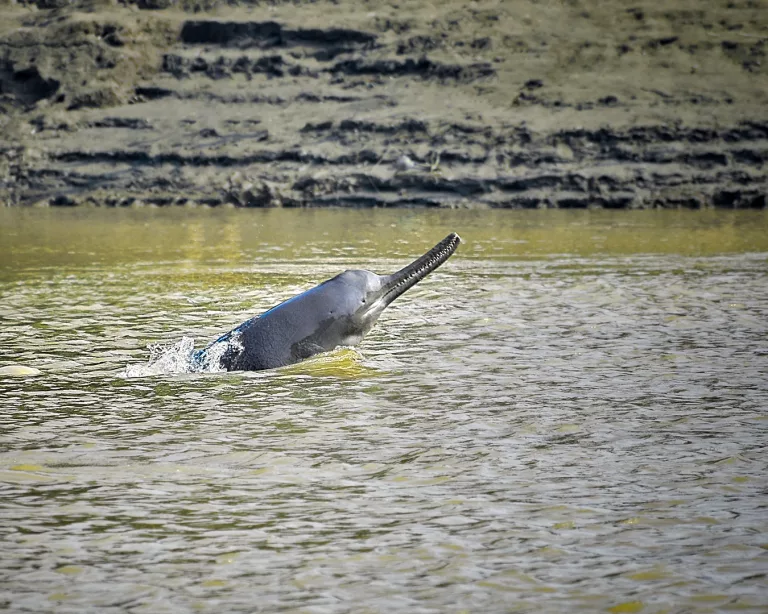
Ganges River dolphins/Kukil Gogoi/Wikimedia Commons
The Buriganga River runs alongside Dhaka, Bangladesh’s densely populated capital, and is heavily affected by industrial waste, sewage and solid pollution. Much of the river is considered unsuitable for many species of fish.
Yet a recent survey has found that around 20 Ganges river dolphins (Platanista gangetica) continue to live in the river.
The findings, published in the Journal of Asia-Pacific Biodiversity, are based on 12 months of surveys conducted between September 2023 and August 2024. Researchers surveyed a 27-km stretch of the Buriganga along the southern edge of Dhaka.
According to Mongabay, dolphins were recorded during 10 of the 12 months of the survey, with the highest numbers seen in December and during the winter months.
The discovery has surprised researchers because of the river’s extreme environmental conditions.
“The Buriganga is not a usual place for dolphins, where native fishes have largely vanished,” researcher Md. Aminur Rahman told Mongabay.
The survey also recorded groups averaging more than four dolphins, while calves made up almost 16% of sightings. The presence of calves suggests the dolphins are still reproducing in the river despite the pollution.
A river under enormous pressure
The Buriganga is under intense pressure from the city and industries surrounding it.
Untreated wastewater from tanneries, textile and dyeing factories, battery plants, metal-processing facilities, pharmaceutical companies and other industries enters the river. Sewage, rubbish and urban runoff add to the pollution.
Studies of the river have detected heavy metals including chromium, lead, cadmium, arsenic, mercury, nickel, copper and zinc in its water and sediments.
During the dry season, oxygen levels in parts of the river can also fall to extremely low levels, creating conditions that are difficult for many aquatic species to survive.
The result has been a dramatic decline in biodiversity, with native fish populations particularly affected.
Despite this, some pollution-tolerant species have managed to survive.
ALSO READ:
The dolphins may be feeding on pollution-tolerant fish
Researchers believe one unlikely food source could be helping the dolphins survive.
The Buriganga is now home to large numbers of suckermouth catfish, an invasive species known for tolerating poor water conditions. Some catfish can also take in air at the surface, allowing them to cope with environments where oxygen levels in the water are low.
Mohammad Abdul Aziz, a zoology professor at Jahangirnagar University, told Mongabay that the dolphins may be hunting these fish.
But having a food source does not mean the river is a safe habitat.
Researchers say pollution remains the biggest concern for the dolphins. Heavy boat traffic is another threat, as vessels can interfere with the animals’ movements and behaviour.
“If we want to conserve the dolphins in the Buriganga, the priority must be to stop the pollution,” Aziz told Mongabay.
Ganges river dolphins are declining in Bangladesh
The Buriganga population is part of a much larger population of Ganges river dolphins found across Bangladesh’s river systems.
A survey by Bangladesh’s Forest Department and WCS Bangladesh recorded 2,307 Ganges river dolphins during surveys covering approximately 4,900 km of 45 rivers between 2024 and 2025.
The survey identified 25 dolphin hotspots across the country.
However, the species continues to face significant threats, including pollution, habitat degradation and harmful fishing practices. Illegal gill nets can trap and kill dolphins, while increasing human activity on rivers puts further pressure on their habitat.
Researchers have also recorded changes in where dolphins are found. Dolphins previously observed in rivers such as the Turag are no longer regularly seen there.
The Buriganga dolphins, meanwhile, appear to move between the river and waterways further downstream, including the Dhaleshwari and Meghna rivers. Many remain concentrated around the Bosila area.
A small population worth protecting
The survival of dolphins in such a heavily polluted river is remarkable, but researchers warn that their presence should not be interpreted as evidence that the Buriganga is healthy.
Instead, it highlights the resilience of a species living under extraordinary pressure.
Bangladesh has already taken steps to protect freshwater dolphins. In 2012, the government declared three wildlife sanctuaries in the Sundarbans to protect Ganges river and Irrawaddy dolphins.
For the dolphins of the Buriganga, however, researchers say broader action is needed.
Reducing pollution, limiting harmful fishing practices and managing boat traffic could all play a role in giving the remaining dolphins a better chance of survival.
For now, the small population continues to inhabit a river where many other species have disappeared, making its survival one of the Buriganga’s most unexpected wildlife stories.
Source: Mongabay
Follow us on social media for more travel news, inspiration, and guides. You can also tag us to be featured.
Instagram | Facebook | Twitter
ALSO READ: