



South Africa is a place where history isn’t always confined to museums, monuments and old buildings. Look closely at the landscape, and you can find evidence of a much older story: ancient volcanic rocks, meteorite impacts, dinosaur-era sandstone, fossilised animals and caves that preserve clues to the origins of humanity.
Some of these landscapes are billions of years old, while others reveal what southern Africa looked like just a few million years ago. Together, they offer a remarkable way to experience deep time by walking through the places where Earth’s story is still written into the rocks.
1. Walk among some of Earth’s oldest rocks in the Barberton Makhonjwa Mountains
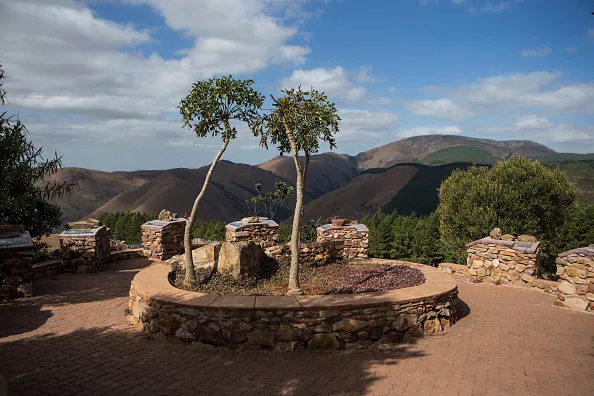
Rocks are displayed with information about their history and creation at the Lebombo Viewpoint on the geotrail of Makhonjwa Mountains near Barberton/Photo by WIKUS DE WET/AFP via Getty Images)
Mpumalanga | 3.6 billion to 3.25 billion years ago
Long before there were mountains, forests, rivers or animals as we know them today, the rocks of the Barberton Makhonjwa Mountains were forming.
The mountain range in Mpumalanga contains part of the Barberton Greenstone Belt, one of the oldest geological structures on Earth. UNESCO describes its volcanic and sedimentary rocks as among the oldest and best-preserved on the planet, dating from approximately 3.6 billion to 3.25 billion years ago.
That visit here is less about finding a single fossil or archaeological object and more about seeing an ancient chapter of the planet itself.
The rocks preserve evidence of the conditions on early Earth, including ancient volcanism, meteorite impacts, the formation of continents and the environment in which early life developed. UNESCO notes that the geological record contained here spans around 340 million years of Earth’s early history.
Look at the landscape differently
The mountains can be enjoyed as a scenic destination, but their real significance is written into the exposed rock. What appears to be another dramatic mountain landscape is actually a window into an Earth that existed billions of years before humans.
The area was declared a UNESCO World Heritage Site in 2018, recognising its exceptional geological importance.
2. Explore the landscape shaped by an ancient meteorite in the Vredefort Dome
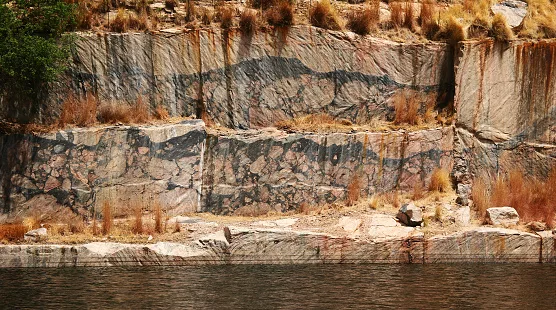
Panoramic view of the pseudotachylite mural, one of the most frequently visited sites in the Vredefort astrobleme. Shot in the UNESCO Vredefort Dome World Heritage Site not far from Vredefort, Free State/By: Attie Gerber/
iStock
Free State | about 2 billion years ago
Two billion years ago, an enormous meteorite struck Earth in what is now South Africa.
The resulting impact created the Vredefort structure, now known as the Vredefort Dome. UNESCO dates the impact to about 2,023 million years ago and describes the site as the oldest, largest and most deeply eroded complex meteorite impact structure known on Earth.
The original impact structure was vastly larger than what visitors can see today. Over billions of years, erosion and geological processes have stripped away much of the crater, exposing rocks from deep beneath the original impact site.
That erosion is part of what makes the Vredefort Dome so fascinating. Instead of simply seeing an obvious crater, visitors encounter a landscape that reveals the geological consequences of an event that happened unimaginably long ago.
Read the rocks
The area contains exposed geological formations that provide evidence of the enormous forces involved in the impact, including shock-related features and structures created when rocks were subjected to immense pressure.
The surrounding countryside also makes the site accessible as a landscape rather than simply a scientific curiosity. Rivers, hills, farms and rocky outcrops form part of the experience, allowing travellers to explore the region while keeping in mind that they are standing inside one of Earth’s most extraordinary geological stories.
ALSO READ:
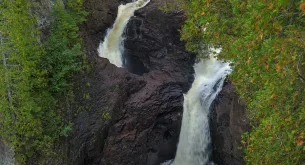
The Devil’s Kettle: The Minnesota waterfall that appears to swallow half its river
3. See a dinosaur-era landscape at Golden Gate Highlands National Park
Free State | about 200 million years ago
The sandstone cliffs of Golden Gate Highlands National Park are beautiful enough to draw visitors without any explanation, but their colours and shapes are also remnants of an ancient world.
SANParks says the park’s geological layers were formed during different environments around 200 million years ago. Mud and sediment were deposited when the region was a wetland or floodplain, followed by sandstone deposits formed when the area became a desert. Later volcanic activity added another layer to the landscape.
This was also a time when dinosaurs walked across what is now the Free State.
Meet the dinosaurs
Golden Gate has a particularly important place in South Africa’s dinosaur story. The region is associated with fossils of Massospondylus, including dinosaur embryos discovered in the park.
The Kgodumodumo Dinosaur Interpretation Centre, launched at Golden Gate in 2025, tells the story of the area’s prehistoric heritage and the roughly 200-million-year-old dinosaur world preserved in its rocks and fossils.
The experience adds another dimension to a visit to Golden Gate. Hiking beneath the distinctive sandstone cliffs becomes a chance to imagine a very different landscape, one in which early dinosaurs moved across floodplains and deserts long before humans appeared.
4. Step into the story of human evolution at the Cradle of Humankind
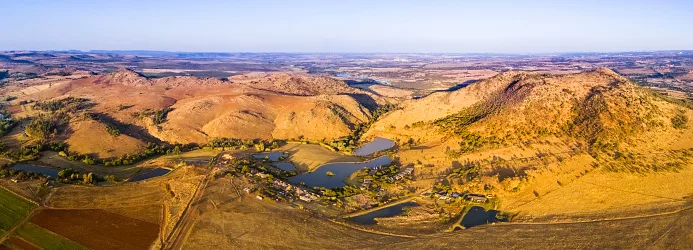
Cradle of Humankind is a World Heritage Site situated 50km North West of Johannesburg, occupying 47,000 hectares of countryside/By: COSMOS-120/Getty Images
Gauteng and Limpopo | more than 3 million years of human history
The story changes dramatically at the Cradle of Humankind, where the focus shifts from the formation of the planet to the evolution of our own species.
The UNESCO-listed Fossil Hominid Sites of South Africa include Sterkfontein, Swartkrans, Kromdraai and surrounding sites in Gauteng, as well as Makapan Valley in Limpopo and the Taung Skull Fossil Site in North West. Collectively, the sites have produced important evidence relating to human evolution over at least the past 3.5 million years.
The caves and fossil-bearing deposits have produced some of the most significant discoveries in palaeoanthropology, including Australopithecus fossils and evidence of early human occupation and technological development.
Go beneath the surface
At the Cradle, the landscape itself is part of the story. Limestone caves and underground deposits helped preserve fossils and other evidence that would otherwise have disappeared.
The Maropeng Visitor Centre provides an accessible introduction to this history, with exhibitions exploring human evolution, fossils and ancient stone tools.
The UNESCO property also extends beyond the better-known Gauteng sites. Makapan Valley in Limpopo contains archaeological caves with evidence of human occupation and evolution dating back roughly 3.3 million years, while the Taung Skull Fossil Site is where the famous Taung Child was discovered in 1924.
Together, these places show that the story of humanity isn’t contained in a single fossil. It is scattered across landscapes, caves and layers of rock.
5. Discover a prehistoric West Coast at the West Coast Fossil Park
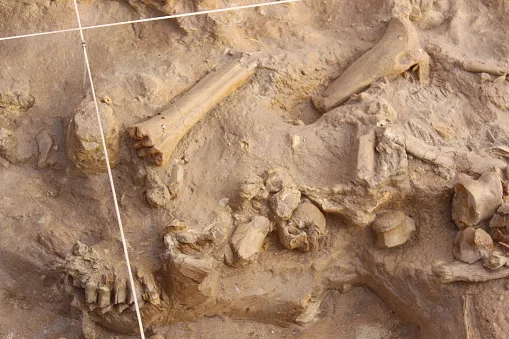
Fossils include bones of over 200 different animal species/By: Winston Fowler/
iStock
Western Cape | about 5.2 million years ago
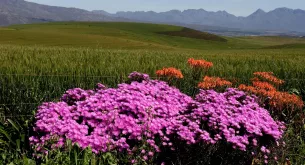
Today, the West Coast is associated with fynbos, beaches, fishing villages and seasonal wildflowers. Around five million years ago, the landscape looked very different.
At the West Coast Fossil Park near Langebaan, exceptionally well-preserved fossils reveal a world of approximately 5.2 million years ago. The site contains evidence of animals including sabre-toothed cats, short-necked giraffes, hunting hyenas and African bears, while the region’s climate was warmer and more subtropical, with riverine forests and open grasslands.
See fossils where they were found
One of the West Coast Fossil Park’s most unusual features is that visitors can see fossils in situ at an active fossil site.
Phosphate miners uncovered the fossil deposits, and part of the former mining area has since been protected as a National Heritage Site. Excavations continue to reveal evidence of the ancient animals and environments that existed here.
It is an especially effective place to understand how dramatically a familiar landscape can change over geological time. The dry-looking West Coast of today once supported a much greener environment inhabited by animals that have long since disappeared.
A journey through deep in time
These five destinations tell very different stories, but together they create a remarkable timeline.
In the Barberton Makhonjwa Mountains, you can encounter rocks dating back around 3.6 billion years. At Vredefort, you can explore the geological aftermath of an impact around 2 billion years ago. Golden Gate reveals a landscape shaped during the dinosaur era around 200 million years ago, while the West Coast Fossil Park preserves evidence of an animal-rich world around 5.2 million years ago.
Then, at the Cradle of Humankind, the story becomes increasingly familiar as the evidence begins to trace the long evolutionary journey that eventually produced us.
The result is a reminder that South Africa’s history is much older than its human settlements, archaeological sites and colonial buildings. It is a story written into mountains, caves, fossils and layers of rock.
Follow us on social media for more travel news, inspiration, and guides. You can also tag us to be featured.
Instagram | Facebook | Twitter | Spotify
ALSO READ: