


The world’s largest penguin colony has suffered a dramatic decline, with its chinstrap penguin population falling by about two-thirds since 2011.
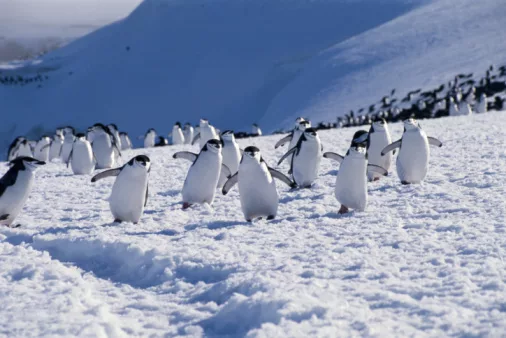
Chinstrap penguins/Zavodovski Island, Antarctica/By: Johnny Johnson/Getty Images
A new study published in Current Biology found that the chinstrap penguin colony on Zavodovski Island in the South Sandwich Islands has experienced what researchers describe as an ‘enormous population crash’. The findings were reported by The Guardian.
The remote island was once home to the world’s largest colony of chinstrap penguins, with around 600,000 breeding birds recorded in 2011. By 2025, that number had fallen substantially, with researchers warning that the colony may have lost its status as the largest of its kind.
Climate change is likely driving the decline
Scientists believe climate disruption is the most likely explanation for the rapid population decline.
Chinstrap penguins depend heavily on Antarctic krill, which form a major part of their diet. Tracking data shows the birds typically forage in cooler waters to the north-west of Zavodovski Island, where krill have historically been abundant.
As ocean temperatures rise, however, krill are shifting further south towards the Weddell Sea. This leaves chinstrap penguins travelling further to find food and struggling to access the resources they depend on.
The wider Antarctic region has experienced significant warming in recent years. Scientists have recorded exceptionally high temperatures around the Antarctic Peninsula, raising further concerns about how quickly the continent’s ecosystems are changing.
A changing ecosystem
The decline is particularly concerning because penguins play an important role in Antarctic food webs.
Researchers compared the ecosystem to a giant Jenga set, warning that removing one component can increase the risk of wider instability.
The study also found that macaroni penguins on Zavodovski Island increased by about 30%. Unlike chinstraps, macaroni penguins have a more varied diet, meaning they may be better able to adapt to changes in food availability.
However, their increase was nowhere near enough to offset the loss of chinstrap penguins.
ALSO READ:
The volcano wasn’t to blame
Zavodovski Island is volcanic and experienced a major eruption in 2016, which initially led scientists to consider whether ash and lava could have caused the penguin population to collapse.
Researchers found little evidence to support this theory.
Instead, the data showed a steady decline rather than a sudden population crash following the eruption. Observations also found that chinstrap penguins largely avoided the areas most heavily affected by ash and lava.
The researchers also ruled out competition between chinstrap and macaroni penguins as a major cause, while the island’s extreme remoteness means human activity is unlikely to have directly driven the decline.
What the decline means for Antarctic wildlife
The speed of the population decrease has raised concerns that chinstrap penguins could eventually qualify for endangered species status.
The findings also highlight how changes in ocean temperatures can affect wildlife far beyond the species directly experiencing them. When a key food source such as krill shifts its distribution, predators that depend on it can be affected too.
With climate change continuing to reshape Antarctic waters, Zavodovski’s penguins provide another warning of how rapidly even some of the world’s most remote ecosystems can change.
Source: The Guardian
Follow us on social media for more travel news, inspiration, and guides. You can also tag us to be featured.
Instagram | Facebook | Twitter | Spotify
ALSO READ:
World Octopus Day: 8 fascinating facts about one of the ocean’s strangest creatures