



Two men have been arrested following a rhino poaching incident at Lawrence de Lange Game Reserve in Komani, Eastern Cape, which left a mother rhino and her calf dead. A third suspect remains at large after allegedly fleeing the scene. The arrests were reported by IOL.
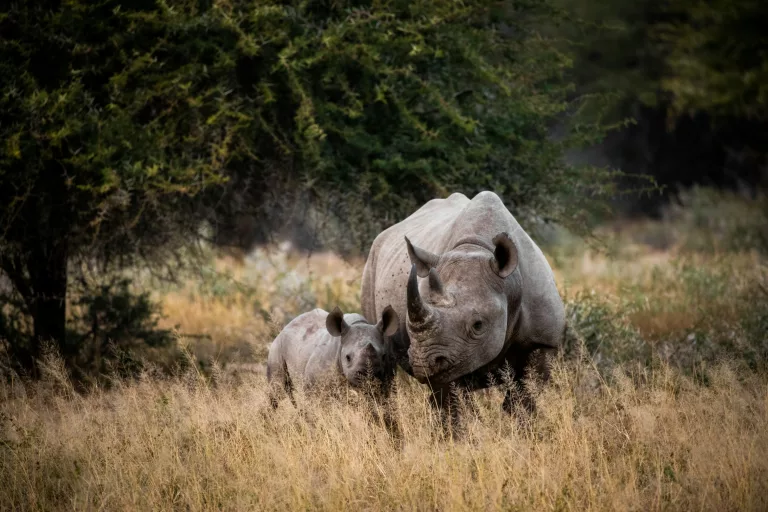
Photo: Unsplash
According to IOL, police spokesperson Captain Yolisa Mgoledela confirmed that the two suspects, aged 35 and 36, were expected to appear in the Komani Magistrate’s Court on Monday. However, their appearance was postponed due to administrative issues, with their first court appearance expected later this week.
The two men, who are Mozambican nationals, face charges relating to the possession of an unlicensed firearm and ammunition, the illegal hunting of protected species and the possession of suspected stolen property, including rhino horns.
Two suspects arrested following joint police operation
The arrests were made on Saturday following a joint operation involving the South African Police Service (SAPS), a private security company and other stakeholders.
Police received information about the suspected poaching incident from Crime Intelligence at approximately 6.55am, after employees at Lawrence de Lange Game Reserve discovered a mother rhino and her calf had been shot dead and their horns removed.
A police team was dispatched to the reserve, where investigators identified a vehicle believed to have been used in the incident.
Later that afternoon, at approximately 4pm, Red Guard Security officers spotted the vehicle at a petrol station on Cathcart Road. They alerted police, who subsequently arrested two men. A third suspect allegedly managed to escape.
During the operation, police recovered four rhino horns, a .375 rifle fitted with a silencer and live ammunition. A Volkswagen Polo with Cape Town registration plates, believed to have been used during the poaching incident, was also confiscated, along with three cellphones.
Missing rhino found with gunshot wound
The incident initially raised further concern when game reserve manager Kevin Lieberum revealed that one of the reserve’s ten rhinos was unaccounted for following the attack.
After an extensive search, the missing animal was located with a gunshot wound, Mgoledela confirmed.
Lieberum said the reserve had not experienced a poaching incident since 2018. Following that incident, the Enoch Mgijima Local Municipality assisted with strengthening security measures at the facility.
The municipality has since condemned the latest attack, describing it as a senseless act of wildlife crime.
In a statement, it said the incident not only robbed the community of its natural heritage but also undermined efforts to develop and promote local tourism facilities as drivers of economic development and job creation.
The municipality added that it would not allow criminal activity to undo years of progress in wildlife conservation, highlighting the importance of rhinos to biodiversity and tourism.
Rhino poaching remains a concern in South Africa
The Eastern Cape incident comes amid ongoing efforts to protect South Africa’s rhino populations, despite encouraging signs of population growth.
On World Rhino Day in September 2026, the Department of Forestry, Fisheries and the Environment (DFFE) reported that the country’s rhino population had increased by 4.9% since 2024.
However, the department warned that poaching remains a significant threat.
Between January and the end of August 2026, 230 rhinos were poached across South Africa, compared with 248 during the same period in 2025. The Kruger National Park recorded the highest losses, with 114 rhinos killed during those eight months.
To strengthen conservation efforts, the DFFE has introduced a 10-year Biodiversity Management Plan aimed at growing South Africa’s black and white rhino populations. This includes improved biological management interventions and support for projects that expand existing rhino populations.
The department also plans to establish a National Rhino Conservation Co-ordination Committee to lead the implementation of the management plan.
According to the DFFE, protecting the country’s rhinos requires continued co-operation between conservation authorities, law enforcement agencies, government institutions, local communities, the private sector and international partners.
While the increase in rhino numbers offers some encouragement, the latest incident in Komani highlights the continued threat posed by wildlife crime and the importance of protecting South Africa’s natural heritage.
ALSO SEE: Cape Town plant poacher fined R80,000 and barred from Western Cape reserves
Cape Town plant poacher fined R80,000 and barred from Western Cape reserves