

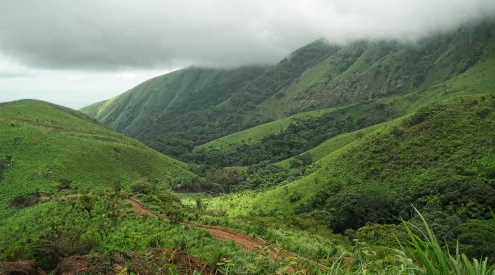


The rugged coastline of Tsitsikamma is one of the most distinctive landscapes along South Africa’s Garden Route, writes Miriam Kimvangu.

Matthias Wesselmann/Unsplash
Characterised by steep cliffs, deep river gorges and dense indigenous forest, the region forms part of the protected area now known as Tsitsikamma National Park. While many visitors recognise Tsitsikamma for its dramatic scenery and the well known suspension bridge at Storms River Mouth, the area’s history reflects a long relationship between people and the coastal environment.
Indigenous heritage and early history
The name Tsitsikamma is believed to originate from the language of the Khoikhoi and is commonly translated as “place of abundant water” or “place of sparkling water.” The name reflects the region’s geography, where numerous short and steep rivers flow from the Tsitsikamma Mountains through thick forest before reaching the Indian Ocean. One of the most prominent of these rivers is the Storms River, which cuts a narrow gorge through the coastal cliffs before meeting the sea.
Archaeological evidence along the Garden Route coastline indicates that human communities have occupied and travelled through the region for thousands of years. Indigenous hunter gatherer groups used coastal caves and forest clearings as temporary shelters and resource sites. The surrounding environment offered a wide variety of food sources, including shellfish, fish, small game and edible plants.
The dense forests also played an important role in indigenous life. They provided medicinal plants, wood and natural pathways that connected the coast with inland areas. Although permanent settlements were uncommon due to the thick vegetation and steep terrain, the region formed part of a broader network of seasonal movement across the southern Cape.
ALSO READ: Ghost infrastructure: Journey through the abandoned projects that quietly shaped Southern Africa
Colonial expansion and the forest economy
European settlement in the Tsitsikamma region expanded during the late eighteenth and nineteenth centuries. However, the rugged geography presented significant challenges to early settlers. Deep ravines, thick forest and limited access routes made travel and agriculture difficult.
Despite these obstacles, the Tsitsikamma forests became an important resource during the colonial period. Woodcutters were drawn to the region to harvest valuable indigenous hardwoods such as yellowwood, stinkwood and other timber species used for construction and furniture making. Small forestry communities developed in isolated pockets within the forest.
Transporting timber from the forests to coastal or inland markets was a slow and labour intensive process. Ox wagons were commonly used to move logs along rough forest tracks, often taking several days to reach nearby towns such as Plettenberg Bay or Humansdorp. Because of the region’s isolation, many forestry workers lived in remote camps and depended heavily on the surrounding environment for survival.
Over time, concerns began to grow about the impact of uncontrolled logging on indigenous forests. By the early twentieth century, parts of the Tsitsikamma forest had already experienced significant exploitation.
ALSO READ: A speed lover’s guide to South Africa’s top motorsport venues
Establishment of Tsitsikamma National Park
Recognition of the ecological importance of the region led to formal conservation efforts during the mid twentieth century. In 1964 the government established Tsitsikamma National Park to protect both the coastal forest and the adjacent marine environment.
The park was significant because it included one of the first marine protected areas in Africa. Approximately 80 kilometres of coastline were placed under protection, creating a sanctuary for marine species such as reef fish, crustaceans and other coastal organisms. The protected forests also helped conserve one of the largest remaining tracts of indigenous forest along the Garden Route. As the park developed, infrastructure was gradually introduced to allow controlled public access while maintaining environmental protection. Walking trails, viewpoints and visitor facilities were established in carefully selected areas.
The construction of the Storms River suspension bridge
One of the most recognisable features within the park is the Storms River Suspension Bridge. The bridge spans the mouth of the Storms River where it flows through a narrow gorge before entering the Indian Ocean. Before the bridge was constructed, reaching the opposite side of the gorge was difficult and sometimes dangerous. Visitors had to scramble over rocks or attempt to cross the river itself, which was often influenced by tides and strong currents.
To improve accessibility to the scenic gorge, park authorities constructed the suspension bridge in 1969. The bridge measures approximately 77 metres in length and is suspended high above the water between two rocky cliff faces. Steel cables anchored into the surrounding rock provide the structural support that allows the narrow walkway to remain stable while accommodating the natural movement typical of suspension bridges.
A gateway to one of South Africa’s best known trails
The suspension bridge also marks the starting point of the renowned Otter Trail. This five day hiking route stretches for approximately 45 kilometres along the rugged coastline between Storms River Mouth and Nature’s Valley. The trail crosses rocky headlands, river mouths and sections of coastal forest, providing hikers with an immersive experience of the Tsitsikamma landscape. Because of its limited daily permits and challenging terrain, the Otter Trail has become one of the most sought after hiking routes in South Africa.
ALSO READ: 5 scenic camping destinations worth the journey
Maintenance and preservation of a landmark
Today the Storms River suspension bridge remains one of the most recognisable landmarks in Tsitsikamma. Thousands of visitors cross it each year, often pausing in the centre to watch the meeting point between river and ocean below.
Like many structures exposed to coastal weather conditions, however, the bridge requires periodic maintenance to ensure its long term safety. In 2026 the bridge entered another chapter in its history when park authorities temporarily closed it to allow for major reconstruction and safety upgrades. The closure, scheduled from March to June 2026, forms part of a broader project to replace key structural components and strengthen the three suspension bridges along the Storms River Mouth trail. Once the work is completed, the upgraded bridges will continue to provide safe access for visitors while preserving the integrity of this popular attraction.
Follow us on social media for more travel news, inspiration, and guides. You can also tag us to be featured.
TikTok | Instagram | Facebook | Twitter
ALSO READ: