

What happens when a fish’s home dries up? Most aquatic animals would struggle to survive, but the African lungfish has a rather remarkable solution. Instead of fleeing in search of water, it buries itself in the mud, forms a protective cocoon and waits for the rain.
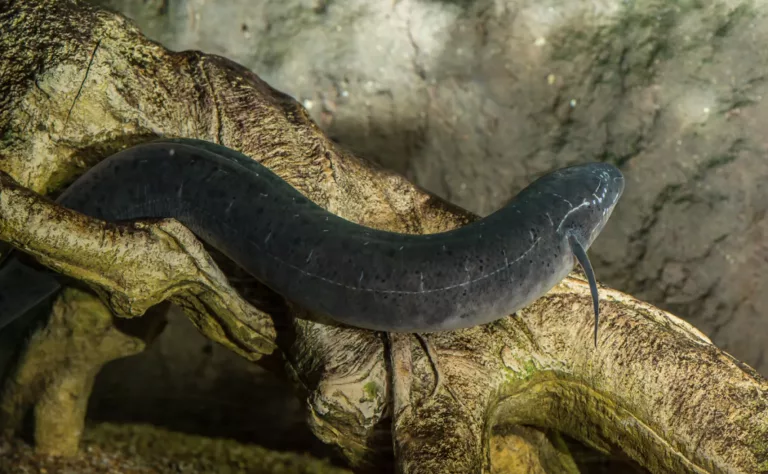
Photo: Oregon Zoo
This unusual freshwater fish can survive for a year or longer without water, thanks to an adaptation that allows it to essentially put its body on standby until conditions improve.
A fish with lungs
The African lungfish belongs to an ancient group of fish that have been around for more than 400 million years. Unlike most fish, it has both gills and lungs. In fact, African lungfish rely heavily on breathing atmospheric air and regularly swim to the surface to gulp oxygen.
There are four recognised African lungfish species, found in freshwater habitats across tropical Africa, including rivers, swamps and floodplains.
Their long, eel-like bodies and slender fins make them quite distinctive.
How does it survive without water?
The real magic happens when its aquatic home begins to dry up.
As water levels drop, the lungfish burrows into the soft mud at the bottom of its habitat. It then secretes mucus that hardens into a protective, papery cocoon around its body.
This cocoon helps prevent moisture loss while the fish waits for the rains to return.
It also leaves a small opening through which the lungfish can breathe air.
The fish enters a dormant state called aestivation, which is similar to hibernation but is triggered by hot, dry conditions rather than cold weather.
During this time:
-
Its metabolism slows considerably.
-
Its heartbeat and breathing rate decrease.
-
It stops feeding.
-
It survives on stored energy.
Some African lungfish can remain in this dormant state for several years under suitable conditions.
What happens when the rain returns?
When rainfall finally replenishes its habitat, the mud softens and the protective cocoon begins to break down.
The lungfish emerges, gradually resumes normal activity and returns to feeding and swimming.
It is an impressive adaptation for an animal living in parts of Africa where seasonal droughts can turn waterways into dry, cracked landscapes.
What does the African lungfish eat?
When it isn’t waiting out a drought, the African lungfish is an opportunistic predator.
Its diet includes smaller fish, frogs, molluscs and other aquatic animals. Some species also consume plant material.
Its strong jaws and specialised tooth plates help it crush and eat a variety of prey.
An ancient survivor
Lungfish are particularly interesting to scientists because they offer clues about the evolutionary history of vertebrates and the transition from aquatic to land-based life.
Their combination of lungs and gills is an unusual feature among living fish, making them important animals in the study of evolution.
Although today’s lungfish are not unchanged prehistoric creatures, their lineage has survived for hundreds of millions of years.
ALSO SEE: Ancient forests beneath Mozambique’s sea are now thriving fish habitats
Ancient forests beneath Mozambique’s sea are now thriving fish habitats